Crypto incident response usually fails off-chain before it fails on-chain
Why incident response in crypto often breaks first in wallets, backend systems, cloud access, domains, CI pipelines, and team operations rather than only in smart contracts.
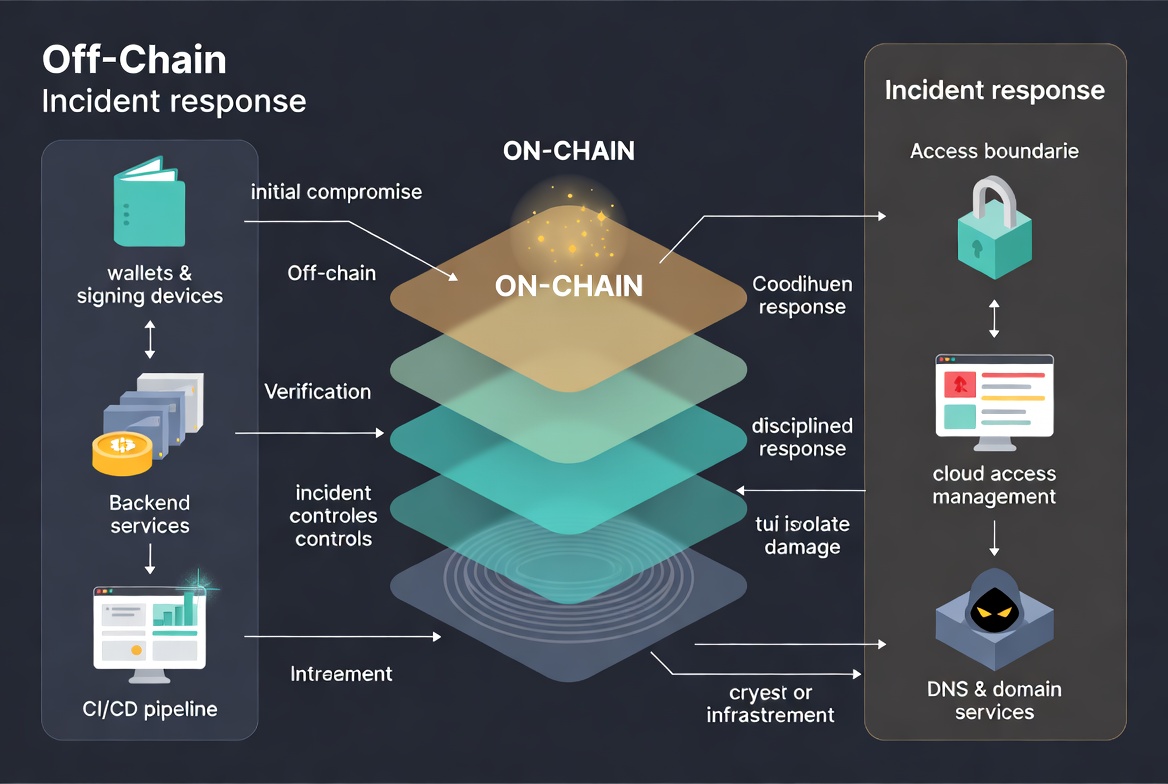
When people think about crypto security incidents, they usually picture a smart contract exploit, a malicious transaction, or an attacker draining funds on-chain. Those events are real, but they are often only the visible end of a much larger failure. In many cases, the real breakdown starts off-chain: a compromised signing device, a leaked secret in CI, a weak domain setup, an overprivileged cloud account, a hijacked admin panel, or a team that has no rehearsed response path when something begins to go wrong.
That is why incident response in crypto cannot be treated as an on-chain specialty alone. If the only plan begins after funds move, the organization is already late. Serious response capability starts much earlier, in the off-chain systems that define who can deploy, who can sign, who can access production, who can change DNS, who can push a frontend update, who can rotate secrets, and who can freeze damage before it cascades.
The attack path usually crosses more than one layer
Crypto incidents rarely stay inside a single boundary. An attacker may begin with social engineering, move into email or identity infrastructure, pivot into cloud access, extract secrets from CI or deployment tooling, tamper with a frontend, and only then use that position to influence wallets, contracts, or user transactions. Even when the final outcome appears on-chain, the path that enabled it often began somewhere much more familiar to Web2 security teams.
That matters because a narrow response model creates blind spots. If a protocol team is prepared to trace fund flows but not prepared to contain compromised infrastructure, revoke access, validate deployment integrity, or confirm whether a domain or backend was altered, then the team is only equipped for the last chapter of the incident. In practice, the ability to stop further damage often depends more on off-chain containment than on post-fact forensics.
Wallets are not just user tools, they are part of the operational perimeter
Many teams still think about wallets only as treasury endpoints or signing devices. In reality, wallets are embedded in a much broader operational system: hardware devices, signer training, approval workflows, transaction review procedures, key backup policies, role design, and the quality of the machines used around signing activity.
That makes wallet compromise a process failure as much as a technical failure. If signers do not verify calldata carefully, if high-privilege actions can be approved from general-purpose laptops, if backup material is poorly handled, or if the same operators hold too much concentrated authority, then the incident path is already open before any malicious transaction appears. By the time something lands on-chain, the real failure may have happened hours or days earlier in operations.
Good incident response therefore has to treat wallet workflows as a monitored and rehearsed environment. Teams should know how to identify which signer was involved, which device was used, whether the transaction path was expected, whether approval controls were bypassed, and what fallback custody path exists if a signer set becomes suspect.
Backend and cloud compromise can become on-chain damage very quickly
A lot of crypto teams still separate “smart contract security” from “backend security” as if they were mostly different topics. In reality, backend compromise can become contract or wallet damage extremely fast. APIs can expose privileged actions. Bots can hold sensitive authority. Deployment systems can push malicious updates. Secret managers can leak keys or RPC credentials. Internal services can alter routing, balances, access checks, or emergency controls in ways that change what the on-chain system ultimately does.
This is why incident response for crypto infrastructure has to include normal cloud discipline: least privilege, environment isolation, network restrictions, audited service-to-service access, hardened CI/CD, secure secret storage, and clean offboarding. Without that, a team can audit contracts thoroughly while leaving the surrounding systems soft enough to become the actual route of compromise.
More importantly, response procedures have to reflect this reality. When something suspicious happens, the question is not only whether a contract was exploited. The question is whether the attacker still has backend access, whether bots or workers are compromised, whether deployment trust is intact, whether secrets must be rotated, and whether internal automation is still safe to run.
Frontends, domains, and DNS are part of incident response too
Crypto security conversations often focus on contracts and keys because they feel more native to the space. But many practical attacks hit users through the interface layer: compromised frontends, injected wallet prompts, hijacked subdomains, altered DNS records, or malicious scripts added through weak deployment processes.
These incidents are dangerous because they bypass the assumption that the protocol itself is the only object under attack. A protocol can be mathematically sound while its web surface becomes the delivery path for theft. When that happens, teams need a response model that includes frontend rollback, DNS verification, CDN integrity, build provenance, and the ability to communicate safely with users while trust is being restored.
This also means preparedness has to cover assets that engineers often treat as secondary. Registrar access, DNS records, deployment permissions, static asset integrity, and admin consoles all deserve the same seriousness as multisigs. If an attacker can alter what users see, they may not need to alter the protocol directly at all.
The first minutes matter more than the first postmortem
A lot of organizations think about incident response as a documentation exercise. They create a policy, assign a few names, and assume that is enough. But in a real crypto incident, the first minutes are operational, not theoretical.
Who has authority to freeze systems or revoke access. Who can disable a compromised bot. Who can pause a frontend. Who can move treasury controls into a fallback path. Who validates whether the source of compromise is identity, cloud, DNS, wallet operations, or code deployment. Who communicates externally without leaking confusion or making the situation worse. These questions decide whether the blast radius stays bounded or starts to spread.
That is why rehearsals matter so much. A response plan that has never been practiced is mostly a comforting document. Teams need drills, escalation paths, named decision makers, fallback channels, and clear containment playbooks for the most likely classes of failure. In crypto, speed matters not only because funds move fast, but because trust can collapse fast too.
Least privilege is incident response before the incident
Many teams describe least privilege as a preventative control, which it is. But it is also one of the strongest incident response controls because it limits how much damage an attacker can do before detection.
If developers cannot directly access production secrets, if CI runners are constrained, if bots hold only narrowly scoped authority, if wallet approval paths are split across people and devices, and if cloud accounts are segmented properly, then compromise tends to stay smaller. The difference between a painful incident and a catastrophic one is often just the size of the initial blast radius.
This is especially important in crypto because privileged actions can have irreversible consequences. A badly scoped permission in a normal SaaS product may create downtime or data loss. A badly scoped permission in a crypto system may create immediate fund loss, governance damage, or a permanent break in trust. Response readiness therefore begins long before detection. It begins in how much power the system grants by default.
Logging, monitoring, and forensics have to cross the same boundaries as the attacker
One of the hardest parts of crypto incident response is stitching together evidence across incompatible systems. Wallet events, cloud logs, API traces, CI activity, DNS changes, deployment records, auth events, and on-chain traces often live in different tools with different retention, ownership, and visibility models.
That fragmentation creates a dangerous delay. A team may know something is wrong without knowing where the compromise actually sits. If logs are incomplete, uncorrelated, or poorly retained, containment becomes guesswork. Worse, some teams only discover during an incident that critical actions were never logged in a way that supports reconstruction.
Good response architecture assumes that forensic visibility must cross off-chain and on-chain boundaries. It should be possible to reconstruct who changed what, who signed what, which service called what, which deployment ran, which secrets were accessed, and what chain activity followed. Without that connective tissue, the team may recover operations while never truly recovering confidence in the system.
Security culture matters because attackers target people before systems
Many of the highest-impact crypto incidents still involve some combination of phishing, impersonation, approval fatigue, weak operational habits, or overtrust in internal workflows. Attackers know that the fastest way into a crypto system is often not through deep protocol math but through humans with privileged access.
That is why response quality depends on culture as much as tooling. Teams need disciplined change management, explicit verification habits, restricted high-risk workflows, careful onboarding and offboarding, and clear norms for how privileged actions are reviewed. If people are trained to optimize only for speed, they will create shortcuts that attackers eventually use. If people are trained to slow down and verify when it matters, the organization becomes much harder to exploit.
This is also why someone needs to own the security function operationally. Not as a vague advisor, but as a real point of accountability for procedures, rehearsals, log review, access review, and incident readiness. Crypto security is too operational to survive as an afterthought.
A serious response model protects the off-chain system around the chain
The most mature crypto teams do not treat incident response as blockchain forensics with better branding. They treat it as the ability to preserve operational control when attackers target the whole environment around the chain.
That means protecting wallets, signers, cloud infrastructure, CI/CD, domains, frontend delivery, admin tools, secrets, bots, identity systems, and communication channels with the same seriousness as contract code. It means building containment paths before an incident, not improvising them during one. And it means understanding that the system users trust is not just the contract address. It is the entire operational structure that surrounds it.
A protocol can survive a bug if the team reacts well enough. It can survive a failed deployment if rollback and authority are disciplined enough. But if the off-chain environment is chaotic, the response itself becomes part of the compromise. That is why crypto incident response usually fails off-chain before it fails on-chain.
If you need help hardening the off-chain side of your crypto project (wallet operations, backend access, CI/CD, domains, incident readiness, or operational security), you can request a security-focused engagement through the Services page or reach out directly via the Contact terminal.