Go market data pipelines fail when teams confuse ingestion with understanding
Why market data pipelines in Go need stronger thinking about normalization, freshness, contracts, backpressure, and downstream semantics rather than just faster ingestion.
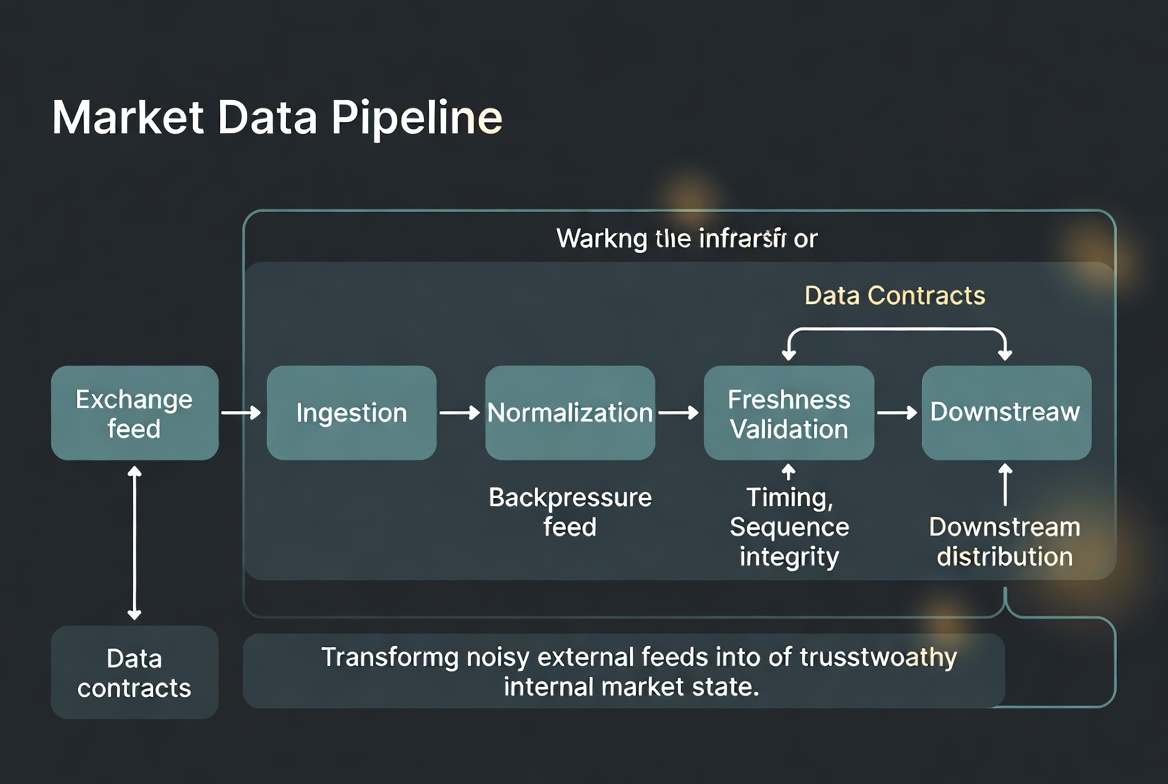
A lot of trading systems believe they have a market data pipeline when what they really have is a collection loop. Messages come in from exchanges, symbols are mapped somehow, a few transforms happen, and the data is pushed downstream. At first, that can feel good enough. Feeds are flowing, charts update, signals are computed, and the system appears alive. The trouble starts when teams realize that ingesting data is not the same as understanding it.
That gap becomes painful fast in real trading environments. Different venues publish different schemas, timestamps carry different meanings, symbols drift, sequence guarantees vary, partial updates arrive out of order, and internal consumers quietly make assumptions that were never encoded anywhere. By the time a strategy misfires or a risk check uses stale or mismatched data, the problem is no longer just one bad message. The problem is that the pipeline never had a disciplined model of market truth.
Collection is easy, normalization is where the work begins
The earliest stage of a pipeline usually feels straightforward. Open connections, subscribe to feeds, read messages, and forward them. Teams often mistake this stage for the hard part because it is the first part that visibly moves.
In reality, market data becomes dangerous only after it starts being trusted. Raw feed collection is not the same as usable internal state. Before data can drive execution, analytics, or risk, it has to be normalized into something the rest of the platform can reason about consistently. That means symbol mapping, event typing, timestamp policy, price precision, venue metadata, missing field handling, and a clear definition of what each downstream consumer is actually receiving.
Without that discipline, downstream services begin building private interpretations of the same stream. One component thinks an event time means exchange publication time. Another treats it as local receive time. One strategy assumes a book snapshot is authoritative. Another treats it as incremental context. The result is not simply inconsistency. It is architectural dishonesty.
Freshness matters more than throughput when the system trades on time
Teams love talking about throughput because it is easy to measure and easy to celebrate. Messages per second feels concrete. But in trading systems, raw throughput is often less important than freshness.
A pipeline that processes massive volume while quietly delivering delayed data is still dangerous. Signals built on stale state can look mathematically correct and still be operationally useless. A strategy may execute exactly as designed while relying on a view of the market that is already old enough to invalidate the trade. Risk logic can remain internally consistent while lagging the world it is supposed to defend against.
That is why market data architecture has to center on freshness budgets, not only processing speed. Teams need to know how old a piece of data is when it becomes visible to a strategy, a dashboard, a risk engine, or an execution service. They need to know where delay accumulates, how long normalization takes, whether fan-out introduces hidden lag, and what happens when one consumer slows down the rest of the path.
Backpressure is part of the pipeline’s truthfulness
A market data system should not only move information. It should be honest about what it can and cannot keep up with. That honesty usually shows up in backpressure behavior.
If one part of the system falls behind, what happens next says a lot about the architecture. Does the pipeline block upstream readers. Does it drop messages silently. Does it buffer until latency becomes meaningless. Does it degrade selectively. Does it protect critical consumers while sacrificing less important ones. These are not implementation details. They are business and risk decisions expressed in engineering form.
This is one reason Go is useful here. It is well suited to building concurrent services with explicit communication patterns, bounded queues, worker coordination, and operationally understandable code. But the language does not solve the architectural question by itself. Teams still need to decide whether the system values completeness, freshness, recoverability, or isolation most in each part of the pipeline. A fast language cannot rescue an ambiguous stance on failure.
Internal contracts matter more than exchange adapters
Many teams put a lot of energy into exchange adapters and not enough into internal contracts. Adapters matter, of course, but they are only the edge of the problem. The deeper challenge is whether the platform has a stable internal representation of market events that downstream systems can trust.
If every consumer has to remember which venue sends which shape of update, or whether a timestamp came from the exchange or from local receipt, then the pipeline is leaking complexity instead of absorbing it. That kind of leak spreads quickly. Strategies become venue-specific by accident. Risk logic becomes harder to generalize. Analytics stop matching execution reality. Debugging turns into archaeology.
A stronger design creates explicit internal event models with documented semantics. It defines what a normalized trade means, what a quote means, what a book update means, what guarantees attach to each, and how missing or partial information is represented. Once those contracts are clear, the rest of the platform can reason at the right level. Without them, every downstream component becomes its own unofficial parser.
Observability should describe the market path, not just the service health
A weak market data pipeline often looks healthy from the outside. CPU is normal, memory is stable, connections are open, and message counts keep climbing. Then a strategy starts behaving strangely or a dashboard disagrees with execution records, and suddenly the team realizes they were monitoring the machine, not the meaning.
Useful observability in market data systems has to follow the path of truth through the pipeline. That includes ingestion lag, normalization latency, sequence integrity, queue depth, consumer delay, symbol mapping errors, stale feed detection, schema drift, and divergence between source and internal state. Service health metrics alone are not enough because the pipeline can remain technically alive while semantically compromised.
This is especially important when Go services fan data out to many consumers. One slow path, one bad transform, or one silent mismatch in a schema can create a long shadow across strategies, dashboards, compliance systems, and post-trade analysis. The earlier the platform can see those distortions, the smaller the blast radius becomes.
One feed is not one truth
Many developers subconsciously assume that one feed corresponds to one stable version of reality. In practice, market data is much messier than that. Exchanges revise trades, emit partial books, send snapshots and incrementals on different cadences, expose different timestamp fields, and recover from outages in ways that are not cleanly uniform.
That means the pipeline has to choose how reality is reconstructed. Which fields are canonical. Which clock matters for which use case. How does the system recover after a gap. When should a consumer trust a partial state versus demand resynchronization. Which feeds are suitable for execution, and which are only suitable for analytics or display. These questions define the usefulness of the pipeline far more than the networking code does.
A disciplined Go pipeline does not pretend that raw exchange output is already truth. It treats external data as material that must be interpreted, versioned, validated, and sometimes distrusted before the platform lets it influence important behavior.
Market data quality is a platform concern, not a strategy concern
One of the most expensive mistakes in trading architecture is pushing too much market data interpretation into the strategy layer. It is tempting because strategy teams move fast and often want direct control. But once each strategy starts compensating for feed quirks in its own way, the platform loses coherence.
A better system treats market data quality as shared infrastructure. Freshness checks, normalization policy, sequencing logic, gap recovery, and venue-specific handling belong in the platform layer so that strategies can focus on decision logic rather than feed archaeology. This also makes operations more reliable because when something breaks, the team can reason about one market truth pipeline instead of ten private interpretations of it.
That separation is where Go can be especially useful. It supports building services that are operationally clear, concurrent, and maintainable, which makes it a strong fit for the coordination-heavy layer between exchange feeds and internal consumers. The value is not just speed. It is the ability to keep market truth disciplined as the platform grows.
Good pipelines protect downstream thinking
A mature market data pipeline does more than deliver events. It protects the rest of the company from having to rediscover feed semantics over and over again.
That means enforcing internal contracts, guarding freshness, making backpressure visible, preserving provenance, and exposing enough observability that people can tell whether the system is still telling the truth. In a serious trading environment, those properties matter more than a flashy claim about low latency by itself. A fast wrong pipeline is still wrong.
Teams that understand this stop treating ingestion as the finish line. They treat it as the beginning of a responsibility: turning messy exchange output into trustworthy internal state. That is the point where a Go market data pipeline stops being a collector and starts becoming infrastructure.
If you need help designing or hardening market data infrastructure (exchange adapters, normalization layers, freshness guarantees, backpressure strategy, or downstream contracts), you can request a high-performance infrastructure engagement through the Services page or reach out directly via the Contact terminal.