A trading risk engine is where the platform decides what it is willing to survive
Why real-time risk engines in trading infrastructure are not just compliance modules but execution-critical systems that define limits, exposure, and survival under market stress.
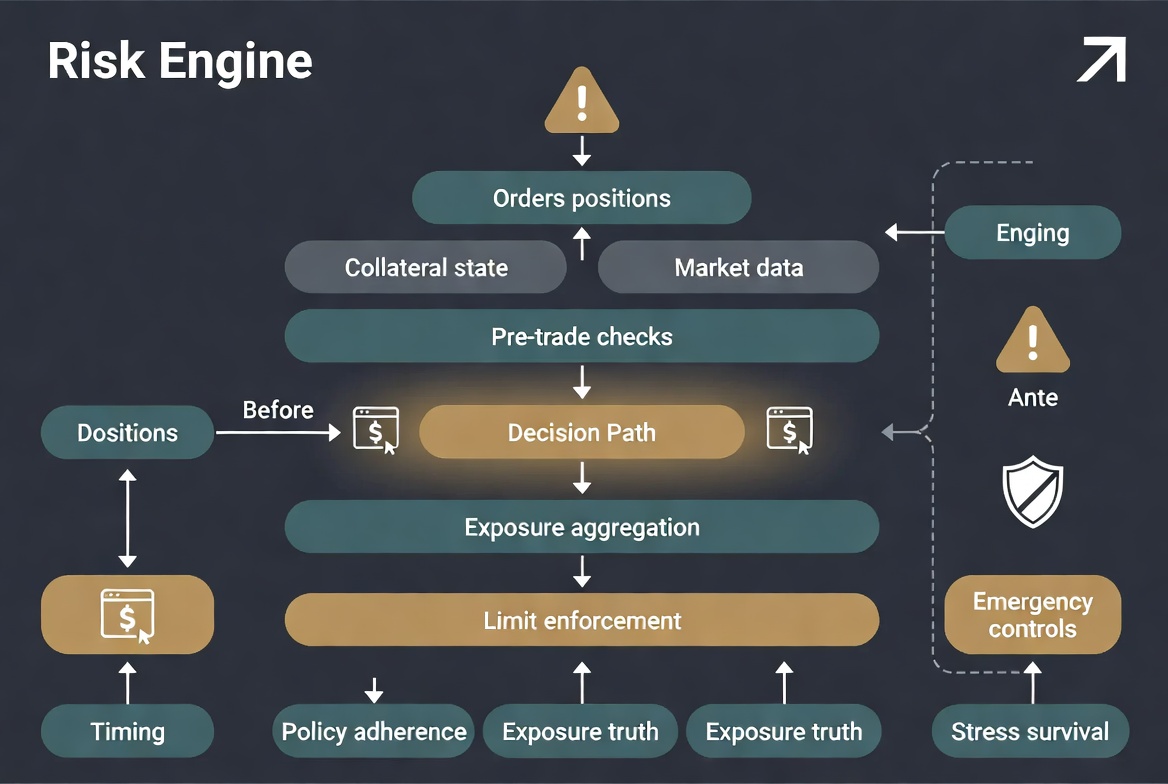
Most people describe a trading risk engine as if it were a control layer that sits beside the real action. Orders are generated somewhere else, execution happens somewhere else, and risk is just the responsible adult in the room checking boundaries. That description is too shallow. In a serious trading platform, the risk engine is not peripheral. It is the place where the system decides what kinds of loss, exposure, behavior, and operational stress it is willing to tolerate in order to stay alive.
That is why a weak risk engine can destroy a good execution stack. A strategy may be clever, market data may be fast, and routing may be efficient, but if risk logic is stale, inconsistent, too slow, or disconnected from the actual shape of positions and exposure, the platform becomes dangerous even when every other component looks healthy. A trading system without a strong risk engine is not just incomplete. It is unserious.
Risk is not a report, it is a gate
A common architectural mistake is to treat risk as something measured after the meaningful decision has already happened. The strategy decides, the order manager prepares, the execution path sends, and then risk is consulted almost as a formality. In low-stress conditions, that may look acceptable. Under real pressure, it becomes reckless.
Risk in a live trading platform has to be a gate, not a commentary layer. That means the system must know whether an order, portfolio state, venue path, or leverage condition is acceptable before irreversible action is taken. Position limits, notional limits, concentration constraints, liquidation thresholds, message-rate policies, and venue-specific controls all belong close to the point of action. If they are evaluated too late, then the architecture is merely describing risk rather than controlling it.
This is one of the reasons risk engines matter so much in derivatives venues and real-time financial platforms. They do not only observe exposure. They transform measurement into action, preventing the system from continuing as if an unacceptable condition were just another metric on a dashboard.
The hard part is not calculation, it is timing
People often imagine the difficulty of a risk engine in terms of financial mathematics alone. The formulas may be complex, but the deeper production problem is often timing. A theoretically correct risk calculation is not enough if it arrives after the order should have been stopped, after the portfolio state has already moved, or after multiple services have acted on different versions of exposure.
This is where many systems quietly fail. One subsystem thinks exposure is current, another is looking at an older state, and a third is applying a limit that was updated but not yet propagated consistently. By the time the platform notices the disagreement, the engine has already allowed behavior that the organization would have rejected if the truth had been synchronized sooner.
That is why real-time risk architecture is less about producing beautiful analytics in isolation and more about ensuring that the right controls see the right state at the right moment. The timing model is part of the risk model. If the platform cannot guarantee that exposure views are fresh enough to govern execution, then the engine is not only slow. It is epistemically weak.
A limit only matters if the system can enforce it coherently
It is easy to write down limits. The difficult part is making them real across a distributed system.
A limit can apply to an account, a desk, a strategy, an instrument, a venue, a jurisdiction, or a portfolio grouping that spans multiple components. If different services interpret that limit differently, apply it with different delays, or rely on different state snapshots, then the platform ends up with risk theater instead of risk control. The limit exists in documentation, but not in operations.
A mature risk engine therefore needs more than formulas and thresholds. It needs a coherent policy surface. Limits must have clear ownership, deterministic evaluation paths, auditable updates, and explicit scoping rules. If a strategy is stopped, the system should be able to explain why. If an order is rejected, the reason should be recoverable and consistent. If the same account tries the same action through a different path, the answer should not change just because it crossed another service boundary.
Exposure is more architectural than people admit
One of the biggest misunderstandings in trading infrastructure is treating exposure as a number you can compute cleanly in one place. In practice, exposure is shaped by architecture. It depends on how positions are aggregated, how pending orders are modeled, how external venue state is reconciled, how hedges are recognized, how funding and margin are represented, and how quickly the platform incorporates new information.
That means exposure disagreements are often architecture disagreements in disguise. If one service counts an order as live while another still sees it as pending, the risk engine can become inconsistent without any formula being wrong. If one path recognizes a hedge and another does not, the system may reject safe behavior or allow dangerous behavior for reasons that look financial but are actually structural.
A good risk engine is therefore built on a strong internal truth model. It needs disciplined representations of positions, orders, fills, collateral, unrealized movement, and venue acknowledgments. Otherwise the system spends its time fighting semantic drift instead of controlling risk.
Fast markets punish centralized illusions
As platforms grow, there is a temptation to centralize every risk decision in one master service. That can feel tidy on an architecture diagram. In reality, fast systems often need a more careful balance.
A single centralized engine may be useful as the source of policy or portfolio truth, but some controls need to live closer to the edge. Pre-trade checks, strategy-level throttles, venue-specific constraints, and emergency kill conditions often need local enforcement paths because the cost of a remote decision can become too high under stress. At the same time, fully fragmented risk logic is dangerous because it creates inconsistent enforcement and policy drift.
The architecture challenge is not choosing centralization or decentralization as an ideology. It is deciding which controls require global context, which need local speed, and how both layers remain consistent enough to defend the same risk posture. A serious platform cannot afford either extreme: one slow brain for everything, or many fast brains that disagree with one another.
Stress behavior matters more than calm behavior
A risk engine that behaves well in ordinary conditions proves very little. The real question is what happens when volume surges, positions move quickly, venues desynchronize, collateral quality deteriorates, or the strategy behaves in a way no one expected that morning.
This is where architecture reveals whether the engine was built for survivability or only for normal operation. Does the system degrade safely when parts of the risk graph become unavailable. Does it fail closed or fail open. Does stale state trigger conservative behavior. Are emergency controls narrow and immediate. Can the platform freeze a strategy, cap a desk, or block a venue path without needing a committee call in the middle of an incident.
The point of a risk engine is not to look elegant when nothing unusual is happening. The point is to define how the platform behaves when reality stops being cooperative. In that moment, every hidden assumption about propagation speed, limit semantics, data freshness, and authority becomes operationally visible.
Explainability is operational, not cosmetic
People often talk about explainability as if it were mainly for audits, compliance teams, or post-trade reviews. Those uses matter, but explainability is also a production requirement.
If the engine blocks a trade, reduces a limit, changes margin treatment, or trips an emergency control, operators need to understand why quickly enough to act. Traders, support teams, and risk operators all need a way to distinguish between a justified block, a stale-state artifact, a policy bug, and a genuinely dangerous market condition. Without that, the platform becomes harder to trust and harder to operate.
This is why good risk systems should not only produce decisions. They should produce understandable decisions. Not in vague prose, but in clear causal terms: which exposure measure crossed which threshold under which state and policy version. In a real-time environment, explainability is not a luxury. It is part of keeping the human layer capable of intervening correctly.
The risk engine defines the platform’s character
Every trading system makes an implicit promise about how aggressively it will pursue opportunity relative to how conservatively it will protect itself. The risk engine is where that promise becomes concrete.
If the engine is permissive, slow, fragmented, or easy to bypass, then the platform is telling the truth about its priorities whether it means to or not. If the engine is coherent, timely, understandable, and tightly attached to execution, then the platform is saying something else: survival matters, not just speed.
That is why the risk engine deserves to be treated as first-class infrastructure. It is not just a module for compliance or a dashboard for managers. It is the place where architecture, policy, exposure, and operational reality meet. In the end, a trading platform’s risk engine is where the system decides what it is willing to survive, and what it refuses to become.
If you need help designing or hardening real-time trading risk infrastructure (pre-trade checks, exposure models, limit enforcement, kill switches, or risk-aware execution architecture), you can request a high-performance infrastructure engagement through the Services page or reach out directly via the Contact terminal.