Crypto backend security fails when teams defend the contract but trust the platform
Why crypto platform security depends on hardening backend services, cloud access, CI/CD, internal APIs, signer workflows, and operational boundaries rather than focusing on smart contracts alone.
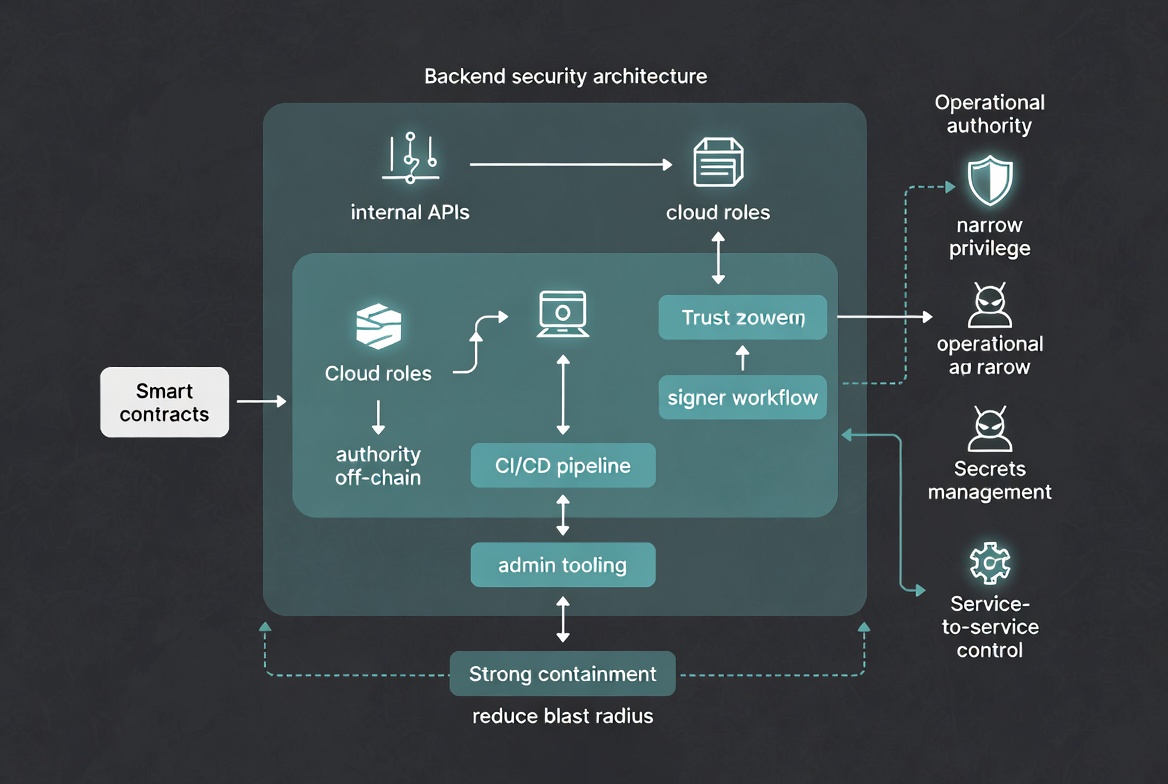
A lot of crypto teams spend serious effort on contract security and still leave the backend architecture soft enough to compromise the entire platform. That is not because backend security is unimportant. It is because many teams still think of the backend as support infrastructure around the real product. In practice, the backend is often part of the security boundary itself.
If a service can trigger sensitive actions, expose operational data, coordinate signers, push frontend updates, route treasury requests, or talk to privileged internal APIs, then it is not a secondary layer. It is one of the places where the platform’s trust model actually lives. A protocol may be formally correct on-chain and still become unsafe if the surrounding systems are overprivileged, weakly segmented, poorly observed, or easy to misuse internally.
The backend is where operational authority accumulates
In many crypto products, the backend starts small. A few APIs, some indexing logic, notification workers, admin tools, maybe an auth layer and a small database. Over time, that modest system becomes the place where more and more authority quietly collects.
Bots rely on it. Dashboards depend on it. Internal operators use it. Emergency actions flow through it. Integrations are added. Secrets are stored. Privileged configuration is managed. Before long, the backend is no longer a convenience layer. It is where identity, workflow, policy, and production control begin to converge.
That is why backend compromise is so dangerous in crypto environments. The attacker does not necessarily need to break the contract if the platform around the contract is powerful enough to distort how the system is used, administered, or trusted. Once authority accumulates off-chain, backend security becomes inseparable from product security.
Least privilege matters more in crypto because mistakes are harder to unwind
In an ordinary SaaS system, an overprivileged internal service can still cause serious damage. In a crypto platform, the consequences are often sharper. One exposed secret, one overly broad admin API, one backend process with signing authority, or one CI runner with too much reach can translate into fund movement, malicious approvals, false interface behavior, or irreversible operational damage.
That is why least privilege is not just a nice security principle here. It is one of the few controls that meaningfully reduces blast radius before a response team has time to act. If services only hold the authority they absolutely need, compromise tends to stay narrower. If every internal system can reach everything important, the platform effectively assumes that no internal boundary matters.
A safer architecture treats privilege as expensive. Internal APIs should expose only narrow actions. Workers should hold task-specific permissions. Signers should stay separated from general application logic. Admin tooling should be segmented from user-facing infrastructure. When teams fail to design those boundaries early, the backend becomes a convenient attack surface because it reflects operational shortcuts accumulated over time.
Internal APIs are part of the threat model
Teams often secure public endpoints more carefully than internal ones. That is understandable, but dangerous. In many crypto platforms, the most damaging functions are hidden behind service-to-service calls, admin endpoints, maintenance jobs, and internal control planes.
If those paths are weakly authenticated, broadly reachable, or poorly audited, then the platform is trusting internal topology more than actual security properties. That trust breaks quickly once an attacker reaches one foothold. A compromised worker, staging environment, VPN credential, or engineering laptop can become the starting point for lateral movement into much more sensitive backend functions.
This is why internal APIs deserve the same seriousness as public surfaces. Authentication, authorization, network restrictions, request provenance, auditability, and failure isolation all matter. The fact that a call is internal does not make it safe. It only means that the attacker’s path to it may look different.
CI/CD is a production control surface whether teams admit it or not
A surprising number of platforms still behave as if deployment systems are operational plumbing rather than a core part of the security model. That assumption is especially weak in crypto.
If CI/CD can publish a frontend, deploy a backend, rotate a config, update routing logic, change environment variables, or alter dependencies, then it can meaningfully change what users and operators are trusting. A compromised pipeline does not need to steal keys directly if it can change the interface that collects approvals, alter a service that prepares transactions, or inject code into a privileged workflow.
This is why secure backend architecture must include secure delivery architecture. Reviewed code paths, restricted deployment authority, signed artifacts where appropriate, strong secret handling, environment isolation, dependency review, and rehearsed emergency rollback are all part of the same security picture. The deployment path is one of the shortest routes from soft trust to hard damage.
Signer workflows should not live inside general-purpose backend logic
One of the most dangerous design patterns in crypto infrastructure is allowing signer-related authority to sit too close to ordinary backend services. Even if raw private keys are not exposed, transaction preparation, approval orchestration, policy logic, and execution triggers can create a de facto signing perimeter around systems that were never meant to hold that level of trust.
This is risky because general-purpose backend environments tend to be more complex, more integrated, and more frequently changed than dedicated signing environments. They have more dependencies, more operators, more release velocity, and more opportunities for accidental privilege expansion. When signing workflows are tightly coupled to these systems, the effective attack surface for critical actions becomes much larger than the team may realize.
A stronger pattern is to keep signer workflows narrow, deliberate, and operationally distinct. Backend services may prepare requests or collect state, but privileged execution should flow through a separate control layer with stricter review, stronger isolation, and clearer operational ownership.
Cloud access is architecture, not just infrastructure
It is easy to talk about “the cloud” as if it were a hosting decision rather than a security design. But cloud architecture shapes who can reach what, how environments are segmented, how secrets move, how services authenticate, and how incident containment actually works.
In crypto platforms, cloud misconfiguration can become capital risk very quickly. Overly broad IAM roles, flat networks, unreviewed secret access, public administrative surfaces, weak environment separation, and permissive service accounts all create conditions where one foothold can spread much further than expected. The platform may appear robust from the application layer while the operational substrate underneath remains dangerously trusting.
Good backend security therefore requires a cloud model built around boundaries: least privilege, deny-by-default posture where possible, narrow administrative paths, strong service identity, logging, segmentation, and a clear distinction between development convenience and production authority. If the cloud layer is vague, the backend layer will inherit that vagueness no matter how careful the code looks.
Admin tooling is often the real high-risk application
Many teams spend more design energy on user-facing products than on internal consoles, emergency tools, and operator interfaces. That is understandable from a product perspective, but backwards from a security perspective.
Admin tools often sit closest to real power. They can alter configuration, pause systems, approve actions, inspect user state, override workflows, or initiate sensitive backend jobs. If these interfaces are weakly segmented, insufficiently logged, reachable from ordinary environments, or protected only by shallow access controls, they become one of the most attractive routes for an attacker.
A mature architecture treats admin tooling as a high-risk product. It should have stronger access policy, narrower visibility, stricter device expectations, better monitoring, and more deliberate workflows than normal user software. The question should never be whether an internal tool is convenient. It should be whether the organization can still trust it under stress and explain every sensitive action it performed.
Backend security is really about preserving trustworthy operations
The biggest mistake in crypto backend design is thinking only in terms of breach prevention. Prevention matters, but the deeper goal is preserving trustworthy operations even when parts of the system are under pressure, under suspicion, or partially compromised.
That means designing for containment as much as correctness. If one service is compromised, can it be isolated without collapsing the product. If one credential leaks, can it be rotated without chaos. If one operator account is abused, can privileged paths still be reviewed and constrained. If one deployment path is suspect, can the team stop movement safely and continue operating from a narrower trusted core.
These are not abstract concerns. In crypto, the backend often decides whether the organization retains enough control to respond intelligently before damage compounds. When that control is absent, even a strong on-chain design may not save the platform from operational failure.
The contract is not the whole platform
Crypto teams often say users should trust the code. That phrase only goes so far when the platform still depends on backend services, APIs, cloud permissions, admin workflows, deployment systems, and signer coordination to function safely in the real world.
That does not mean smart contract security matters less. It means the platform’s real trust boundary is larger than many teams want to admit. The backend is part of the system that users are actually depending on, whether it is visible or not. If it is weak, the trust story is incomplete.
Serious backend security therefore begins with honesty. The platform should assume that off-chain systems can become high-value targets, that internal authority accumulates silently, and that operational shortcuts eventually become security architecture whether anyone intended them to or not. Once a team accepts that, the backend stops being treated like support code and starts being treated like what it really is: part of the product’s core security model.
If you need help hardening the backend side of your crypto platform (internal APIs, CI/CD, signer workflows, cloud access, admin tooling, or operational security architecture), you can request a security-focused engagement through the Services page or reach out directly via the Contact terminal.