Designing senior and junior tranches for institutional RWA yield
How to structure senior and junior tranches, capital buffers, and risk waterfalls so RWA yield vaults can actually serve institutional treasuries.
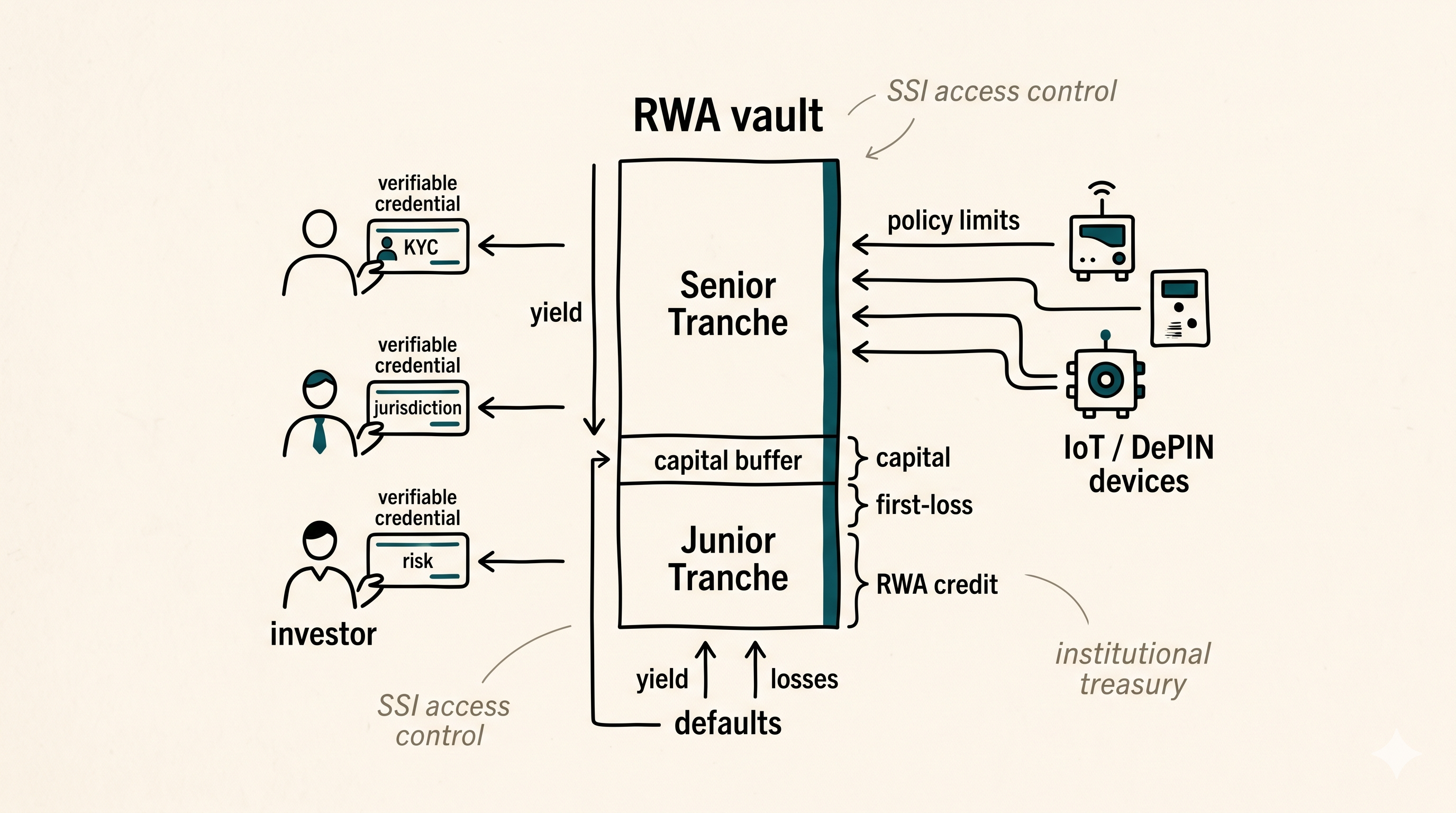
Every serious RWA DeFi protocol eventually runs into the same question: how do you let different investors take different levels of risk without building a separate product for each profile? That is the core job of tranched credit markets. Senior and junior tranches are not just token names — they are risk agreements encoded directly into the vault’s cash flow and loss waterfall.
Traditional finance has used tranching for decades in securitizations and structured credit. DeFi imported the idea, but in 2026, tranched vaults are no longer “experimental yield toys”. They are becoming infrastructure for tokenized private credit, emerging market lending, and institutional RWA portfolios. The protocols that will survive are the ones that design their tranches like real risk products, not marketing sliders.
What “senior” and “junior” actually mean in practice
In a well designed tranched vault, the senior tranche is the first in line to be paid and the last in line to take losses. It targets predictable, often capped returns, making it suitable for treasuries, conservative funds, and institutions that care more about stability than max APY. The junior tranche stands on the other side: it absorbs losses first in exchange for amplified upside, appealing to DeFi-native users and high-risk capital that understands they can lose everything.
This is more than a marketing story. The waterfall logic defines exactly how cash flows are distributed. Yield flows to senior until its obligations are satisfied. Whatever remains flows to junior. In a loss scenario, the direction inverts: junior gets hit first, and only after junior is fully wiped do senior positions start losing principal. That ordering is what makes it possible for the same pool of RWA exposure to serve both low-risk and high-risk participants.
Capital buffers and minimum junior-to-senior ratios
The waterfall alone is not enough. If there is too little junior capital beneath a large senior layer, the buffer is cosmetic. In stress events, senior can still take meaningful losses. That is why serious tranched protocols enforce minimum junior-to-senior capital ratios and pause deposits when those ratios drift below safe thresholds.
Practically, this means encoding guardrails such as: “for every 1 unit of senior capital, there must be at least X units of junior capital beneath it”. As losses accumulate in the underlying portfolio, the protocol can automatically throttle new senior deposits or redirect new inflows to junior until the buffer is restored. This kind of ratio management is a core parameter in institutional tranche design, and it is exactly what separates real risk engineering from “senior in name only”.
Fixed, floating, and residual yield
Another design axis is how each tranche’s yield is defined. Many senior tranche positions target fixed or narrowly-bounded yields: for example, a defined annual rate or a band around a benchmark (like a tokenized Treasury or money market rate). Junior tranches, in contrast, receive whatever is left after the senior commitments are met, which means their returns are residual and highly variable.
In RWA credit, this maps naturally to how underlying deals are structured. Private credit yields in tokenized structures often sit in the 8–15% range, with part of that flow earmarked as “promised” to senior and the remainder going to junior. If performance is strong, junior enjoys leveraged upside. If performance deteriorates, junior gets eaten first, and only if losses pierce the buffer do senior holders see their principal impaired.
Why institutions care about tranche mechanics
For institutional treasuries, the existence of a “senior token” is not enough. They need to know how that senior piece behaves under stress: how large is the junior buffer, what happens when losses exceed that buffer, and how governance can or cannot change the rules mid-flight. In DeFi, these questions become smart contract questions: is the waterfall immutable, are the ratios enforced on-chain, and what are the exact failure modes encoded in the code?
This is why STRATA’s approach to senior and junior tranches is not just cosmetic. The tranche waterfall is immutable, the math is explicit, and the program is designed around capital buffers from day one. Instead of trying to “overcollateralize everything” the way early lending markets did, STRATA uses layered risk: senior takes the predictable slice, junior takes the residual, and the vault’s parameters ensure the buffer remains meaningful. That is the design pattern that makes tranched RWA yield a credible building block for real-world credit, not just another DeFi experiment.
If you need help hardening the off-chain side of your crypto project (wallets, backend, domains, or incident response), you can request a security-focused engagement through the Services page or reach out directly via the Contact terminal.