Your treasury is not secure if one wallet can move everything
Why crypto treasury security depends on role separation, MPC or multisig controls, cold storage, approval flows, and founder-risk reduction.
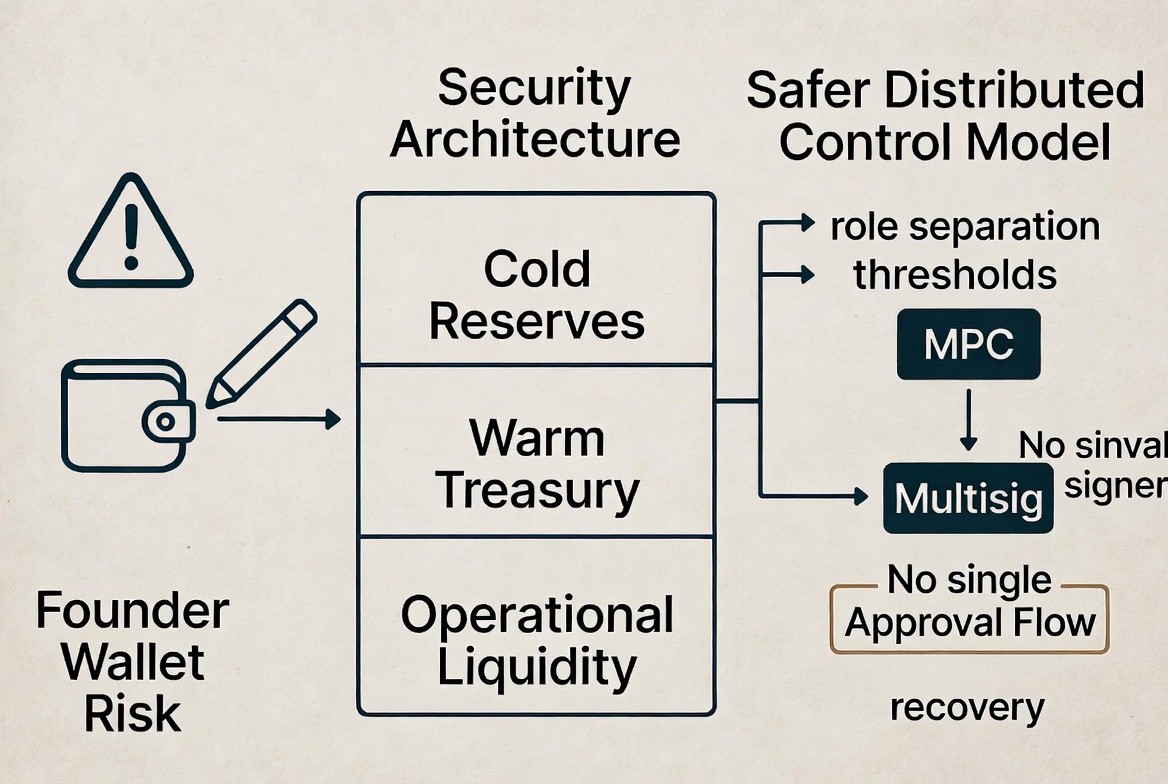
A lot of crypto companies say they take treasury security seriously, but their actual setup tells a different story. One founder wallet can still move critical funds. One hot signer still has too much reach. One compromised device can still become a company-level incident. That is not treasury architecture. That is concentrated operational risk wearing a Web3 label.
A treasury is not secure because the team uses a hardware wallet. It is secure when the system makes dangerous actions structurally difficult. That means no single signer should be able to move meaningful funds, bypass approval flows, or silently change the risk posture of the company.
The real problem is concentration of control
In most early-stage crypto teams, control grows in an informal way. The person who deployed the first contracts also controls upgrades. The person who paid vendors from day one still controls treasury outflows. The person who manages infra also has access to deployment secrets and backend signing permissions. Over time, a startup ends up with a hidden super-admin model built around convenience.
That is exactly the wrong direction for a treasury that may eventually hold customer funds, protocol reserves, stablecoins, governance assets, or strategic positions. Security starts when the company reduces concentration: one person should not be able to initiate, approve, sign, and settle the same critical transaction path.
Multisig and MPC solve related but different problems
A lot of teams talk about multisig and MPC as if they were interchangeable. They are related, but they solve different operational problems.
Multisig is good for explicit approval logic on-chain. It makes governance visible and enforces that multiple signatures are required before funds move. MPC changes how signing authority is created and distributed. Instead of assembling one full private key in one place, the wallet uses multiple key shares and collaborative signing. That makes MPC especially attractive for operational wallets and institutional custody flows where reducing single-key exposure matters.
The best choice depends on the role of the wallet. A governance treasury may benefit from transparent multisig approvals. An operational treasury may benefit from MPC for smoother yet still segmented signing. In many serious setups, both models exist in different layers of the same treasury system.
Cold, warm, and operational capital should not live together
One of the easiest mistakes in crypto treasury design is treating all funds as if they had the same purpose. They do not.
A mature treasury separates capital into at least three buckets:
- long-term reserves that should sit in highly restricted cold custody,
- warm capital for planned treasury operations and medium-frequency movements,
- operational liquidity for near-term payments, market activity, or protocol execution.
When these buckets collapse into one wallet environment, the company turns a routine payment path into a direct route toward strategic reserves. The goal is not just “protect the wallet”. The goal is to prevent low-trust, high-frequency operations from ever touching the highest-value assets in the first place.
Approval design matters as much as storage design
Teams often focus on where keys are stored, but not enough on how decisions are made. Secure custody without secure approval logic still leaves room for bad transfers, rushed decisions, fraud, or internal mistakes.
A serious treasury should define:
- who can propose a transaction,
- who can approve it,
- what thresholds apply at different amounts,
- which destinations are pre-approved or restricted,
- what review steps are required for unusual movements,
- and what happens when an emergency override is needed.
This is where treasury security becomes business governance. A wallet is not just a cryptographic object. It is a control surface for real company decisions.
Founder risk is a real treasury risk
Crypto teams often underestimate founder risk because it feels personal. But from a security perspective, founder risk is simply concentration risk attached to identity. If too much of the company depends on one founder’s wallet, one founder’s laptop, or one founder’s judgment under pressure, the treasury is fragile by design.
This does not mean founders should be excluded. It means the company should evolve past founder-centralized trust. Critical assets should be held in structures that survive device loss, role changes, compromise, travel, illness, or internal disagreement. A treasury that only works when one person is available is not resilient enough for real money.
Treasury security is operational security
Treasury losses do not always look like dramatic hacks. Sometimes they look like rushed payments, wrong destination addresses, broken recovery assumptions, missing backup procedures, unreviewed permissions, or a signer leaving the company with too much unresolved access.
That is why treasury security has to be exercised operationally. Teams should review permissions regularly, rotate or refresh sensitive access, rehearse recovery flows, document approval thresholds, and stress test what happens when one signer disappears or one device is compromised. Security is not just about preventing theft. It is about preserving continuity under stress.
The right standard
The correct standard for a crypto treasury is simple: no single action, device, or person should be able to create catastrophic loss on its own. If your system still depends on one wallet to protect the whole company, you do not have a treasury architecture yet. You have a hidden point of failure.
The teams that scale safely are the ones that treat treasury design as part of core security engineering. They separate roles, split signing power, isolate capital pools, define approvals clearly, and assume that operational mistakes are not hypothetical. In crypto, treasury security is not an admin task. It is part of survival.
If you need help hardening the off-chain side of your crypto project (wallets, backend, domains, or incident response), you can request a security-focused engagement through the Services page or reach out directly via the Contact terminal.