Crypto security is not a smart contract problem
Why serious crypto security must cover smart contracts, wallets, backend systems, frontend risks, treasury controls, and incident response.
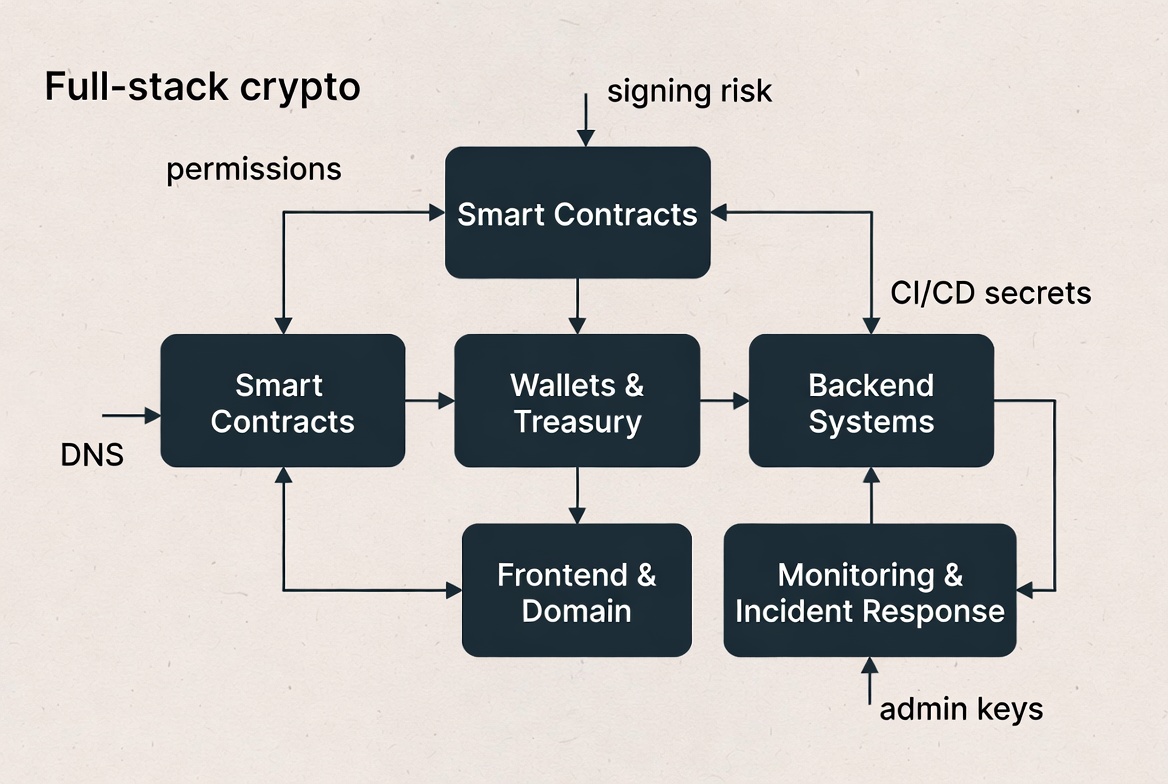
A lot of crypto teams still talk about security as if it were a single task: audit the smart contracts, fix a few bugs, and move on. That mindset is one of the easiest ways to get exploited. In real projects, losses rarely come from only one layer. They come from the interaction between code, wallets, backend systems, frontend trust assumptions, team operations, and weak response processes.
A secure crypto project is not the one with the best audit PDF. It is the one that treats security as a full-stack discipline. Smart contracts matter, but they are only one part of the attack surface. If your treasury keys are badly managed, your frontend can be hijacked, your backend can issue invalid authorizations, or your team can be phished, then a perfect on-chain design still does not save you.
Security starts with architecture, not patching
The strongest projects design for security from the start. They do not add it later as a checklist before launch. That means thinking in layers: contract logic, wallet permissions, infrastructure boundaries, user flows, operational access, and monitoring.
This layered approach matters because most crypto systems are hybrid systems. Even “fully on-chain” apps depend on off-chain components such as RPC providers, deployment pipelines, CI/CD secrets, admin dashboards, signing devices, alerting systems, and domain infrastructure. Attackers do not care whether the weak point is elegant or decentralized. They only care whether it gives them a path to funds or control.
Smart contracts are only one boundary
Smart contracts still deserve serious attention. They define the irreversible part of the system: fund flows, permissions, upgrades, pricing, accounting, liquidations, or vault logic. Bugs here are dangerous because they are usually public, fast, and final.
But focusing only on contracts creates blind spots. Many protocols with audited contracts still fail because of unsafe admin privileges, weak upgrade paths, stale oracle assumptions, or bad integration design. Good smart contract security means more than “no reentrancy bug.” It means explicit invariants, limited trust assumptions, safe failure modes, and code paths that remain understandable under stress.
Wallet and treasury security are business-critical
If smart contracts define what the protocol can do, wallets define who can actually do it. This is why custody and treasury controls are not “ops details” — they are core security architecture.
Projects handling real money should clearly separate hot operational wallets from long-term treasury custody. Sensitive actions should use multi-signature or MPC-based approval flows, not a single founder wallet with broad privileges. Teams should also know exactly which wallets can pause contracts, rotate parameters, move treasury funds, publish frontend updates, or authorize backend actions. When that mapping is unclear, the project is already unsafe.
Backend and frontend are part of the attack surface
A crypto project can have clean contracts and still lose users through a compromised frontend or poisoned backend. If the web app is hijacked, users may be tricked into signing malicious approvals or transactions. If the backend issues bad data, creates invalid authorizations, or routes users to the wrong contracts, the on-chain layer can still be misused.
This is why frontend and backend security must be treated as first-class concerns. Domains, DNS, deployment keys, API secrets, cloud permissions, and admin dashboards all sit on the path between user intent and on-chain execution. In modern crypto systems, especially those using account abstraction, policy engines, or compliance checks, the backend is often a high-value target because it shapes what users are allowed to do.
Identity, access control, and human risk
Some of the worst failures in crypto do not start with code. They start with people. A team member reuses passwords, stores seed phrases badly, clicks a phishing link, or shares broad access to systems that should have been segmented. From there, one compromised identity becomes an infrastructure compromise.
That is why strong projects apply the same discipline internally that they expect from protocols: least privilege, role separation, hardware-backed authentication, audited access reviews, and clear offboarding procedures. Security culture matters because attackers often choose the cheapest path. Breaking an employee account is usually easier than breaking verified contract logic.
Monitoring and incident response are part of security
Security is not just prevention. Detection and response matter just as much. Even mature teams miss things, integrations break, and assumptions fail under real market conditions.
A serious crypto project should know how it will detect abnormal events: unusual wallet movements, failed invariant checks, abnormal withdrawal spikes, oracle anomalies, admin key usage, or frontend integrity changes. Just as important, it should know what happens next. Who gets paged? Who can pause what? Which wallets must rotate? How will users be notified? A protocol without an incident response plan is not secure — it is only untested.
The correct mental model
The right way to think about crypto security is simple: every place where trust, code, credentials, or money changes hands is part of the security model. That includes contracts, wallets, servers, domains, CI/CD pipelines, RPC assumptions, humans, vendors, and emergency controls.
Projects that understand this early build differently. They reduce privileged paths, isolate risk, document assumptions, and make failure easier to contain. In crypto, security is not a feature you add after product-market fit. It is the operating system of the entire business.
If you need help hardening the off-chain side of your crypto project (wallets, backend, domains, or incident response), you can request a security-focused engagement through the Services page or reach out directly via the Contact terminal.