How to design a tranche waterfall without breaking your vault
A practical guide to tranche waterfall design, loss ordering, and accounting edge cases for serious RWA vaults.
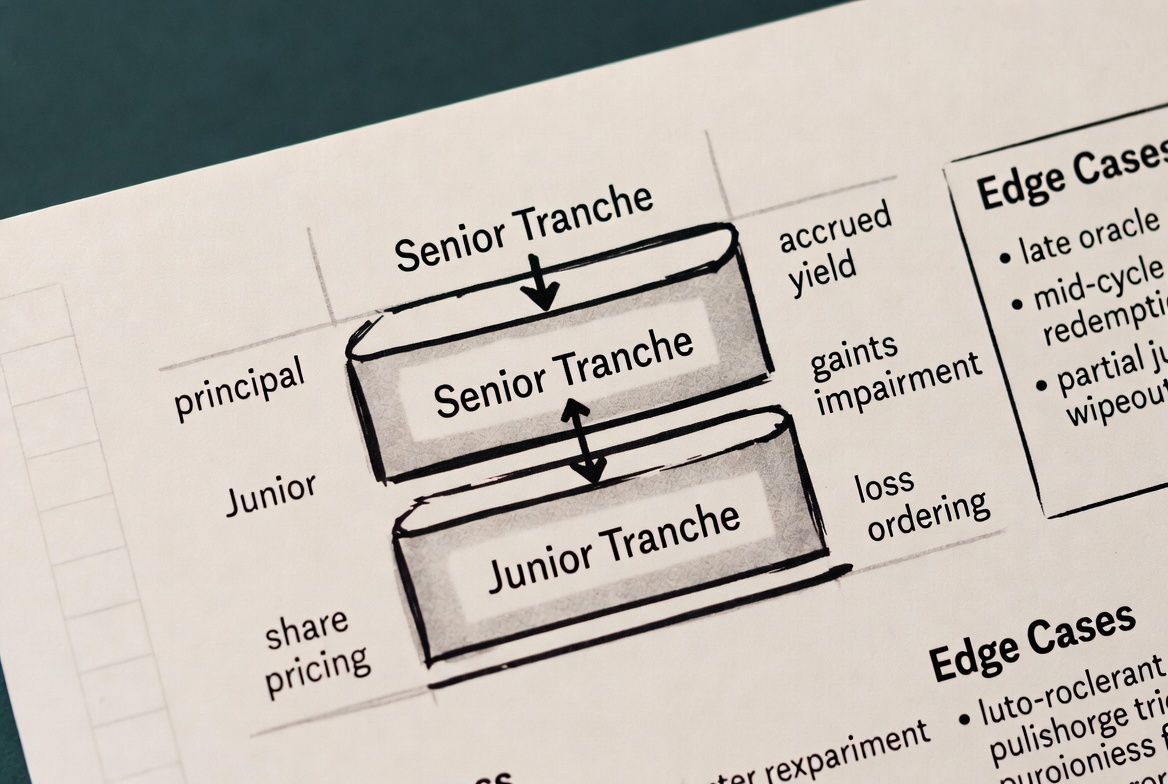
A lot of DeFi teams talk about senior and junior tranches as if adding two tokens automatically creates structured risk. It does not. A tranche system only works when the vault has a precise and internally consistent waterfall that defines how profits, losses, withdrawals, and redemptions are processed under both normal and stressed conditions.
This matters even more in RWA vaults. In traditional private funds and structured products, distribution waterfalls define who gets paid first, who absorbs losses first, and how cash moves once thresholds are reached. If the on-chain version of that logic is incomplete, ambiguous, or mathematically fragile, the vault is not implementing risk segmentation — it is implementing confusion.
A tranche waterfall is an ordering function
At the highest level, a tranche waterfall is just an ordering rule for capital flows. In gain scenarios, cash usually flows to the senior side first until its promised or target return is met, with the residual flowing to junior. In loss scenarios, the order reverses: junior absorbs losses first, and senior only takes impairment after the junior buffer has been exhausted.
That sounds simple, but real vaults have to encode this as an explicit accounting system. The contract must define what counts as profit, what counts as loss, when a loss is realized, how share prices update, and what happens when redemptions occur mid-cycle. A waterfall that only works in a happy-path spreadsheet is not a vault design.
The first rule: separate principal, accrued yield, and impairment
One of the easiest ways to break a tranche vault is to let all accounting collapse into a single “total assets” number. That works for simple single-pool vaults. It becomes dangerous in tranched systems because principal protection, accrued yield, and realized impairment do not behave the same way.
A safer design keeps three concepts logically distinct:
- principal allocated to each tranche,
- yield accrued but not yet withdrawn,
- realized losses or impairments that must reduce one side of the capital stack.
If these states are mixed together too early, the vault can accidentally allow junior depositors to dilute senior protection, let senior redeemers exit at inflated prices, or misallocate losses after a default event.
The second rule: losses must be applied before optional redemptions
A lot of waterfall bugs come from timing. Suppose the underlying RWA portfolio suffers a loss, but the vault has not yet applied that impairment to tranche accounting. If a user can redeem against stale share values before the loss is processed, the vault effectively lets one class escape while pushing the damage onto whoever remains.
For a serious RWA vault, realized losses must be pushed through the accounting layer before non-emergency redemptions are processed. In practice, that means the protocol needs a clean event flow:
- underlying loss event is recorded,
- impairment is allocated through the waterfall,
- share values are updated,
- only then are ordinary withdrawals and redemptions processed.
That sequence is not optional. It is part of preserving the credibility of the tranche structure.
The third rule: junior protection must be measurable, not rhetorical
Many protocols market a “junior buffer” but never encode how large it is, how it changes over time, or when it becomes insufficient. In a real structured product, the junior layer exists to absorb defined losses before senior is touched. That means the vault should always be able to answer:
- how much junior principal is currently subordinated,
- what percentage of senior it protects,
- how much loss junior can still absorb before senior impairment begins.
If the system cannot compute those values directly from on-chain state, then the supposed protection is not operationally trustworthy. The buffer should be visible in state, not buried in marketing language.
The fourth rule: share pricing must reflect tranche position
Senior and junior claims are not symmetrical, so they should not be priced as if they were. In a simple design, each tranche can maintain its own share accounting and effective asset base. Senior share value should reflect the fact that junior stands beneath it as a first-loss layer. Junior share value should reflect the fact that it is levered to both upside and downside.
This becomes especially important after partial loss events. If the junior tranche absorbs a loss, its effective asset base changes immediately. If the contract does not update pricing correctly, new entrants can buy into the tranche at the wrong level, existing holders can be diluted, and redemptions can leak value across the stack. Good waterfall design is therefore inseparable from good share accounting.
The fifth rule: edge cases define the real protocol
Most broken financial logic does not fail on the normal path. It fails on edge cases:
- a loss arrives between deposit and settlement,
- junior is almost but not fully wiped,
- the oracle updates late,
- one tranche is closed while the other remains open,
- a redemption request spans multiple accounting periods.
These are not rare corner cases. In production, they are the cases that determine whether the vault is actually safe. A serious tranche design should define behavior for each one in advance, test them explicitly, and keep the rules simple enough that auditors and allocators can reason about them.
What this means for STRATA
For STRATA, the tranche waterfall is not a cosmetic feature added on top of a generic yield vault. It is one of the protocol’s core security boundaries. The senior side only means something if the junior side is truly subordinated in code, losses are allocated deterministically, and share accounting cannot be gamed through timing or stale state.
That is why a robust RWA vault is not just about tokenizing assets or plugging into a yield source. It is about designing a capital ordering function that remains coherent under stress. When the waterfall is explicit, measurable, and enforced at the accounting layer, tranches become a real risk primitive. Without that, they are just labels on a UI.
If you need help hardening the off-chain side of your crypto project (wallets, backend, domains, or incident response), you can request a security-focused engagement through the Services page or reach out directly via the Contact terminal.