Why so much crypto infrastructure is written in Go
A practical look at why Go ended up as a default choice for off-chain infrastructure in crypto and financial platforms.
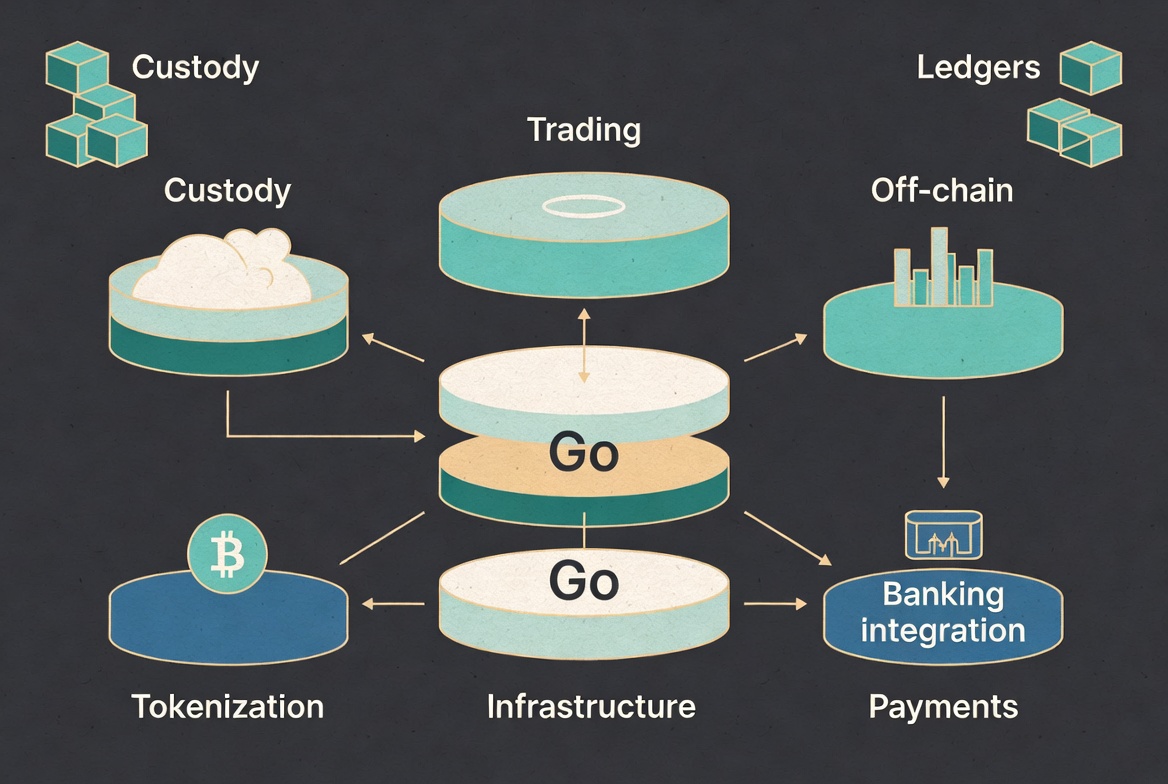
If you read enough job posts or look at enough repos in crypto, a pattern appears: Rust on the protocol side, but Go for a lot of the off-chain infrastructure and backend work. That is not an accident. It reflects the shape of the problems teams are actually trying to solve: making services that are fast enough, simple enough to operate, and easy enough to staff and evolve over time.
Go did not become a default in this space because it is fashionable. It became a default because it makes it straightforward to build the kind of services that hold a crypto platform together: APIs, orchestration layers, wallet and custody systems, risk services, monitoring agents, and internal tools. Those are the areas where reliability and operability are often more important than squeezing out the last microsecond.
Off-chain infrastructure looks a lot like cloud-native Go
Modern crypto and digital-asset platforms increasingly resemble other financial infrastructure: modular services, APIs, queues, event streams, and background workers running in cloud-native environments. Many of the standard building blocks — from Kubernetes to key cloud tools — are themselves written in Go or provide first-class SDKs for it.
That ecosystem fit matters. When teams are building custody, tokenization, trading, and payments platforms, they want services that integrate cleanly with cloud tooling, CI/CD, observability stacks, and managed infrastructure offerings. Go lines up naturally with that environment: small static binaries, friendly to containers, clear concurrency model, and a strong standard library for networking and systems work.
Custody and wallet infrastructure benefit from simplicity
Institutional custody and wallet platforms have to manage keys, policies, approvals, transaction lifecycles, and integrations with banks or card networks. They are part security system, part operational system, and part integration layer. The code needs to be understandable, auditable, and maintainable over years — often under regulatory scrutiny.
Go’s focus on simplicity and readability is attractive in that context. It allows teams to express complex flows — multi-step approvals, policy engines, key management services, orchestration with banking infrastructure — without burying the logic in excessive language complexity. Combined with static typing and a good standard library, that gives custody teams a way to build infrastructure that is easier to reason about across a mixed seniority team.
Performance needs are about throughput and scale, not microseconds
There are parts of the crypto stack where ultra-low latency and cache-line-level optimization matter, and many of those end up in languages like Rust or C++. But a significant amount of crypto infrastructure is about consistent throughput, concurrency, and resource usage rather than extreme latency: handling API traffic, processing events, managing queues, reconciling balances, and talking to external systems.
Go shines in this “fast enough at scale” zone. Experience from production systems shows that Go services can handle high request volumes with modest memory usage. For exchanges, custodians, and BaaS providers supporting digital assets, that means they can run a lot of infrastructure without a huge operational footprint.
Microservices and modular platforms align with Go’s strengths
Many digital-asset platforms are built as modular systems: custody, tokenization, trading, payments, on/off-ramps, card issuing, reporting, and compliance often live in separate components. This is partly driven by regulation and partly by the need to integrate with external partners and legacy systems.
Go has become one of the common languages for microservices and distributed systems, with frameworks and patterns that make it easier to build and operate multiple services in parallel. For a team assembling a platform out of custody modules, settlement services, risk engines, and client-facing APIs, picking one language that works well across those services simplifies hiring, tooling, and long-term maintenance.
Talent and ecosystem availability matter
Technical properties are only part of the story. As more banks, custodians, and infrastructure providers move into digital assets, they need languages where they can actually hire and grow teams. Go has hit a point where there is a solid global talent pool, many engineers coming from other backends can pick it up quickly, and there are enough libraries and examples for common infrastructure tasks.
That lowers risk for institutions making long-term bets on digital-asset infrastructure. They can choose Go knowing that they are not locking into an obscure niche language, and that Go’s trajectory in cloud, DevOps, and backend work is likely to remain relevant for years.
Go is often the “glue” between finance and on-chain logic
A recurring pattern in digital-asset architecture is to separate responsibilities: specialized components implement on-chain logic, matching engines, or protocol-critical code, while Go-based services coordinate everything around them — custody workflows, banking interfaces, stablecoin rails, cards, reporting, risk, and internal tooling.
In that sense, Go often becomes the “glue language” for the platform: the place where traditional finance concepts meet on-chain systems and where user-facing products are composed out of lower-level capabilities. It is not always the star of the demo, but it is the backbone of the system.
If you need help deciding where Go fits in your crypto or financial architecture — from custody and wallet services to banking integrations and off-chain orchestration — you can request a security-focused engagement through the Services page or reach out directly via the Contact terminal.