The API edge is the contract: designing a Go API layer for serious crypto platforms
Why the API layer of a Go-based crypto or fintech platform is more than just routing requests, and how to treat it as the formal contract of your system.
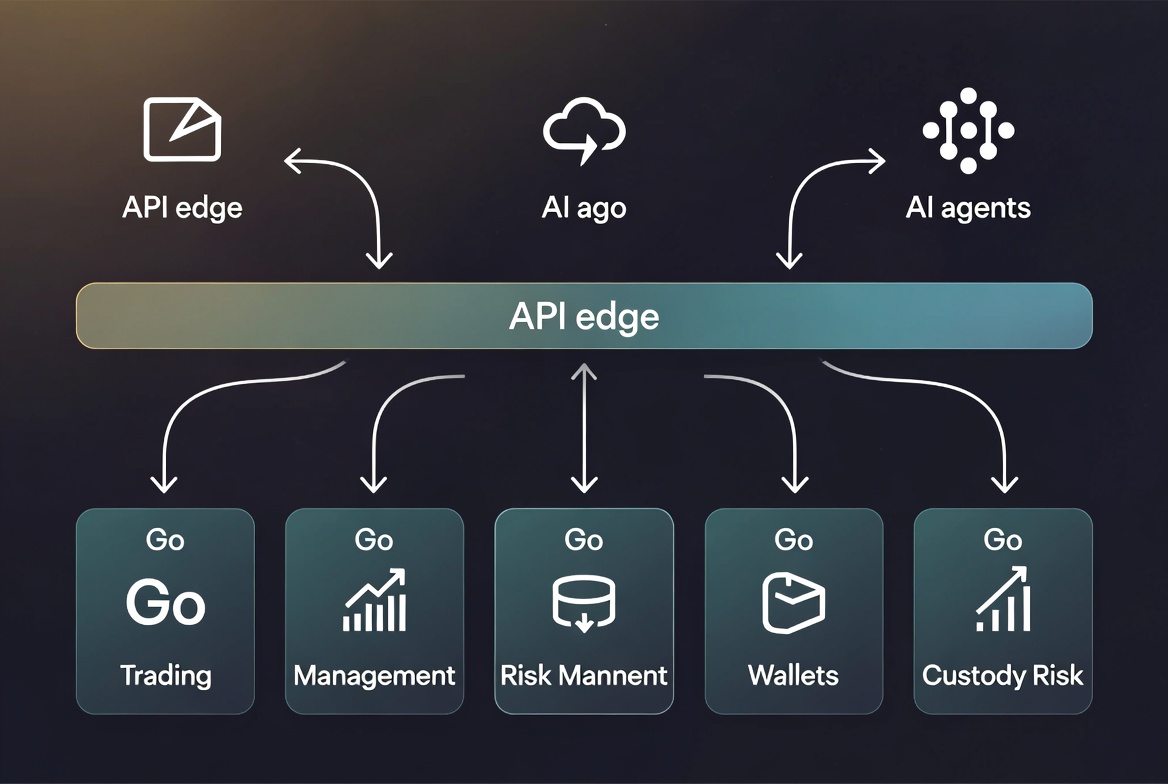
In a modern crypto or fintech platform, the API edge is not just plumbing. It is the formal contract between everything outside the platform (apps, partners, AI agents, backoffice tools) and everything inside it. In a Go-first stack, that edge becomes one of the most important services: it defines how the platform is used, what is allowed, and how changes are introduced without breaking the world.
Thinking about the API layer as “just a gateway that forwards traffic” underestimates its role. In reality, it sits at the intersection of product, security, compliance, observability, and developer experience. If it is sloppy, the entire platform feels accidental. If it is disciplined, the rest of the system can evolve behind a stable, well-understood façade.
The API layer should be thin but opinionated
The usual advice is that API gateways and edge services should be “thin,” and that still holds. Business logic belongs in downstream Go microservices: trading, risk, wallets, custody, banking connectors, and so on.[web:683] The edge should not duplicate that logic or become a second backend.
However, “thin” does not mean “dumb.” The API layer owns a few critical concerns: authentication and authorization, basic request validation, rate limits and quotas, version negotiation, and the mapping between public resources and internal services. It also owns the external representation of errors and the rules around idempotency and retries. These are not details; they are the outer surface of the platform.
A good Go API layer enforces contracts, not just types
Go already gives strong typing inside services, but at the edge the contract is expressed in HTTP semantics, JSON or protobuf schemas, and documented behavior. That contract is how external clients and internal teams understand what is possible and what is stable. Breaking it casually is the fastest way to accumulate operational and product debt.
Treating the API as a contract means being deliberate about resource naming, versioning, pagination, and error models. It means resisting “just one more ad-hoc endpoint for this feature” and instead asking where it fits in the domain. Over time, that discipline pays off: API evolution becomes predictable, and the platform can grow without fragmenting into dozens of incompatible surfaces.[web:680]
Security starts at the edge, not in the middle
For fintech and crypto, security is not something to bolt on after the fact. APIs have become the primary attack surface for SaaS and financial platforms, and attackers actively look for inconsistencies, shadow endpoints, and forgotten paths.[web:650][web:653] The API layer is where many of the first defenses live: authentication tokens, client certificates, IP and device signals, anomaly detection hooks, and coarse-grained access control.
A Go-based API edge can integrate tightly with identity providers, secrets management, and threat-detection tooling while staying small and auditable. The rule of thumb is that no internal service should ever see a “raw” unauthenticated call from the outside world. Every request that reaches a business service should already be tied to a principal, scoped to a role, and tagged with the context needed for logging and risk decisions.
Observability at the edge makes every incident easier
When something goes wrong in a distributed system, the first useful question is often “what did the client actually experience?” The API layer is the best place to answer that. It sees every request as the outside world sees it, along with latency, response codes, and high-level failure reasons.[web:680]
Instrumenting the Go edge services with structured logging, metrics, and tracing gives an instant view into health: which endpoints are failing, which clients are affected, and whether a problem is local or systemic. Because every downstream call starts here, traces that originate at the edge can stitch together the full path through trading, risk, wallet, and other services. That turns incident response from guesswork into investigation.
The API is where AI agents plug in safely
If the platform later exposes AI agents or automated workflows, the safest integration point is the same API layer that apps and partners use. Agents become just another class of client: they authenticate, call documented endpoints, receive structured errors, and are subject to the same quotas and monitoring as everyone else.[web:661][web:675]
This keeps agents inside the existing guardrails instead of granting them special privileges. It also gives observability “for free”: when an agent misbehaves, operations and risk teams can see its calls, error patterns, and latencies the same way they would for any other integration. The alternative — custom agent backdoors into the core — usually leads to opaque behavior and painful audits.
Why the Go API layer is worth obsessing over
Teams often want to rush past the edge and focus on core services, trading logic, or custody flows. Those are important, but the API layer is the multiplier. A clear, well-governed, well-instrumented Go API edge makes everything else easier: onboarding clients, integrating partners, adding AI agents, passing security reviews, and surviving incidents.
In practice, that means treating the API layer as a product in its own right. Its “users” are external developers, internal teams, operators, risk and compliance, and sometimes even auditors. For a Go-based crypto or fintech platform that aims to be infrastructure, not just another app, that is exactly the level where the real leverage lives.