A Go-first architecture for modern crypto platforms
A practical high-level architecture for building a crypto platform in Go, from APIs to trading, wallets, custody, and banking rails.
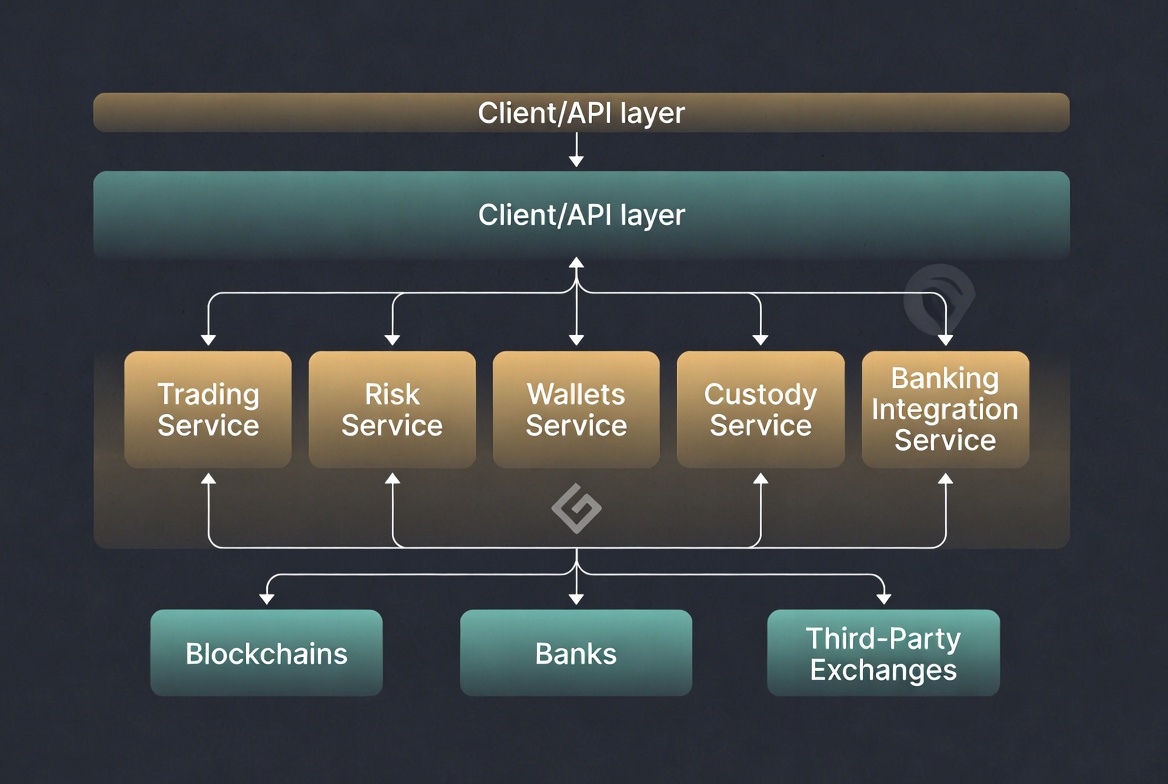
If you treat crypto as infrastructure instead of hype, the platform you need to build starts to look a lot like a modern fintech stack: clear APIs, reliable services, custody and compliance rails, and clean separation between products and the underlying plumbing. Go fits this world well because it was designed for building scalable, networked systems without a lot of ceremony.
A Go-first architecture does not mean rewriting everything in one language. It means using Go as the backbone for the off-chain services that tie the platform together: APIs, trading workflows, risk, wallets, custody, and integration with banks and external venues. Other languages can live at the edges — smart contracts, matching engines, specialized analytics — while Go handles the day-to-day work of moving requests, enforcing rules, and keeping the system observable.
1. Edge and API layer
At the edge of the platform sit the components that talk directly to users and clients: REST and WebSocket APIs, admin consoles, and partner integrations. In a Go-first stack, these are typically implemented as HTTP and gRPC services that terminate TLS, enforce authentication, and translate product-level operations into internal commands.
This layer stays intentionally thin. Its job is to validate inputs, apply basic rate limiting, attach identity and context, and then hand off to the right internal services. Because Go is comfortable under load and plays nicely with API gateways and service meshes, it works well here as a high-throughput, low-drama front door to the rest of the platform.
2. Trading and order workflow services
Behind the API layer, trading-related services coordinate everything from intent to execution. Depending on the platform, that can mean talking to an internal matching engine written in Go, or orchestrating orders across multiple external exchanges and liquidity venues. Either way, this layer owns order lifecycle, state, and routing logic.
In Go, you can model this as a set of services: an order service that tracks state and persistence, a routing service that decides where to send flow, and adapters that talk to specific venues. When the trading core is external, Go’s role is to normalize APIs, handle retries and backoff, and expose a stable contract to the rest of the platform even when individual venues are messy or unreliable.
3. Risk, limits, and compliance rails
A serious platform cannot treat risk and compliance as an afterthought. A dedicated layer of Go services can handle position limits, exposure checks, velocity limits, AML-style transaction screening, and jurisdictional rules before requests reach execution or settlement paths. This is where “should we do this?” is decided.
These services sit on the hot path, so they need to be predictable and fast rather than extremely clever. A typical pattern is to implement a central risk engine that maintains in-memory views of exposure and limits, alongside rule services that evaluate policies and produce structured decisions. Because they are just Go services, they can share the same observability, deployment, and testing story as the rest of the stack, which matters when regulators or clients ask how decisions are made.
4. Wallets and custody core
Wallets and custody form the part of the architecture that actually touches assets. This layer manages address creation, key usage, policy and approval workflows, signing, broadcasting, and reconciliation against both blockchains and internal books. It often spans hot, warm, and cold configurations, plus specialized flows for institutional clients.
Go fits here as the “coordination language” for custody. You can keep the most sensitive components — HSMs, MPC nodes, or specialized signing modules — small and focused, while surrounding them with Go services that orchestrate approvals, enforce policies, schedule transactions, and track state. The result is a custody core that is modular enough to evolve, but simple enough that people can still reason about it during incidents.
5. Banking, payments, and off-chain integration
Modern crypto platforms live at the intersection of on-chain and off-chain systems. They need to talk to banks, card processors, payment gateways, and sometimes traditional brokers or custodians. These integrations are messy, protocol-heavy, and full of edge cases, which makes them a natural home for Go-based adapter services.
In practice, this layer is made up of connector services that translate between the platform’s internal models and external schemas: files, proprietary APIs, batch reports, and payment networks. Go’s standard library and ecosystem cover most of the required protocols and data formats, so teams can focus on business rules and reconciliation logic instead of fighting tooling. This is also where a lot of the “crypto-as-infrastructure” story becomes real: stablecoin settlement, IBAN-like accounts, and embedded finance use cases built on top of custody.
6. Shared services: identity, ledger, observability
Around the core business flows sit shared services that everything depends on: identity and access management, internal ledgers, configuration and feature flags, and the observability stack. These are not glamorous, but they are where many platforms either become maintainable or slowly fall apart.
Go is a natural choice for implementing internal ledgers and accounting services that need to be correct, auditable, and fast enough rather than exotic. Likewise, telemetry from all the other services tends to flow into a small number of logging, metrics, and tracing tools, and Go’s runtime and libraries are friendly to consistent, structured instrumentation. The more uniform these shared services are, the easier it becomes to keep the whole platform coherent.
7. Putting it together
If you draw this architecture on a whiteboard, Go ends up as the spine running through the middle: most internal services, connectors, and coordination logic are implemented in one language, with specialized components (like smart contracts or highly optimized engines) plugged in where they make sense. That makes the platform easier to staff, test, deploy, and reason about over time.
It also leaves room for the future. As new products emerge — AI-assisted wallets, novel settlement rails, or tokenized real-world assets — they can often be integrated as new Go services in the existing architecture, reusing the same identity, custody, risk, and banking rails. The result is a platform that feels more like a living system than a collection of unrelated experiments.