MEV protection on Solana is an execution problem before it is a slogan
Why protecting trades on Solana from MEV is less about marketing claims and more about execution paths, transaction delivery, slippage discipline, landing strategy, and infrastructure design.
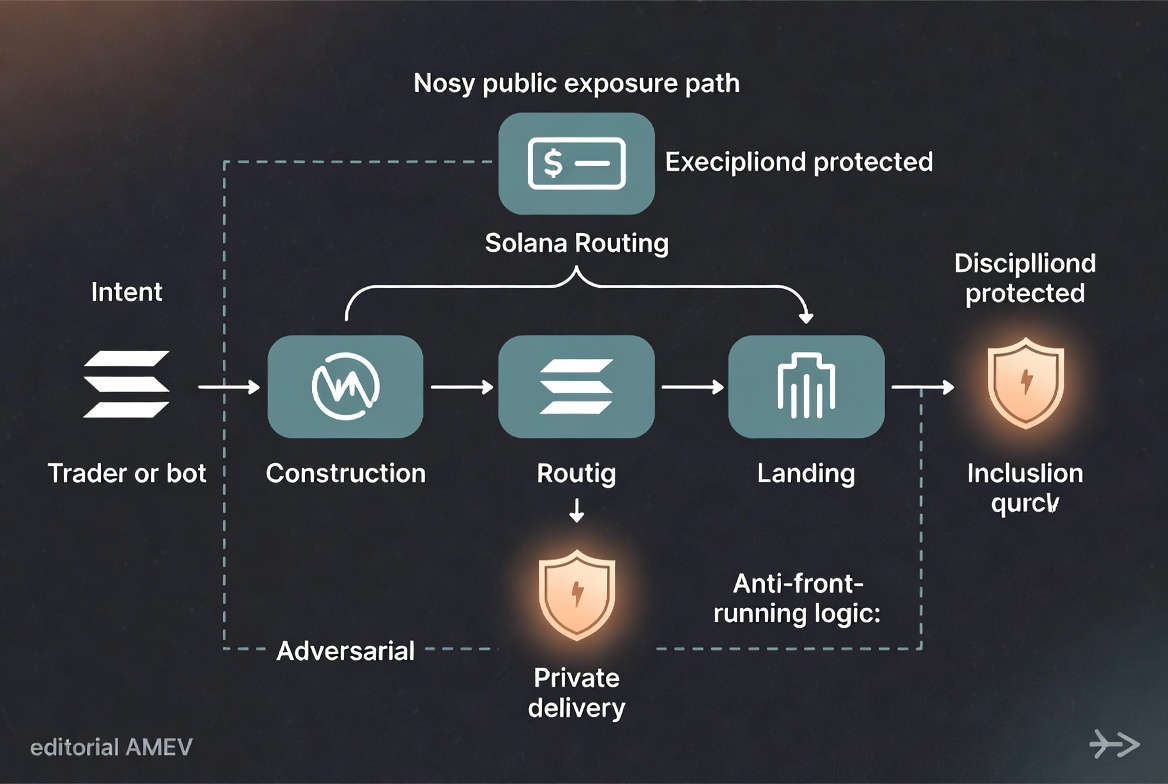
A lot of products talk about MEV protection as if it were a simple feature flag. Turn it on, route trades through a special path, and assume the problem is solved. That framing is easy to market, but it hides the harder truth. On Solana, MEV protection is mostly an execution problem. It depends on how transactions are constructed, where they are sent, how quickly they land, how much information leaks before inclusion, and how much freedom an attacker has to exploit the trade.
That is why serious protection cannot be reduced to a badge on a swap interface or a sentence in product copy. Solana has a different MEV surface from public mempool chains, but that does not mean harmful extraction disappears. It changes shape. The real question is not whether a platform claims to protect users. The real question is whether the execution stack meaningfully reduces the opportunities for reordering, sandwiching, copy trading, latency exploitation, and bad landing outcomes.
Solana changes the MEV surface, not the existence of MEV
One reason people get confused about Solana MEV is that they import assumptions from Ethereum too literally. Solana does not expose the same kind of public mempool behavior, and that changes how extraction works. But a different surface is still a surface.
MEV on Solana tends to be shaped more by validator relationships, block engine paths, searcher infrastructure, transaction forwarding, landing strategy, and priority mechanics than by a classic open mempool race. That makes the ecosystem feel safer at a glance, but it also means many users underestimate the operational side of protection. You do not defend trades just by hiding them from a mempool that does not exist in the same form. You defend them by reducing information leakage, constraining ordering risk, and tightening the path from intent to inclusion.
Protection starts with transaction construction
A surprising amount of MEV exposure begins before the transaction is even sent. If a swap or strategy transaction is loosely defined, wide on slippage, overpermissive in execution assumptions, or careless about account layout and route selection, then the system has already offered attackers room to work with.
Good protection begins with transaction construction that is intentionally hard to exploit. Tight slippage matters because a larger allowed price movement creates more room for adverse extraction. Conservative route logic matters because path complexity can increase attack surface. Clear account usage and predictable execution shape matter because noisy transactions are easier to mishandle or exploit. On Solana, some protections even depend on adding specific accounts or using submission paths that influence bundle behavior and ordering constraints.
This is why protection cannot be bolted on at the end. If the transaction itself is permissive, the rest of the stack is already compensating for an avoidable weakness. A disciplined execution system starts by making the trade itself less attractive to manipulate.
Landing speed is part of the security model
On paper, a transaction might be valid, profitable, and correctly signed. In practice, what matters is whether it lands quickly and in the conditions the strategy assumed. Delay is not just a performance problem. In adversarial environments, delay is a security problem.
When a transaction hangs between construction and inclusion, more things can go wrong. Market conditions drift. Searchers infer intent. Competing flows arrive first. The original assumptions that made the trade acceptable begin to decay. This is one reason landing strategy matters so much on Solana. Priority fees, tips, block engine access, RPC quality, compute efficiency, and submission path discipline all affect whether a transaction lands in time to preserve its assumptions.
Teams often talk about latency as a PnL metric, but for protected execution it is also a trust metric. If your platform promises protection yet sends user flow through slow, noisy, or inconsistent infrastructure, then the protection story is weaker than the UI suggests. A transaction that arrives too late is often just another way of saying the platform failed to defend the user’s original intent.
Private paths matter more than marketing
Many “protected” experiences are really just public experiences with different branding. The transaction still leaks too much, or the routing path is not meaningfully different, or the system depends on generic infrastructure that was never designed for adversarial execution.
Real protection depends on execution paths that reduce exposure before inclusion. That can mean private relays, block engine integrations, tighter routing, disciplined bundle handling, or specific submission methods that reduce the chance of harmful ordering. On Solana, anti-front-running techniques can include constructing transactions in ways that constrain bundle placement and using delivery paths designed around those guarantees. But these tools only help if the rest of the stack is built to support them consistently.
This is why infra quality matters so much. MEV protection is not a product copy problem. It is a routing problem, a relay problem, a validator-path problem, and an operational discipline problem. If those layers are weak, the feature label does not matter.
Bots and platforms need different kinds of defense
A retail swap frontend and a professional execution bot do not face exactly the same threat model. The basic problem overlaps, but the operational reality is different.
For user-facing platforms, the biggest goal is usually to reduce sandwich exposure, bad execution, and avoidable slippage harm. That means safe defaults, route quality, stable delivery paths, and protection mechanisms that work without requiring the user to understand infrastructure. For bots, market makers, and arbitrage systems, the goal is broader. They need protection not only from sandwiching, but from information leakage, latency disadvantage, weak simulation loops, stale assumptions, and infrastructure bottlenecks that destroy execution quality.
That difference matters because many teams accidentally build one kind of protection while marketing another. A swap flow designed for casual users is not automatically suitable for competitive automation. A serious execution bot on Solana needs a stack that treats network path, simulation accuracy, fee strategy, compute optimization, and delivery quality as first-class concerns. Protection here is inseparable from system design.
Slippage discipline is still one of the strongest defenses
There is a temptation to think advanced infrastructure makes basic execution discipline less important. In reality, simple controls remain some of the most effective ones.
Wide slippage is an open invitation to extract value. Even if the delivery path is good, a trade that tolerates too much movement gives adversarial actors economic room to interfere. This is why slippage settings are not just UX detail. They are part of the security perimeter. The same goes for route quality, pool selection, and trade sizing. Thin liquidity and careless routing create profit windows that no amount of branding can fully erase.
Good protection therefore combines infrastructure-level defense with strategy-level restraint. Better relays and routing help. Better defaults help. But if the execution assumptions are loose, the platform is still leaking value through policy rather than code.
Protection claims should be judged by execution architecture
When a protocol, wallet, bot, or trading product says it offers MEV protection, the useful question is not whether the phrase appears on the landing page. The useful question is what the execution architecture actually does.
Does the product change the submission path in a meaningful way. Does it reduce information leakage before inclusion. Does it control slippage tightly by default. Does it optimize for landing speed under congestion. Does it use private or specialized routing where appropriate. Does it distinguish user flow from professional flow. Does it monitor outcomes and adapt when market conditions change. These are architecture questions, not branding questions.
That is also why protection should be tested in outcomes, not slogans. Fewer failed assumptions, fewer harmful sandwiches, better landing quality, lower drift between expected and realized execution, and tighter control over order flow are the signals that matter. If a system cannot explain how it achieves those results, then its protection story is probably weaker than it sounds.
Solana MEV protection is really execution quality under adversarial conditions
The most useful way to think about protection on Solana is not as a magic layer that removes adversaries. It is as a discipline for preserving user intent under hostile conditions.
That discipline touches everything: how trades are formed, how much slippage they allow, how compute is budgeted, where transactions are sent, how fast they land, how bundles are handled, and how the platform observes and improves outcomes over time. In that sense, MEV protection is not separate from execution quality. It is execution quality under adversarial conditions.
The platforms that take this seriously do not treat protection as a decorative add-on. They design the entire path around it. That is what makes the difference between a system that sounds safe and a system that is actually harder to exploit.
If you need help designing or hardening Solana execution infrastructure for protected order flow (routing, landing strategy, private submission paths, bot execution, or anti-MEV architecture), you can request a high-performance infrastructure engagement through the Services page or reach out directly via the Contact terminal.