RWA vault security is not just smart contract security
Why securing an RWA vault means thinking across legal structure, custody, compliance, oracle integrity, operational controls, and smart contract design at the same time.
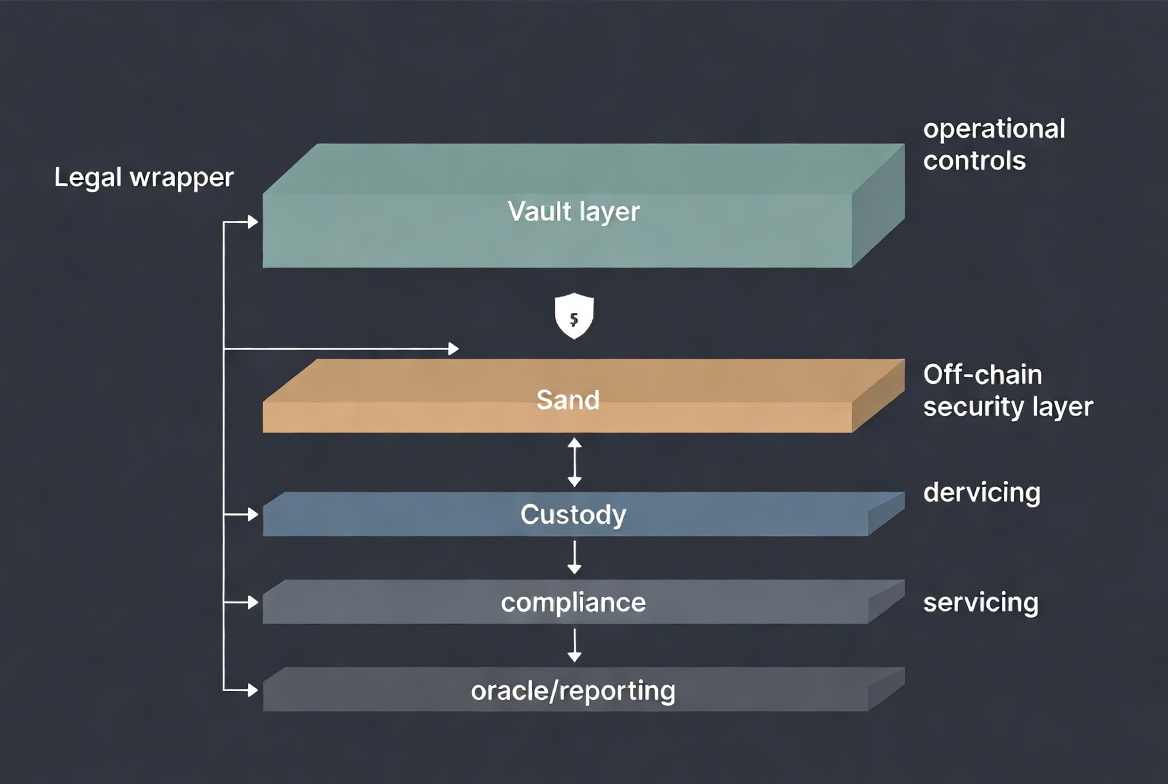
Real-world asset vaults are often described as if they were just another DeFi primitive. Stablecoins go in, a tokenized claim comes out, yield is distributed, and the rest looks like standard on-chain finance. That framing is convenient, but incomplete. An RWA vault is not only a smart contract system. It is a bridge between on-chain capital and off-chain rights, off-chain processes, custody relationships, compliance obligations, and real-world failure modes.
That is why RWA vault security has to be treated differently from purely crypto-native protocol security. In a normal DeFi system, the main question is often whether the contracts behave correctly under adversarial conditions. In an RWA vault, that question is still important, but it is no longer enough. The more serious question is whether the entire structure, legal, operational, custodial, data, and technical, continues to mean what users think it means when the system is under pressure.
The smart contract is only one layer of the vault
A common mistake is to think of the vault contract as the vault itself. In practice, the contract is only the on-chain interface to a broader structure. The token represents a claim, or an economic relationship, tied to assets that exist somewhere else: in a custodian account, inside a fund, behind an SPV, under a servicing agreement, or inside another legal wrapper.
That distinction matters because a contract can be technically flawless and still sit on top of a weak structure. If the off-chain asset is not properly segregated, if the legal entity is not bankruptcy-remote, if redemption rights are vague, or if the servicing process is operationally weak, the token may continue to move on-chain while the underlying assumptions are already compromised. In other words, an RWA vault can remain functional at the smart contract level while becoming ambiguous at the asset-rights level.
Legal structure is part of the security model
Purely on-chain thinking can make teams underestimate how much legal design affects technical security. But in RWA systems, legal structure is not decoration. It is part of the security model itself.
If the asset sits inside an SPV, trust, fund vehicle, or similar wrapper, that entity has to be designed so that asset ownership, investor claims, governance rights, bankruptcy treatment, and enforcement paths are actually clear. If those relationships are weak, the protocol may look clean in a code audit while still exposing users to risks that the chain cannot solve. The vault token should not just point to yield; it should point to a structure whose rights and obligations survive stress, disputes, and operational failure.
This is why serious RWA design is usually closer to financial infrastructure than to generic token issuance. The on-chain contract and the legal wrapper have to agree on what the token means, who has rights, who can redeem, who can intervene, and what happens if a service provider fails. When that alignment is missing, the protocol is not truly secured. It is only cosmetically tokenized.
Custody and servicing are attack surfaces too
In crypto, teams are used to thinking about private keys, admin roles, multisigs, and upgrade authority. In RWA vaults, that remains important, but another set of attack surfaces appears immediately: custodians, trustees, fund administrators, servicers, transfer restrictions, and the operating procedures that connect real assets to the token layer.
A vault can fail because the code was exploited, but it can also fail because the wrong asset records were maintained, because servicing logic broke down, because redemptions were frozen operationally, or because there was no disciplined process for reconciling on-chain balances with off-chain asset positions. If a team says the vault is secure but cannot clearly explain custody, verification, reconciliation, and exception handling, the system is not actually secure. It is only technically assembled.
Operational security becomes even more important when multiple providers are involved. One party may hold the assets, another may issue reports, another may run compliance checks, and another may control token logic or access policies. The security question is no longer just who controls the contract. It becomes who controls the full chain of meaning between the token and the underlying asset.
Oracles and reporting can break trust without breaking code
A lot of crypto engineers think about oracles mainly in price-feed terms. But RWA systems depend on broader categories of truth: valuation, NAV updates, payment status, maturity events, servicing data, compliance status, reserve composition, and sometimes legal or administrative events that do not fit cleanly into standard DeFi assumptions.
That creates a subtle problem. The vault contract may continue to execute exactly as written while consuming delayed, incomplete, or misleading off-chain information. In that scenario, no hack is required. Trust can degrade simply because the system’s representation of reality is no longer reliable enough for the token to mean what users think it means.
This is one reason RWA vault design needs stronger thinking around data provenance, publication schedules, exception handling, and recovery paths. It is not enough to say an oracle exists. Teams need to know who publishes what, under which controls, how disputes are handled, how stale data is flagged, and what the protocol does when reality and reported state drift apart.
Compliance logic belongs in the architecture, not around it
RWA builders sometimes treat compliance as a wrapper added after the product shape is decided. That usually leads to awkward systems where transfer restrictions, investor eligibility, wallet controls, and reporting obligations are bolted onto the protocol instead of designed into it.
That approach creates security problems because compliance is part of system behaviour. If eligibility rules are enforced inconsistently, if wallet-to-identity mapping is weak, if access control is fragmented across services, or if policy changes are hard to propagate safely, the platform starts accumulating legal and operational risk in hidden ways. In RWA infrastructure, weak compliance architecture is not only a regulatory problem. It is a platform integrity problem.
A stronger design treats compliance as infrastructure. That means clear policy surfaces, deterministic enforcement paths, auditable role changes, documented exception workflows, and strong separation between user eligibility logic and the core accounting model. The goal is not to make the vault feel permissionless at the surface while quietly depending on chaos underneath. The goal is to make restrictions explicit, enforceable, and operationally coherent from the beginning.
Upgrades, admin actions, and emergency powers need tighter design
RWA vaults often require more governance flexibility than simple crypto-native products. There may be pauses, blacklist actions, forced transfers, servicing updates, policy changes, emergency procedures, or controlled changes to counterparties and custodians. That is not automatically bad. In many regulated structures, it is unavoidable.
The danger appears when these powers are treated as routine implementation details instead of first-class security concerns. Every emergency function changes the trust model. Every admin path creates a question about abuse resistance, reviewability, key management, and operator accountability. In purely on-chain DeFi, that conversation already matters. In RWA vaults, it matters even more because admin actions can affect not only token movement but also legal rights, redemption outcomes, and access to off-chain capital flows.
Good design here is not about pretending admin power does not exist. It is about making authority narrow, observable, multi-party, and well-scoped. If a protocol can freeze, reroute, or alter critical flows, the exact conditions for those powers should be obvious in both code and operations. Ambiguity is not flexibility. In financial infrastructure, ambiguity is latent risk.
Security means reconciliation across layers
The deepest challenge in RWA vaults is not code quality by itself. It is cross-layer reconciliation. The system has to keep multiple truths aligned at once: token balances, legal rights, custody records, eligibility state, reporting outputs, settlement state, and real-world asset performance.
That is much harder than normal DeFi because not all of those truths live on one ledger. Some are contractual. Some are administrative. Some are operational. Some are produced by external institutions with their own timelines and controls. A secure vault is one that continuously reconciles these layers instead of assuming they stay aligned by default.
This is why serious RWA security needs architecture, not just audits. Audits are necessary, but they mostly answer the question of whether the code behaves as intended. The bigger challenge is whether the full structure continues to support the intended economic and legal meaning of the token across upgrades, incidents, delays, counterparties, and stress.
The vault is only as strong as its weakest non-obvious layer
The biggest risks in RWA systems are often not the obvious ones. Teams spend time hardening contracts and reviewing token flows, then leave the deeper assumptions under-modeled: who can authorize an off-chain movement, what happens if servicing data is wrong for a week, how legal claims are enforced during distress, how investors are mapped to identity records, or how emergency actions are reviewed and documented.
That is why secure RWA vault design requires a broader mindset than standard DeFi engineering. It demands legal clarity, disciplined custody, robust compliance infrastructure, trustworthy reporting, narrow admin authority, and smart contracts that reflect all of those realities instead of pretending they do not exist.
A secure vault is not one that merely avoids exploits. It is one that preserves meaning. When users deposit capital, the token they receive should still represent the same rights, controls, protections, and economic exposure under stress as it does on a calm day. That is a much harder standard than normal smart contract safety, but it is the standard that RWA infrastructure has to meet if it wants to be taken seriously.
If you need help designing or hardening the security architecture of an RWA vault (legal-technical alignment, admin controls, compliance flows, oracle assumptions, or off-chain operational risk), you can request a security-focused engagement through the Services page or reach out directly via the Contact terminal.