Rust for trading execution engines
Why Rust is a strong fit for low-latency trading execution engines, where predictable performance, concurrency safety, and reliability matter more than convenience.
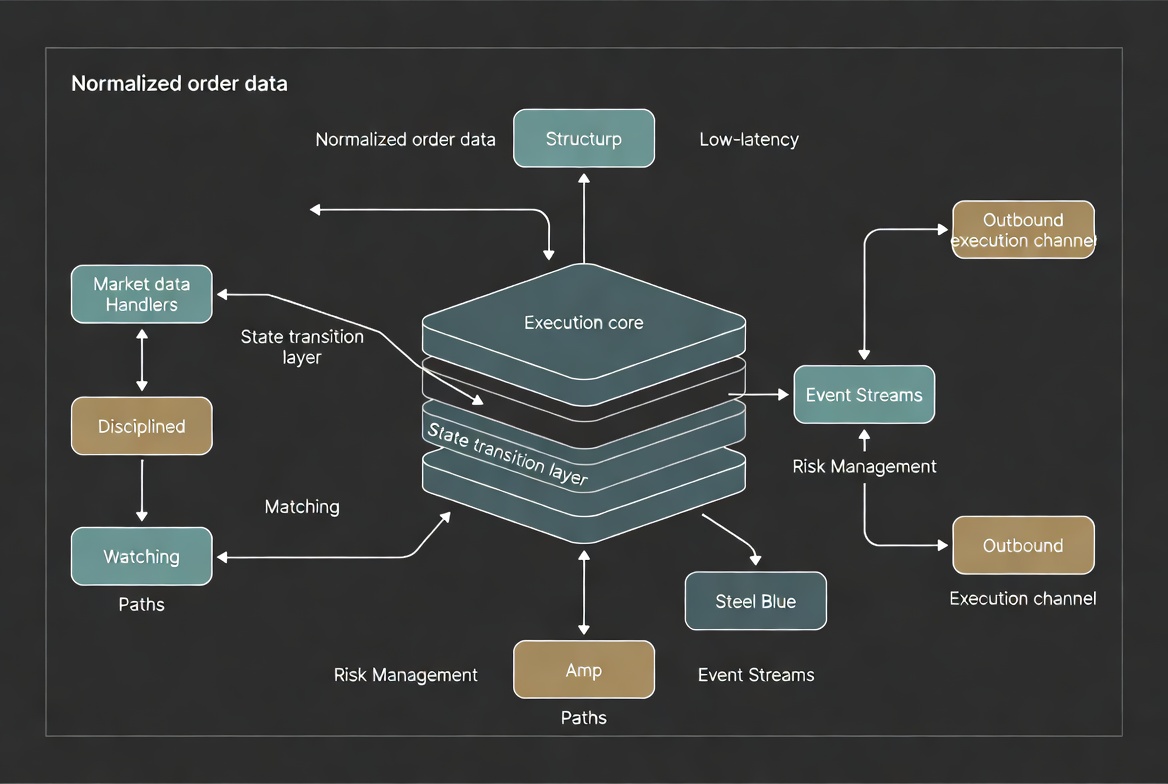
Most trading systems talk about latency as if it were a single number. In reality, there are two very different worlds inside the same platform: the world where trades are decided, and the world where trades are actually executed. The execution engine lives in the second one. It is the piece that receives orders, matches them, updates state, and pushes results out under pressure. It is also the part that hurts the most when something goes wrong.
Most languages let you build this layer by combining fast code with discipline and conventions: a bit of C++ here, some Java there, Python glue on top. That stack can work, but every shortcut becomes a risk: shared mutable state, unspecific ownership rules, background GC pauses, and invariants that only exist in documentation. Rust changes the trade-off. It gives you enough control to hit tight latency budgets, but forces you to encode the rules that keep a trading engine honest directly in the type system and in the structure of your code.
Execution is where systems lie or tell the truth
On paper, every trading platform has a clean mental model: orders arrive, get validated, go into a book, match against liquidity, generate fills, update risk, and produce events. In production, the real system is messier. Messages arrive in bursts. Network links drop. Clocks drift. Downstream venues reject orders that looked valid upstream. If the execution layer is vague about who owns which state and when it can change, everything downstream becomes a gamble.
Rust does not magically simplify that complexity, but it forces you to make the real invariants explicit. Instead of trusting that this struct is only mutated in one thread, you encode that as a single mutable reference and a handful of narrow APIs. Instead of assuming that this order ID always points to some live order, you model that as explicit enums and state transitions, so a stale handle becomes harder to represent by accident. In a trading engine, this matters because every lie the system tells itself eventually becomes a PnL surprise, a stuck book, or an incident that only shows up under the worst possible market conditions.
Latency budgets punish vague ownership
Fast code is not enough if the architecture is vague. A lot of low-latency systems end up fighting their own design: allocations on the hot path, shared state behind global locks, queues that grow unbounded under stress, and components that pretend to be stateless while hiding state in singletons. The result is a system that looks fast in benchmarks, but collapses when the real world pushes it off the happy path.
Rust’s ownership rules are uncomfortable precisely where trading engines tend to cheat. If you want to share state across multiple tasks, you cannot just throw it behind a global; you have to decide whether it is owned by a specific component, wrapped in an Arc, or protected by a lock you chose deliberately. If you want to mutate a book, you need a clear owner for that mutation, and the compiler will only let you borrow that owner in ways that respect your own invariants. That extra friction is not ceremony. It is your future self refusing to debug weird behaviour at two in the morning with a market open and a book frozen.
The payoff is that once the ownership relationships are encoded cleanly, the compiler becomes a collaborator instead of a cop. Refactoring the engine, splitting responsibilities, or adding new order types stops being a blind surgery and becomes a guided process. If a change breaks the invariants that guarded your latency budget or your risk controls, you find out at compile time, not after a week of it only happens under load stories.
Concurrency is a feature, not a background hazard
Trading engines are inherently concurrent. Orders arrive from many sources, risk updates run in the background, market data streams flow in, and outbound messages must be flushed with minimal delay. Many ecosystems treat concurrency as a set of libraries bolted onto a core language model that never really assumed safe parallelism. Rust goes the other way: safe concurrency is part of the language’s contract from the start.
Send and Sync are not buzzwords. They are part of the guarantee that data structures you move across threads or tasks obey the constraints you say they do. If you try to move something that is not safe to share, the compiler stops you. If you want to bypass that safety, you can, but you have to do it in a way that makes the danger explicit through unsafe, specialized primitives, or well-defined FFI boundaries. In an execution engine, that means you can choose exactly where you are willing to carry risk, like in a custom lock-free queue or a thin wrapper around venue-specific APIs, while keeping the rest of the system inside the safer subset of the language.
This makes a big difference when you design how concurrency works at the engine level. You can isolate the hot path, the minimal code that processes orders, updates the book, and emits events, using efficient structures with clear ownership. Risk aggregation, metrics, backpressure logic, and logging can run concurrently without sharing mutable state with the core. Rust gives you the tools to build this without everything dissolving into a global thread pool plus locks everywhere design.
The hot path should not carry network chaos
In most trading systems, the biggest source of chaos is not the execution logic itself. It is the interfaces with the outside world. Venues send malformed messages. Gateways drop connections. Latency spikes for reasons no profiler will ever fully explain. If the hot path of your engine is tightly coupled to that chaos, every glitch at the edge becomes a glitch in the core.
Rust encourages a different architecture: isolate the hot path from the environment as much as possible. Incoming messages are parsed and normalized at the edge into strongly typed events before they reach the engine core. Outgoing messages follow the same pattern in reverse. The execution engine does not parse JSON or protocol-specific noise in the matching layer; it consumes and produces domain-level structures that encode what actually matters: orders, fills, cancels, and risk events.
This separation matters because it lets you keep the hot path small, predictable, and easy to profile. Parsing, backoff logic, reconnect strategies, and protocol quirks all live in layers that can fail, restart, and evolve without contaminating the core execution logic. When the network misbehaves, the core continues to operate on cleaner inputs and outputs. Rust’s type system makes this separation easier to maintain over time, because it becomes harder to pass raw edge complexity into the engine just because it was convenient.
Observability is part of correctness
In a serious trading engine, it works is not enough. You need to know how it works under load, which paths are hot, which queues grow, which invariants get close to breaking, and where pressure starts to accumulate. Observability is not an add-on. It is one of the ways you verify that the system you designed is the one that actually runs in production.
Rust helps here by making instrumentation less fragile. Structured logging, metrics, tracing spans, and counters can be wired into the code in ways that remain explicit and maintainable. If you add a new branch in matching logic and forget to observe it, good architecture and strong typing make those blind spots easier to notice during review and refactoring. If you restructure a subsystem, you are less likely to silently drag hidden state and broken assumptions with it.
The combination of predictable performance and strong observability is what actually moves the needle for desks and platforms. It is not enough to shave microseconds if every change increases the risk of unpredictable behaviour. An engine that is both fast and introspectable gives teams the confidence to evolve it while keeping incidents under control.
Where Rust fits in a real trading stack
A trading platform is more than an engine. There are risk systems, surveillance tooling, client APIs, backoffice processes, databases, dashboards, and operational services around it. Not every part of this stack benefits from Rust in the same way. Trying to force Rust everywhere is usually a sign of confusion, not architectural maturity.
The execution layer, including the engine core, market data handlers, and some parts of the risk path, is where Rust’s combination of low-level control and strong safety guarantees shines the most. This is where you care about cache locality, allocation patterns, contention, and tail latencies, but cannot afford memory corruption or vague concurrency semantics. Around this core, other languages can still make sense for control planes, orchestration services, UIs, analytics, and slower-moving business logic.
Thinking in these terms, hot path versus control plane, low-level execution versus orchestration, helps teams decide where Rust belongs in the stack. It also makes the architecture easier to explain: Rust is not there because it is fashionable, but because it fits the parts of the system where mistakes are the most expensive.
Fast is not enough if the system is hard to trust
There is always another microsecond to chase. You can move from per-message allocations to pools, from coarse locks to narrower coordination, from generic abstractions to hand-tuned code. At some point, those gains start trading off against clarity, maintainability, and the ability to reason about what the engine actually does under stress.
Rust gives you a way to push performance without silently sacrificing trust. You can drop into unsafe in narrow, well-reviewed pockets when you truly need it, while keeping the rest of the engine inside a safer, testable, auditable subset. You can encode assumptions as types and invariants, so that new engineers do not have to recover them from tribal knowledge and log files.
In a domain where errors show up as real money lost, broken books, and operational damage, that combination matters more than theoretical peak performance. A trading execution engine built in Rust is not automatically better than one built in another language. But the language makes it easier to align architecture with the realities of low-latency, failure-sensitive financial systems, and harder to lie to yourself about what the code is actually doing.
If you need help designing or hardening the execution layer of your trading platform (engine core, market data handlers, risk paths, or low-latency backend services), you can request a high-performance infrastructure engagement through the Services page or reach out directly via the Contact terminal.