Go is where trading platforms learn operational discipline
Why Go fits the control plane of trading and crypto platforms, where APIs, service boundaries, operational clarity, and platform discipline matter more than raw execution speed.
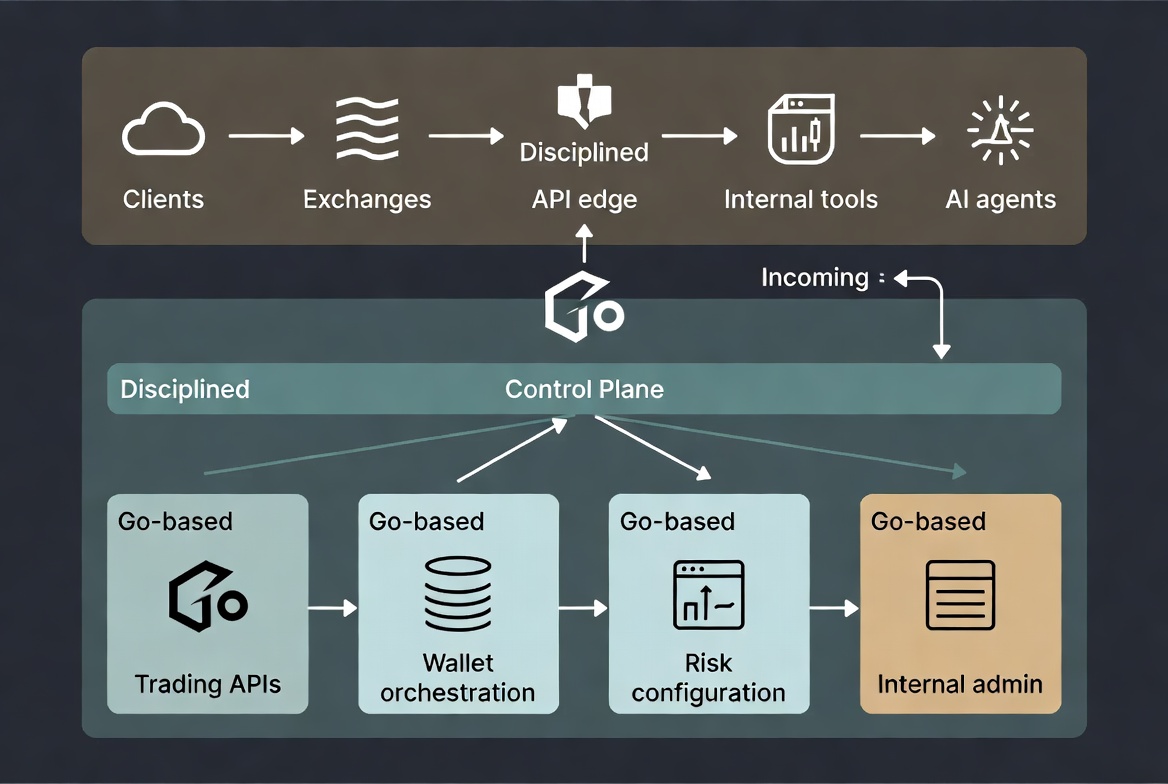
A serious trading platform is not just an execution engine. Around the hot path, there is another layer that decides how the system is exposed, coordinated, authenticated, observed, and operated. That layer is the control plane. It includes API gateways, orchestration services, admin flows, service coordination, risk configuration, wallet operations, and the platform logic that keeps everything coherent as the business grows.
This is where many platforms become fragile. The execution core may be fast, but everything around it turns into a pile of handlers, background jobs, duplicated validation, and inconsistent service contracts. Teams often notice the problem only when growth begins to hurt: more exchanges, more accounts, more compliance requirements, more internal tools, more customers, more things that need to change without destabilizing the core. Go fits this layer well not because it is exotic, but because it encourages a style of engineering that values explicitness, service boundaries, and operational clarity.
The control plane is where platforms become real
In infrastructure language, the control plane is the part of the system that defines, configures, coordinates, and governs behaviour, while the data plane is the part that carries the live traffic or executes the critical workload. In a trading or crypto platform, that distinction maps naturally to real architecture: the execution path handles orders and market events, while the control plane manages APIs, routing, service discovery, policy, identity, and the coordination logic around the core.
This distinction matters because teams often build platform APIs as if they were just another thin transport layer. They expose endpoints, forward requests, and keep pushing business rules downward until the boundaries are no longer clear. Over time, the system becomes operationally noisy. No one is quite sure which service owns which decision, where validation should live, or how a change in one workflow affects the rest of the platform. A good control plane gives the system a spine. It creates a place where contracts, policies, and platform-level rules are made explicit instead of leaking through the entire stack.
Go is good at making boundaries boring
The control plane does not need the same properties as the execution core. It does not usually live under the same microsecond constraints, but it does need to be understandable, deployable, inspectable, and resilient under change. That is where Go tends to shine.
Go makes it relatively easy to write services that do one job clearly. Handlers, interfaces, workers, queues, auth middleware, RPC layers, health checks, and structured logging can be built without turning the codebase into a framework puzzle. That simplicity matters more than people admit. In platform code, boring is often a feature. When a team is operating API edges, wallet orchestration, custody workflows, or compliance-facing services, the cost of ambiguity is much higher than the value of abstraction elegance.
This is one reason Go continues to show up in production microservice ecosystems and platform foundations. It supports maintainable service boundaries, straightforward deployment patterns, and code that many engineers can reason about quickly even under operational pressure. For control-plane work, that is a stronger advantage than cleverness.
APIs are not a thin edge, they are a policy surface
A common mistake in fintech and crypto platforms is treating the API layer as a dumb ingress. Requests come in, get lightly authenticated, and are passed through as fast as possible. That design looks efficient early on, but it usually becomes a liability as the platform matures.
The API edge is where platform discipline begins. It is where authentication, authorization, rate limits, contract enforcement, idempotency, request shaping, and audit-friendly behaviour should start to become explicit. In more mature infrastructure, the control plane is often described as the layer that manages discovery, configuration, governance, and coordinated behaviour for the rest of the system. A crypto or trading platform needs the same mindset even if the stack is smaller. The API edge should not feel like a bag of routes. It should feel like a controlled boundary between clients and the internal machinery.
Go fits this kind of work because it encourages service code that stays legible while still being strict. You can build API services that remain readable as they accumulate auth rules, retries, internal service calls, request validation, and observability. That matters because the API surface is not just transport. It is part of the platform’s security and operational model.
Microservices only help when the control plane has a spine
A lot of teams move toward microservices because the platform is growing: more exchanges, more asset classes, more products, more teams. In trading systems, that can make sense when bounded domains become clearer and when scaling, logging, compliance, and deployment isolation start to matter.But splitting into services without a coherent control plane usually creates more problems than it solves.
Without discipline, microservices turn into distributed confusion. One service owns a piece of risk, another owns a piece of wallets, another owns a piece of identity, and none of the contracts feel stable. Teams then spend more time coordinating than delivering. Articles on modern Go microservices keep returning to the same patterns for a reason: clear ownership, explicit service boundaries, consistent API behaviour, traceability, and predictable operational contracts are what make service-based systems actually work.
That is why the control plane matters so much. It is the layer that makes service boundaries governable instead of accidental. In a trading platform, this can mean one place where API policies are enforced, one model for internal auth, one approach to service discovery, one way to reason about retries and failure domains, and one operational language for what the rest of the platform is doing. Go is not the whole answer, but it is a very good language for expressing this kind of operational discipline without unnecessary complexity.
The control plane should reconcile, not just react
A weak platform reacts to events one request at a time. A stronger platform has a model of desired state and works to keep reality aligned with it. That idea shows up clearly in control-plane thinking across infrastructure systems: APIs define intent, and controllers or management services reconcile actual state toward that intended state.
That mental model is powerful for trading and crypto platforms too. Instead of treating every workflow as a pile of imperative steps, teams can design services that represent what should be true: an account should have a certain permissions profile, a wallet should be under a certain custody policy, a venue adapter should be enabled with a known config, a risk profile should propagate consistently across subsystems. The platform then becomes more than a collection of endpoints. It becomes a system that manages state deliberately.
Go is especially comfortable in this space. It is well suited to long-running services, reconciliation loops, workers, schedulers, and operational tooling that repeatedly inspects, validates, and repairs platform state. That makes it a natural fit for admin and control-plane services in crypto environments where drift, misconfiguration, and partial failures are expensive.
Good platform code is easy to operate at 3 a.m.
There is a practical test for control-plane architecture: can someone understand and operate it when production is under stress? If the answer depends on a specific engineer remembering a dozen undocumented assumptions, the platform is not well designed.
Go helps because it tends to keep operational code direct. Service startup is visible. Concurrency primitives are explicit. Logging and metrics are easy to wire consistently. Binaries are easy to build and ship. Runtime behaviour is usually easier to inspect than in stacks that rely heavily on deep framework magic. These properties are not glamorous, but they are exactly what make Go attractive for service infrastructure and platform tooling at scale.
In trading and fintech systems, that operational clarity matters because incidents do not stay local for long. A control-plane failure can block onboarding, freeze wallet actions, break policy propagation, corrupt internal workflows, or create confusing partial states across services. The teams that survive those moments best are not the ones with the most abstract code. They are the ones whose platform behaviour is clear enough to debug under pressure.
Go belongs around the core, not inside every core
None of this means Go should own every part of the platform. That kind of thinking is as unhelpful as insisting that one language solve the whole stack. Architecture gets better when each layer is allowed to optimize for its real job.
The hot execution path may still belong in Rust, C++, or another environment built for strict latency and memory control. The control plane, meanwhile, benefits from different traits: clear APIs, operational readability, good concurrency ergonomics, manageable service deployment, and a healthy bias toward explicit behaviour. That is the zone where Go earns its place.
For many trading and crypto platforms, the strongest architecture is not a monoculture. It is a layered system where the execution engine is optimized for deterministic performance, while the control plane is optimized for coordination, governance, and operations. Go is often one of the best tools for that outer layer because it helps platforms stay understandable as they become more ambitious.
Discipline matters more than style
It is easy to romanticize systems programming and underinvest in the layer that keeps the platform coherent. But in real companies, growth pain usually arrives through operations first. Internal APIs drift. Teams duplicate auth logic. One service retries too aggressively. Another hides critical state transitions. Wallet and risk services disagree about the same account. Admin tooling becomes a dangerous afterthought.
That is why control-plane code deserves the same seriousness as engine code. It is not less important because it is less latency-sensitive. In many companies, it is the layer that decides whether the platform grows cleanly or decays into an expensive tangle.
Go is valuable here not because it promises magic. It is valuable because it rewards directness. It gives teams a practical way to build the policy surface, service boundary layer, and operational backbone of a serious trading platform without turning the entire company into a framework archaeology project.
If you need help designing or hardening the control plane of your trading or crypto platform (API edge, service boundaries, internal auth, wallet orchestration, or operational services), you can request a high-performance infrastructure engagement through the Services page or reach out directly via the Contact terminal.