AI agents need boring Go infrastructure underneath
How to plug AI agents into a Go-based crypto/fintech stack without turning your platform into an ungoverned black box.
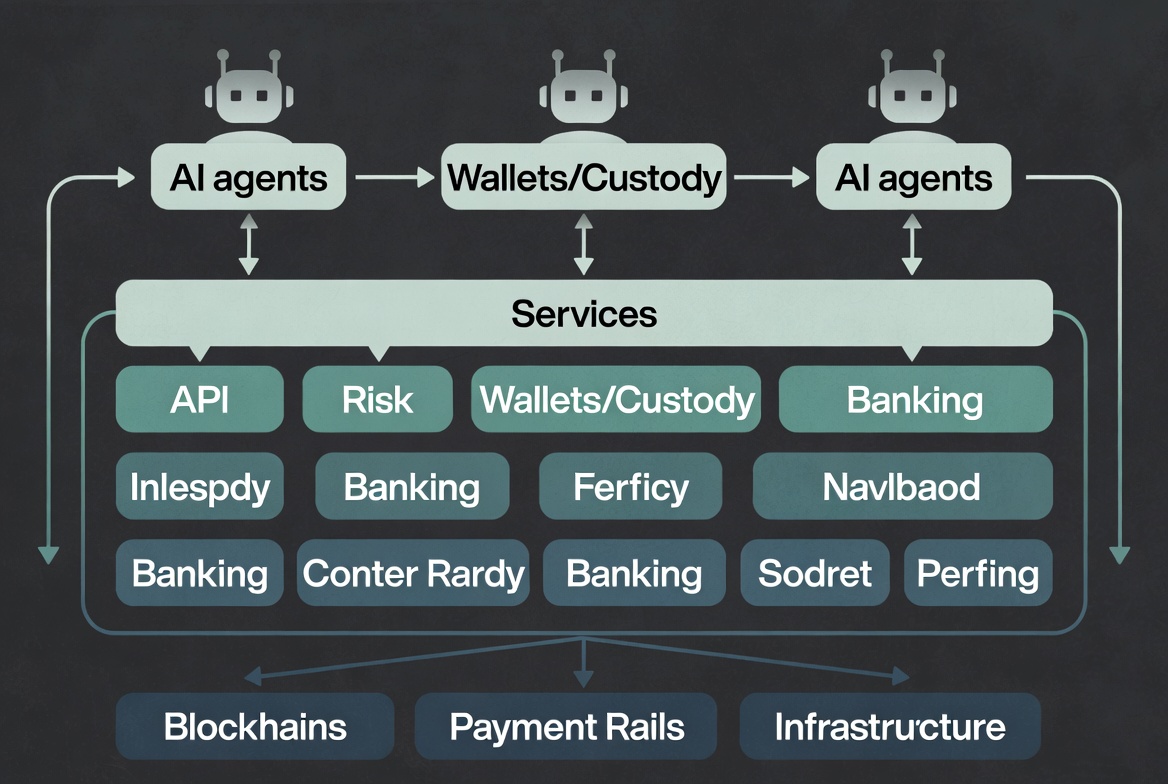
Most AI-agent demos stop at the fun part: an LLM talking to a user, maybe calling a couple of tools, and showing that it can “place a trade” or “rebalance a portfolio”. In production finance, that is the easy part. The hard part is everything that happens after the agent decides what it wants to do: routing requests through risk, custody, banking, compliance, and audit.
If you already have a Go-first architecture for your crypto or fintech platform, you are in a good position. Instead of letting agents touch money directly, you can treat them as new clients of the same backend you would trust a web app or a partner API with. The agents live in their own environment, but every irreversible action still flows through your Go services, guardrails, and observability.
Agents are callers, not special snowflakes
The fastest way to lose control of AI agents is to give them privileged, bespoke access paths: direct database access, raw signing APIs, or backdoor endpoints. A safer pattern is to treat agents as normal clients of your Go platform. They authenticate, call documented APIs, and receive the same validations and risk checks as any other caller.
In practice, that means exposing a set of well-scoped “agent APIs” from your Go services: request a quote, propose an order, ask for a simulation, submit a withdrawal request for review, and so on. The agent’s job is to decide which API to call and with what parameters. Your platform’s job — still in Go — is to decide whether to allow it, how to execute it, and how to log it.
Governance and risk stay in Go
Agentic AI is good at exploring options, chaining tools, and reacting to feedback. It is bad at bearing regulatory responsibility. Governance and risk have to live in deterministic code, with predictable behavior and clear audit logs. That is exactly the profile of the risk and policy services you have (or should have) in Go.
A simple model is: the agent suggests actions; Go services approve or reject them. The risk engine applies exposure and velocity limits. Custody services enforce policy and approvals. Compliance services run KYT, sanctions, or jurisdiction checks. The agent never bypasses these layers; it just experiences them as “sometimes my call fails with a clear reason”. That keeps the intelligence where it helps and the responsibility where it belongs.
Workflows become agentic, infrastructure stays microservice
From an architectural perspective, AI agents are a new way to orchestrate workflows, not a replacement for your microservices. The workflows might span trading, reconciliation, reporting, or client communication, but the steps still map to concrete Go services: API, risk, wallet, custody, banking connectors, ledgers.
You can keep the workflow definition outside the agent — in an orchestrator or a controller service written in Go — and let the agent handle the parts that benefit from flexible reasoning: classification, summarization, exception handling. The rest of the steps remain normal service calls, with retries, timeouts, and monitoring. This separation avoids the “all logic lives in the prompt” anti-pattern, and makes the whole thing testable and debuggable.
Observability and audit logs are non‑negotiable
Once an AI agent can move assets or trigger financial operations, “it worked in the demo” stops being interesting. You need to know exactly what it did, why, and based on which inputs. That means the same observability standards that apply to your Go services must extend to agent-driven activity.
A practical approach is to treat the agent as a noisy but explainable user of your API. Every agent-initiated request is tagged as such, with an agent identity, model version, and decision metadata. Your Go services log the request, the guardrails that fired, and the outcome. Over time, this gives you a corpus of behavior you can review with risk and compliance: which actions are safe to automate, where to require human approvals, and where to tighten policies.
Why Go still matters when “the smart part” is the model
It is tempting to think that if the interesting work is being done by a model or an agent framework, the rest does not matter. In finance and crypto, the opposite is true: the more powerful your agents are, the more you need a boring, reliable, strongly-governed infrastructure underneath.
Go is a good language for that infrastructure because its strengths are exactly what AI agents lack: determinism, operational simplicity, clear concurrency, and predictable performance. Models can explore, adapt, and propose. Go services can enforce, reconcile, and keep books balanced. Together, they can build something that feels new to users without forgetting everything the industry has learned about safety over the last century.