Wallets and custody in Go: building the part that actually holds the assets
How Go fits into the architecture of digital asset wallets and institutional custody platforms, and what makes this layer different from the rest of the stack.
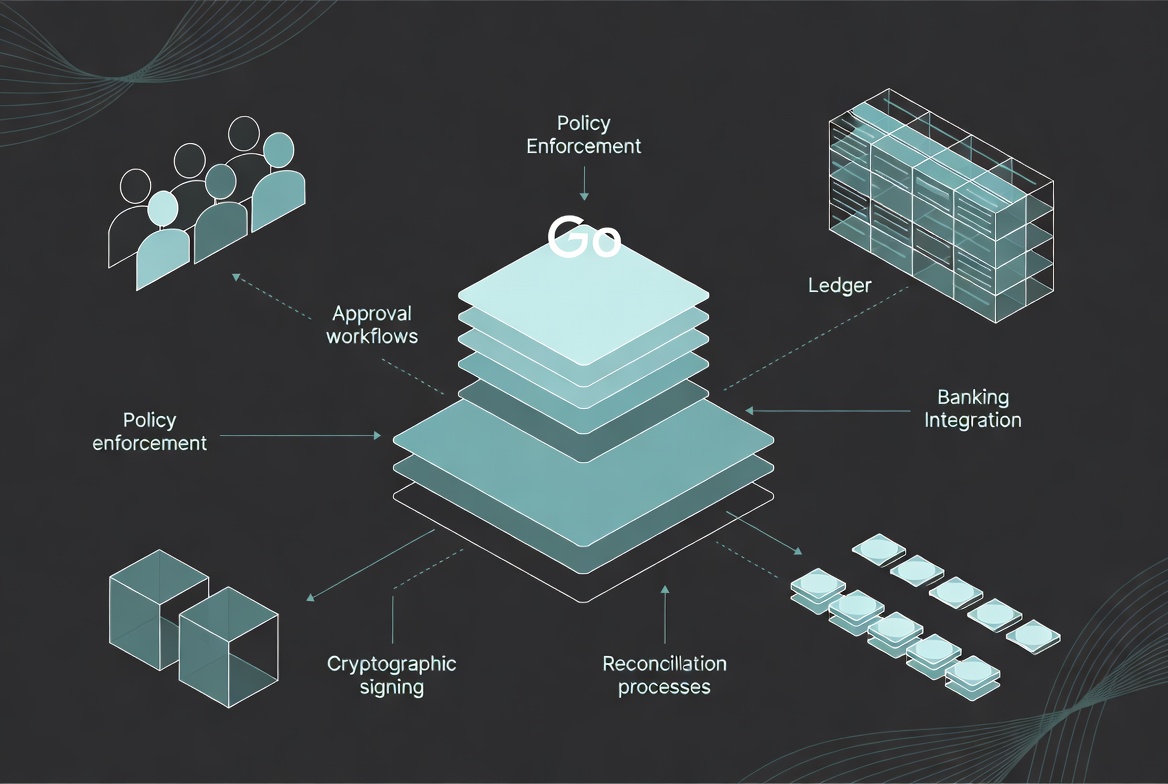
When people talk about crypto platforms, they often jump straight to trading, DeFi, or UX. But under every serious platform there is a quieter component that decides whether anything else matters: custody. Wallets and custody systems are where keys are managed, policies are enforced, and actual movement of assets is orchestrated. If this layer fails, nothing else in the platform really works.
Go shows up a lot in this part of the stack because custody is as much about infrastructure discipline as it is about cryptography. A custody system needs to be boring in the best sense of the word: predictable, auditable, testable, and operable under stress. Go’s focus on simplicity, concurrency, and straightforward deployment maps well to that kind of work.
Custody is more than “a wallet service”
A production custody platform is not just a “send/receive” API on top of a node. It is a pipeline of decisions and checks: account mapping, policy evaluation, KYT and sanctions checks, approvals, signing, broadcasting, and post-trade reconciliation. In institutional setups, high-value flows often pass through multiple governance and compliance steps before a transaction is even eligible to be signed.
Go is a good fit for implementing this pipeline as a set of clear services. You can separate responsibilities into components like “policy engine”, “approval workflow”, “signing coordinator”, “chain broadcaster”, and “reconciliation worker”, each with its own API and telemetry. That separation makes it easier to reason about behavior, monitor the system, and adapt to new asset types or regulatory requirements without rewriting everything.
Key management needs operational discipline
Keys are at the core of custody, but key management is not just a cryptographic problem. It is an operational one: who can request signatures, under what conditions, through which paths, and with which hardware or MPC components involved. Modern custody setups combine HSMs, MPC protocols, or TEEs with software that coordinates approvals and enforces policy.
Go’s strengths in building small, focused daemons and services help here. You can keep the actual signing surface as narrow as possible, implemented as a minimal Go service that speaks to HSMs or MPC nodes over audited channels, while surrounding it with higher-level Go services that handle policies, approvals, and business logic. That way, the most sensitive parts stay small and understandable, and the rest of the system can evolve more freely.
Policies and approvals are first-class concerns
In retail wallets, policy often looks like a simple PIN, 2FA, or biometric check. In institutional custody, policy is its own subsystem: limits by asset and jurisdiction, whitelists and blacklists, velocity limits, multi-step approvals, and special handling for high-risk flows. These rules change over time as clients, regulators, and risk teams update their expectations.
A practical way to handle this in Go is to implement policy as a dedicated service or library with a clear interface: given a proposed transaction and current context, it returns a decision plus reasons. That service can support features like per-account configurations, emergency freezes, temporary overrides, and audit logs of every decision. Because Go makes it easy to ship self-contained binaries, you can deploy updated policy engines alongside the rest of the stack without complicated runtime environments.
Wallet operations are long-lived workflows
Custody operations are often long-lived workflows rather than single HTTP calls. A transfer might move from “requested” to “under review” to “awaiting approvals” to “ready to sign” to “broadcasted” to “confirmed” to “reconciled” over minutes or hours. Failures can happen at any step: missing approvals, chain congestion, node issues, or external banking delays.
Go is well suited to implementing these workflows as background workers, queue processors, and state machines. Goroutines, channels, and well-structured worker patterns make it straightforward to process many concurrent workflows while still keeping code readable. Combined with proper observability, this lets custody teams see exactly where transactions are stuck and why, which is crucial when clients and regulators expect precise answers.
Integration with banks and capital markets is part of custody
By 2026, custody for digital assets is less and less isolated from traditional finance. Banks, card programs, and capital-markets rails intersect with custody flows, whether for funding client accounts, settling trades, or handling stablecoin-based payments. That means custody systems have to speak both “on-chain” and “off-chain” fluently.
Go’s standard library and ecosystem make it a comfortable choice for these integrations: REST and gRPC APIs, message queues, FIX-like protocols, file-based reporting, and all the glue needed to talk to banks, brokers, and clearing systems. A custody platform written in Go can implement these off-chain interfaces alongside its on-chain logic, without pulling in a completely different technology stack just to talk to the banking world.
Auditability is not optional
Every serious custody platform lives under the expectation that one day, someone external will ask hard questions: auditors, regulators, or large institutional clients. They will want to know who approved which transaction, which policy was in force, which checks ran, and why a specific decision was made at a specific time.
Building custody in Go makes it easier to treat auditability as a design constraint instead of an afterthought. Services can emit structured logs for every step, correlate decisions with transaction IDs and approval records, and expose reporting APIs that reconstruct the full history of an asset’s movement. When code is relatively simple and uniform across services, those audit trails are easier to trust and maintain.