Most smart contract exploits start long before deployment
Why smart contract security is really about assumptions, invariants, permissions, and failure modes — not just audits before launch.
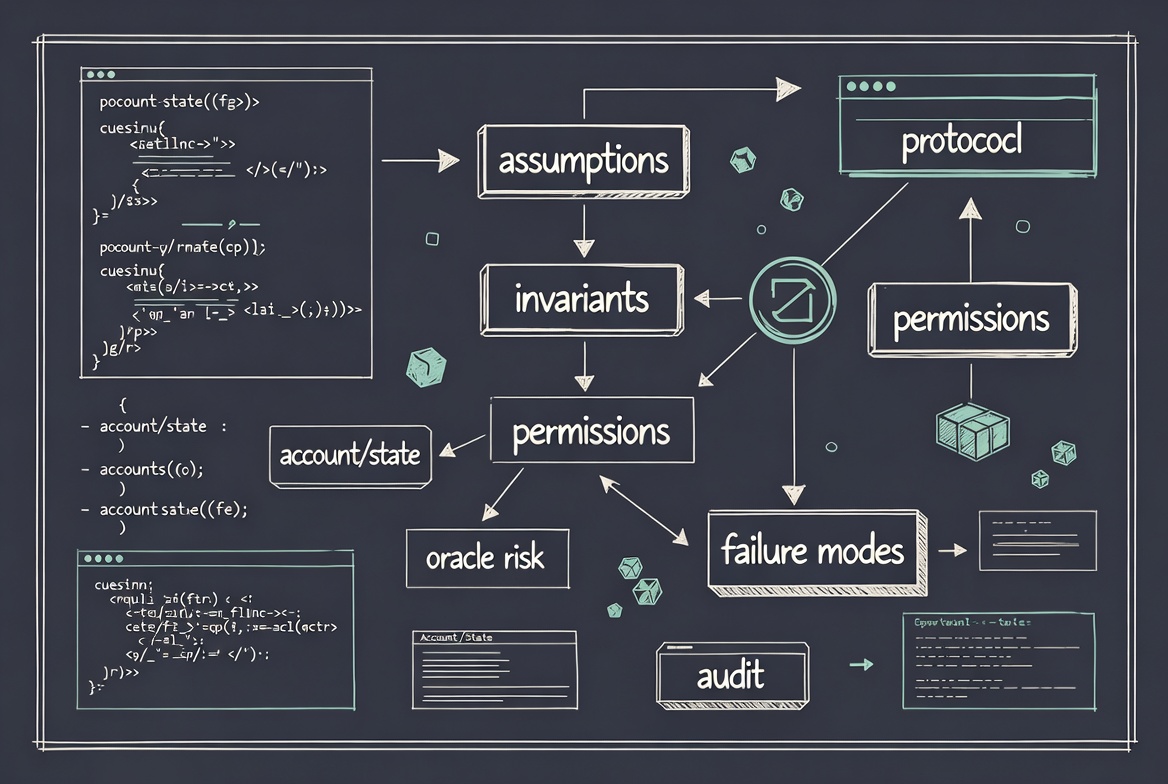
A lot of teams treat smart contract security as the final step before mainnet: finish the code, send it to auditors, fix the findings, and deploy. That model is too shallow for serious systems. Most smart contract exploits do not begin at deployment. They begin much earlier, when teams bake unsafe assumptions into the design, skip clear invariants, blur permission boundaries, or fail to define what the protocol should do under stress.
By the time an exploit happens on-chain, the real mistake has usually already been made. The code is just the last place where the mistake becomes visible. That is why smart contract security is not only about vulnerability hunting. It is about designing a protocol whose behavior stays coherent even when users, markets, or external dependencies behave adversarially.
The first security problem is unclear assumptions
Every smart contract is built on assumptions, whether the team writes them down or not. A protocol may assume the oracle updates frequently, the admin acts honestly, the pricing model cannot be manipulated within one block, the backend sends correct inputs, or the withdrawal flow is always executed in a specific order.
The problem is not that assumptions exist. The problem is when they remain implicit. If a contract depends on assumptions that are not documented and enforced, then the system becomes fragile in ways the team will not notice until something breaks. Strong smart contract design starts by making assumptions explicit and minimizing how many of them the protocol truly needs.
Invariants matter more than intuition
Many teams understand their protocol informally: “this is how it should work.” That is not enough. Serious smart contract systems need invariants — conditions that should always remain true no matter what sequence of valid actions occurs.
Examples of useful invariants include:
- total shares must always map consistently to total assets,
- privileged actions must only be executable by the correct authority,
- losses must be allocated in the correct order,
- user balances must never exceed the assets actually controlled by the vault,
- expired authorizations must never be accepted.
Without invariants, testing becomes shallow and audits become narrower than they should be. Invariants give the team, the auditors, and the test suite a concrete model of what the protocol is supposed to preserve.
Permissions break protocols more often than teams expect
According to modern smart contract security guidance, access control remains one of the most common and dangerous classes of vulnerability. That is not surprising. Permissions sit at the boundary between business logic and trust. If they are wrong, every other control may become irrelevant.
A contract should define privileged authority with painful clarity. Who can pause? Who can upgrade? Who can configure risk parameters? Who can create or revoke authorization state? Who can move treasury-controlled assets? In smart contract systems, permission ambiguity is itself a vulnerability. The protocol should not merely “have admins.” It should have tightly scoped, reviewable authority paths that match the real operating model of the system.
Business logic bugs are real security bugs
One of the biggest mistakes in Web3 is treating only low-level technical flaws as security issues. Reentrancy, unchecked calls, and arithmetic bugs are important, but business logic failures are just as dangerous. If the protocol’s rules can be gamed while all functions behave “as coded,” the exploit is still real.
This is especially important for vaults, lending systems, and RWA products. If deposits can happen against stale pricing, if redemptions can escape pending losses, if tranche logic can be bypassed through timing, or if authorization flows can be replayed outside their intended scope, then the issue is not cosmetic. The business logic itself has become the exploit surface.
External dependencies must fail safely
Most smart contracts do not live alone. They rely on oracles, token programs, external protocols, bridges, compliance systems, or off-chain services. Every dependency expands the failure surface.
Good smart contract design asks hard questions about dependency failure. What happens if an oracle stalls? What if an external CPI target changes behavior? What if a backend issues malformed authorization data? What if an upgrade path is triggered under abnormal conditions? Security is not just about making the happy path work. It is about ensuring the contract fails in a way that limits damage when the outside world stops behaving as expected.
Anchor helps, but it does not remove responsibility
On Solana, Anchor gives teams safer defaults and strong account validation patterns. That is a real advantage. Account ownership checks, signer requirements, PDA derivation, and account constraints can eliminate large classes of mistakes when used correctly.
But Anchor is not a security substitute. If the underlying model is wrong, clean constraints only protect a flawed design. Teams still need to think carefully about seed derivation, authorization scope, account mutability, CPI trust boundaries, invariant testing, and privileged flows. Frameworks reduce certain implementation risks. They do not remove the need for protocol-level security thinking.
Audits are necessary, but they are not the beginning
A good audit is valuable because it pressures the protocol to state its rules more clearly, document assumptions, and expose weak points in implementation. But the audit should not be where the protocol first discovers its own logic.
The best time to think about smart contract security is during architecture, then during state design, then during permission design, then during test design, and only then during audit and deployment. Security is strongest when it is carried through the whole lifecycle. If it begins the week before mainnet, it already began too late.
The real standard
A secure smart contract is not just one that survives a checklist of known bugs. It is one whose assumptions are explicit, whose invariants are testable, whose permissions are narrow, and whose failure modes are predictable. That is the real bar.
Teams that build this way do not just reduce exploits. They create protocols that are easier to audit, easier to reason about, and harder to break under stress. In smart contract systems, that is what maturity looks like.
If you need help hardening the off-chain side of your crypto project (wallets, backend, domains, or incident response), you can request a security-focused engagement through the Services page or reach out directly via the Contact terminal.