Rust doesn’t have exceptions — and that’s a feature
Why Rust’s explicit error handling with Result and Option leads to more reliable systems than hidden exception paths.
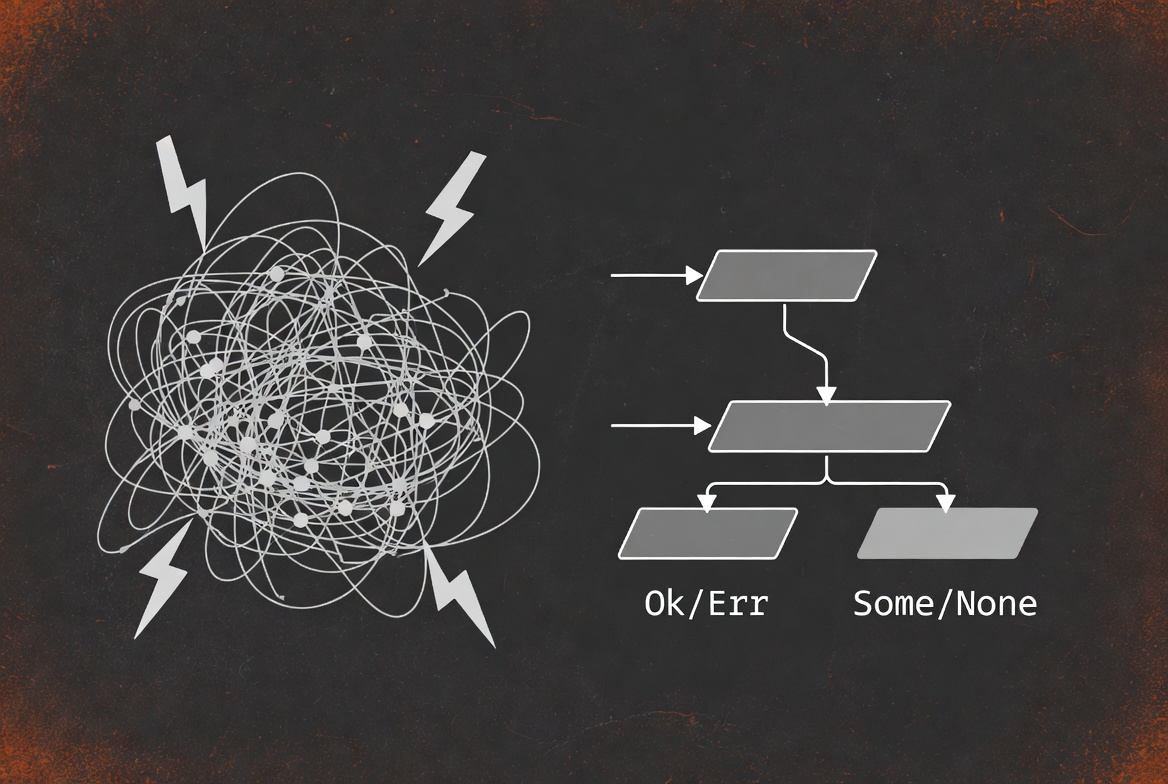
Most mainstream languages normalize exceptions: you write happy-path code and throw when something goes wrong, hoping the right try/catch will catch it. Rust takes a very different approach. It does not have exceptions for recoverable errors. Instead, it uses the type system — Result and Option — to force errors into the explicit shape of your APIs.
That design is not just a stylistic choice. It pushes teams toward systems where failure is part of the contract instead of a side channel. A function that can fail returns Result<T, E>, a function that might legitimately have “no value” returns Option<T>, and the compiler makes you acknowledge both possibilities. In aggregate, that changes how you think about reliability.
Result and Option encode intent, not just mechanics
At first glance, Option<T> can look like just a Result<T, ()> with a different name. But the semantics matter. Option<T> says “this value is optional; absence is expected and not an error.” Result<T, E> says “there is a happy path and an error path, and the error variant carries information about what went wrong.”
That distinction lets APIs communicate much more precisely. A database lookup that may or may not find a row should return Option<T>. A parse function that must either succeed or report what failed should return Result<T, ParseError>. The type tells you whether absence is normal or failure, and that is valuable context for anyone calling the function.
The ? operator makes explicit handling practical
If every Result had to be unwrapped manually, Rust’s error model would feel unbearably verbose. The ? operator is what makes it ergonomic. It lets you propagate errors up the call stack concisely while still keeping them explicit in the type signature.
Rather than a hidden throw, ? is “return early with this error if it exists, otherwise keep going.” The caller can see from the function’s return type that errors may bubble up. Combined with tools like thiserror and anyhow for richer error types, this makes it possible to build robust error handling without drowning in boilerplate.
Reliability improves when failure is visible in types
When a function can throw at any point, reasoning about what might fail becomes hard. You must mentally track which calls might throw and which exceptions might surface. In large codebases, this often degenerates into broad catch blocks that hide useful distinctions between failure modes.
Rust’s approach makes potential failure part of the function signature. If a call returns Result<T, E>, the caller must either handle or propagate that error — there is no way to silently ignore it without being very explicit about doing so. That pressure often leads to clearer error paths, better logging, and more deliberate decisions about what should be retried, escalated, or treated as fatal.
Recoverable vs unrecoverable is a design choice
Rust draws a line between recoverable errors (modeled with Result) and unrecoverable errors (modeled with panic!). A missing config file, a transient network failure, or a user input issue should usually be recoverable. An out-of-bounds access or a violated invariant is a bug and should probably crash.
This distinction matters architecturally. It forces you to think about which conditions your system is expected to handle gracefully and which conditions indicate deeper defects. Over time, that leads to designs where panics are rare and meaningful, while Result-based errors are handled at appropriate boundaries with context.
Error APIs become part of your architecture
The way you structure error types affects how your system behaves under stress. Module-level error enums, layered error conversions (From), and clear top-level error boundaries all become tools for shaping your architecture.Instead of a soup of stringly-typed messages, you get typed errors that convey where and why things went wrong.
This also plays well with observability. Typed errors can carry IDs, categories, and structured context that feed directly into logs, traces, and metrics. That makes it easier to see patterns: which classes of error are common, which are rare but critical, and where they originate.
Why this is a feature, not a nuisance
Rust’s explicit error handling can feel annoying at first, especially if you are used to exceptions. But the payoff is systems where failure is harder to ignore and easier to reason about. The compiler becomes an ally in making sure you do not accidentally drop important error paths on the floor.
By choosing Result and Option over exceptions, Rust trades a bit of convenience for more honest APIs and more reliable behavior. For infrastructure, financial systems, and security-sensitive code, that is a trade worth making. Rust doesn’t have exceptions — and that is one of the reasons it’s a good foundation for serious software.
If you need help hardening the off-chain side of your crypto project (wallets, backend, domains, or incident response), you can request a security-focused engagement through the Services page or reach out directly via the Contact terminal.