Designing Go backends for crypto execution, not hype bots
Why serious crypto platforms use Go for order routing, execution services, and risk-aware automation instead of chasing fragile bot scripts.
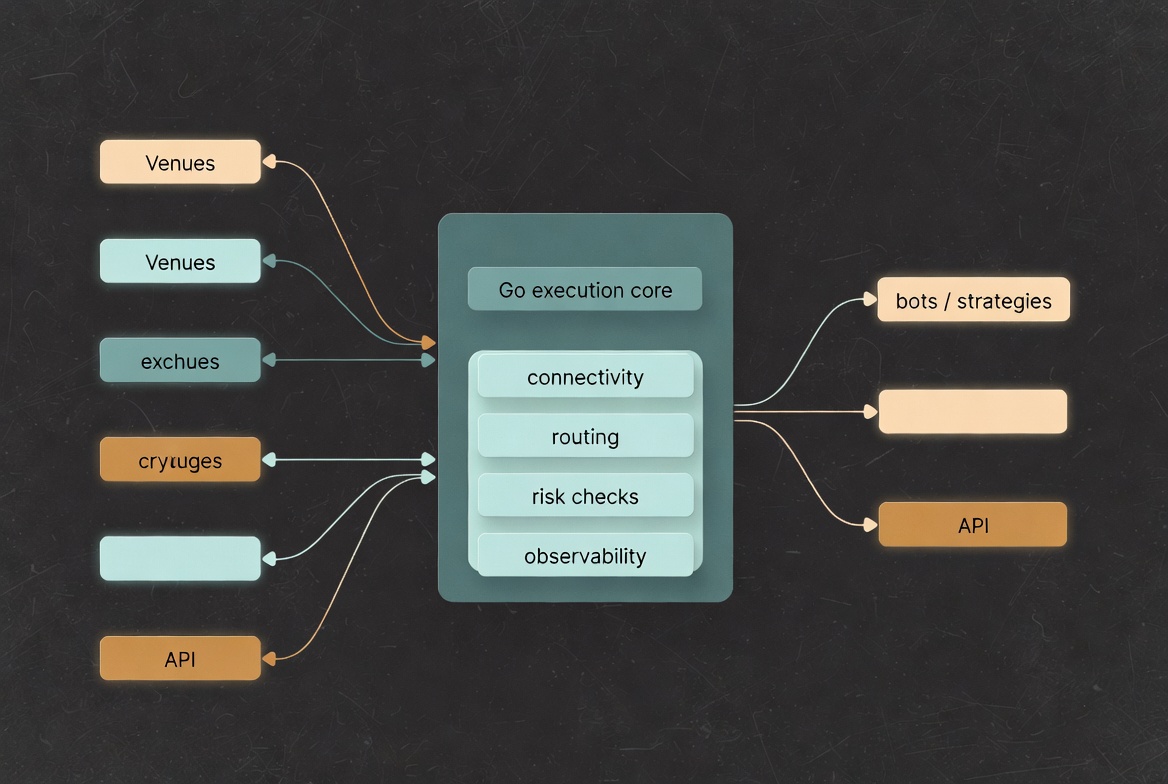
Most crypto content about automation focuses on bots: magic scripts that promise effortless profits in a few lines of code. In production platforms, the reality looks very different. Real systems need reliable order routing, exchange connectivity, throttling, risk controls, and observability, all working together under live market conditions. That is not a bot. That is a backend.
Go fits this backend-shaped problem better than most languages people reach for when they think about automation. It was designed for networked services with high concurrency, clear process boundaries, and enough simplicity that an operations team can understand what is going on in production. For crypto platforms that care about execution quality instead of marketing hype, this alignment matters.
Execution is a platform concern, not a side script
In a serious trading or exchange environment, execution is not something you bolt on later as a side project. It is a core part of the platform: managing connectivity to multiple venues, building and submitting orders, handling acknowledgements and rejects, tracking positions, applying throttles, and enforcing risk rules.
That work spans multiple services: connectors to exchanges, internal routing logic, risk and limits engines, monitoring agents, and sometimes simulation or backtesting components. Each of these needs clear APIs, predictable behavior under load, and a way to be observed and debugged. Go’s model of small, focused services communicating over well-defined boundaries fits this pattern well.
Go handles the concurrency shape of execution services
Execution backends have to do many things at once: stream market data, maintain local order books or snapshots, manage websockets and REST calls to multiple venues, handle order lifecycle events, and update internal state. Most of this is I/O-bound work that benefits from a concurrency model which is simple to express but not tied to heavyweight threads.
Go’s goroutines and channels are well aligned with this class of problem. A service can maintain concurrent connections to multiple exchanges, process streams of events, and coordinate work between components without exposing every detail of the underlying scheduling machinery. That does not turn Go into a magic high-frequency engine, but it does make it a good fit for the orchestration layer around real-world execution.
Microservices give execution room to evolve
As a platform grows, execution logic tends to fragment into multiple concerns: venue connectivity, smart order routing, internal crossing, risk checks, throttles, exposure monitoring, and various forms of analytics. Trying to force all of that into a single process usually leads to a system that is hard to reason about and harder to change.
Go works well in a microservices or modular architecture where each responsibility can live in its own service with clear contracts. A connectivity layer can focus on talking to venues. A routing service can focus on where to send orders. A risk service can enforce limits. Each piece can scale independently, deploy separately, and be monitored in isolation. For crypto, where venues and products change frequently, that flexibility is a practical advantage.
Observability is not optional for execution
Execution systems live and die on their ability to show what is happening. When an order is delayed, partially filled, rejected, or misrouted, teams need to see the path it took through the system, which decisions were made, and which limits were applied. Without that visibility, debugging and incident response become guesswork.
Go’s ecosystem around logging, metrics, and tracing is mature enough that building observability into services does not require inventing everything from scratch. For a crypto platform, this makes it easier to treat execution as an auditable, instrumented part of the system instead of a black box. That in turn makes it more realistic to add protections, alerts, and guardrails around automation.
Bots and scanners should hang off a robust core
There is nothing inherently wrong with bots, scanners, or strategy automation. The problem is when they are built as fragile scripts with direct access to capital and no serious infrastructure around them. In a healthier design, automation hooks into a robust execution core that enforces platform-level rules.
In that model, Go-based services handle connectivity, order lifecycle, risk, and monitoring. Bots and scanners become clients of well-defined APIs rather than the place where everything important happens. This makes it possible to experiment with strategies without weakening the integrity of the platform.
Go is not about “high frequency” as a slogan
High-frequency trading is often misunderstood. True HFT at scale is a specialized domain where nanoseconds and colocated hardware matter. Go is not a magic ticket into that world, and serious players rely on a mix of tools optimized for the exact constraints they face.
Where Go shines is in building the rest of the system: the infrastructure that handles real-time API traffic, integrates with multiple venues, coordinates risk and routing, and exposes reliable surfaces for strategies and external clients. For most crypto platforms, that is the kind of “fast enough” that actually matters.
Why execution-focused Go backends matter for real users
From a user’s perspective, good execution looks like reliability: orders reach the market, rejections are clear, partial fills are handled correctly, positions make sense, and the platform behaves predictably during volatility. That experience depends on the quality of the off-chain backend much more than on the existence of a clever bot.
Go is a practical language for building that backend. It encourages services that are simple enough to run, observable enough to debug, and concurrent enough to handle the real shape of execution traffic. For crypto teams who care more about robust execution than about hype, that is exactly what they need.
If you need help hardening the execution side of your crypto stack — from Go-based order routing and venue connectivity to scanners, bots, and incident response — you can request a security-focused engagement through the Services page or reach out directly via the Contact terminal.