Three rules for not wrecking your Go platform when you add AI agents
A short, opinionated checklist for plugging AI agents into a Go-based fintech or crypto stack without losing control.
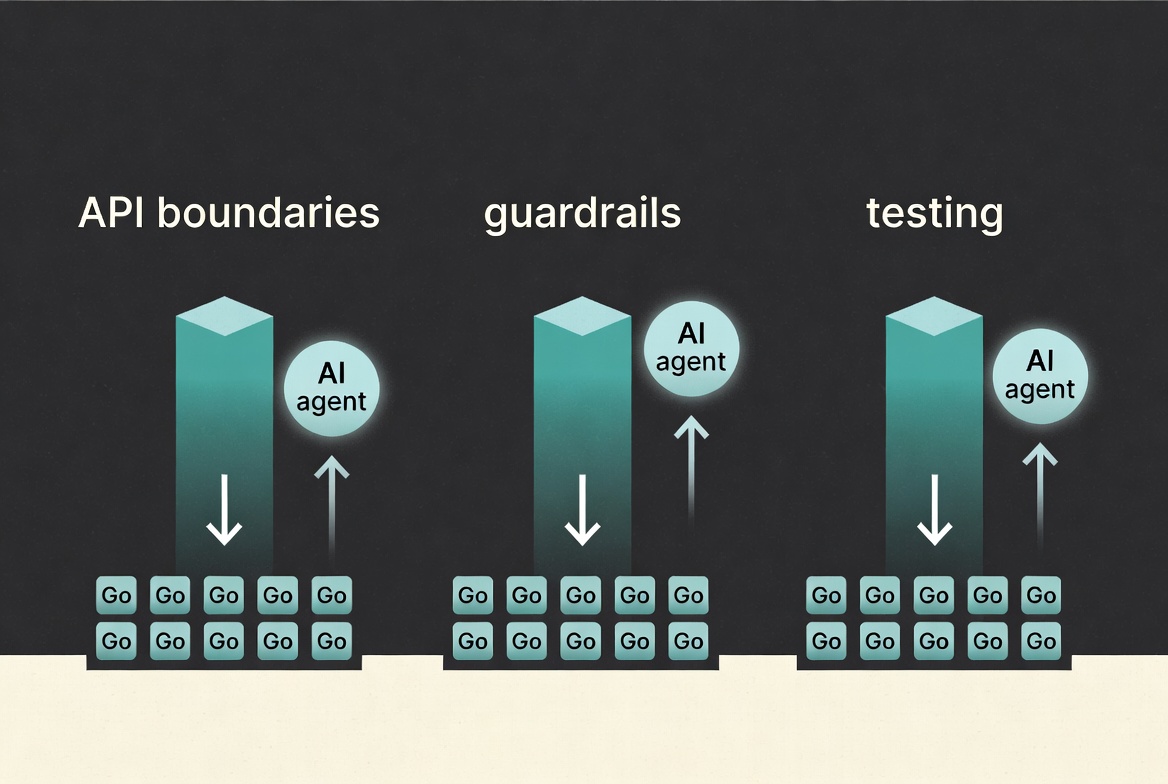
Everyone wants to add AI agents to an existing Go stack and let them take actions. That part is easy. The hard part is doing it without turning a stable platform into an unpredictable one. The safest mindset is simple: the agents are the experimental layer, while the Go infrastructure underneath is still the part users, operators, and auditors have to trust.
Rule 1: Agents should never bypass your APIs
If an AI agent can do something that a normal client cannot do through the platform, the architecture is already drifting in the wrong direction. Agents should use the same Go services through the same REST or gRPC interfaces, with the same authentication, rate limits, validation rules, and operational boundaries that apply to every other caller.
A good pattern is to expose a narrow set of agent-facing capabilities such as simulate, propose, request approval, or submit for execution. The agent chooses which action to request, but the backend still owns validation, execution semantics, and logging. That keeps the agent inside a controlled contract instead of letting it improvise directly against databases, raw wallets, or internal-only systems.
Rule 2: Guardrails belong in infrastructure, not in prompts
A prompt is not a control system. In a financial or crypto environment, real guardrails live in deterministic infrastructure: policy engines, approval workflows, spending limits, identity boundaries, and risk checks. Those controls should exist in code and services that can be versioned, tested, monitored, and audited over time.
The clean operating model is this: the agent suggests, the platform decides. The model can propose a transfer, a rebalance, or a support action, but the Go services still enforce the real rules. If the model behaves badly, hallucinates, or misreads context, the infrastructure should be able to reject the action cleanly and consistently without depending on the model to “be careful.”
Rule 3: Test agents in realistic sandboxes before production
An agent that worked in a demo is not ready for production. Before it touches anything irreversible, it should spend time in a sandbox that mirrors the real platform closely: same APIs, same contracts, same error shapes, same timing issues, and similar workflow complexity.
The point is not only to see whether the agent succeeds. It is to see how it fails. You want to observe how it reacts to denials, partial outages, stale information, retries, malformed upstream responses, and edge cases in workflow state. A disciplined rollout starts with shadow mode, then limited execution in narrow scopes, and only later expands into higher-trust actions.
Why this matters
AI agents become dangerous when they are treated like magic instead of software. The more autonomy they get, the more important it becomes to keep the surrounding platform boring, explicit, and constrained.
That is why Go still makes sense underneath all the AI excitement. Models can reason, classify, and propose. Go services can enforce, log, reconcile, and keep the platform understandable when something goes wrong. The winning setup is not “AI everywhere.” It is AI sitting on top of infrastructure that still knows how to say no.