When machines become LPs: DePIN treasuries and RWA yield
How DePIN and IoT networks use machine wallets, policy constraints, and RWA yield vaults to turn physical operations into programmable treasury flows.
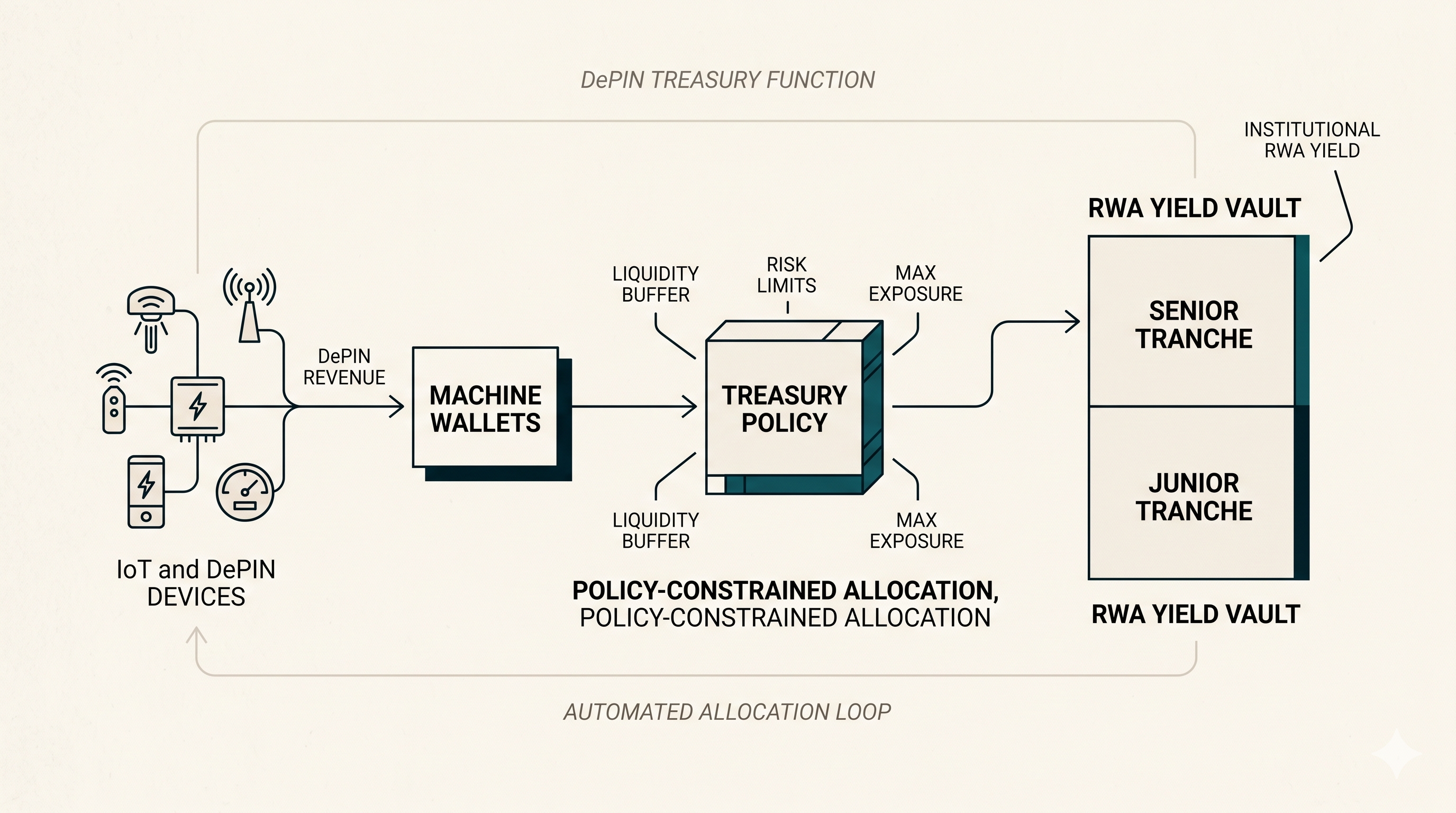
Most DePIN and IoT projects still think about wallets as user-facing access points. A human configures a payout address, and tokens show up when the device or node does its job. But the on-chain reality of 2026 is different: machine wallets are becoming persistent economic actors. They receive revenue, pay for resources, and allocate idle capital — all without a human clicking “confirm” on every transaction.
For these machine-native networks, the question is no longer “how do we pay devices?”, but “how do we turn device revenue into a disciplined treasury strategy?”. DePIN projects that want to survive real-world volatility need more than emissions. They need a way to route surplus cash into institutional-grade RWA yield while still respecting hard policy limits: liquidity buffers, risk caps, and regulatory constraints across jurisdictions.
The rise of agent and machine wallets
By 2026, a meaningful slice of DeFi transactions already comes from agents and automated systems, not humans clicking around in a browser. These agents operate with their own wallets, sign transactions programmatically, and interact with protocols according to pre-defined policies. DePIN fits naturally into this evolution: every node, sensor, or gateway can be modeled as a semi-autonomous on-chain actor with recurring revenue and recurring costs.
In this model, a machine wallet is not just a balance. It is a programmable endpoint in a larger control system. Revenue from physical work flows in. Payments for compute, bandwidth, or maintenance flow out. The gap between those two streams — the free cash flow — is what can be allocated into RWA yield vaults like STRATA’s senior tranche. The challenge is making that allocation verifiable, compliant, and safe-by-design.
Policy-constrained treasury flows for machines
Human treasurers think in policies: “keep three months of runway in cash”, “no more than 20% of treasury in any single protocol”, “only allocate to counterparties with specific risk ratings”. The same logic has to exist for DePIN treasuries, but encoded in a way that machines can execute without improvisation.
A policy-constrained DePIN treasury might look like this: every time a machine wallet’s balance exceeds a threshold, an agent checks current obligations (upcoming payouts, hardware replacement schedules, operating costs) and calculates “excess capital”. A portion of that excess is authorized to flow into a senior RWA tranche with strict loss expectations and transparent risk. The authorization is not a blind approval — it is represented as a short-lived on-chain permission tied to identity, policy, and limits. If the machine tries to allocate beyond those rules, the transaction fails on-chain.
Why RWA senior tranches fit DePIN better than pure DeFi risk
For most DePIN projects, the risky part of the stack is already the core business: building decentralized infrastructure in the physical world. They do not need their treasury to take the same kind of reflexive risk that DeFi-native yield products often require. What they need is boring, explainable, real-world yield that can be justified to partners, regulators, and hardware manufacturers.
This is where RWA senior tranches become attractive. They sit on top of a junior buffer, target more stable returns, and can be backed by familiar asset classes—tokenized credit, Treasuries, or other on-chain RWA primitives. From a DePIN treasury perspective, that means: convert volatile, episodic device income into a smoother yield stream without turning the project into a hedge fund. STRATA’s architecture is explicitly designed for this use case: machines can be restricted to senior exposure only, while human or DAO-governed capital can decide how much risk to take on the junior side.
Identity and accountability for machine decisions
If machines are going to move treasury capital, someone has to own those decisions. That “someone” can no longer be a single human signing every transaction, but it cannot be “no one” either. This is where self-sovereign identity and verifiable credentials meet DePIN.
In STRATA’s model, a machine can present proof that it is an authorized device in a specific network. An operator (or DAO) presents proof that they approved a given allocation policy. A separate credential can encode treasury constraints: maximum exposure per protocol, per asset class, per jurisdiction. The resulting authorization is represented as an on-chain PDA that STRATA validates before moving any capital. The outcome is simple: every automated allocation from a machine wallet into an RWA vault is traceable back to real-world roles, policies, and limits — without turning the system into a centralized black box.
From protocol users to on-chain counterparties
The deeper shift is conceptual. In early DeFi, protocols treated wallets as anonymous users. In the emerging DePIN + RWA world, protocols will increasingly treat machine wallets and agent wallets as on-chain counterparties with identities, responsibilities, and risk profiles. That is a better match for institutional expectations: you are not just farming yield with random addresses; you are offering structured, policy-constrained yield rails for real infrastructure networks.
STRATA’s integration path with DePIN is built around this idea. Machines do not need full access to every feature. They need a narrow, safe interface into senior RWA yield, guarded by identity proofs and strict policies. Humans — operators, treasurers, allocators — define the rules. Machine wallets execute within those boundaries. That is how “machines becoming LPs” stops being a meme and starts becoming a credible treasury primitive for decentralized infrastructure.
If you need help hardening the off-chain side of your crypto project (wallets, backend, domains, or incident response), you can request a security-focused engagement through the Services page or reach out directly via the Contact terminal.