Agentic finance becomes dangerous when autonomy outruns architecture
Why AI agents in trading, treasury, and DeFi need stronger execution boundaries, governance, identity, and operational controls before autonomy can be trusted in production.
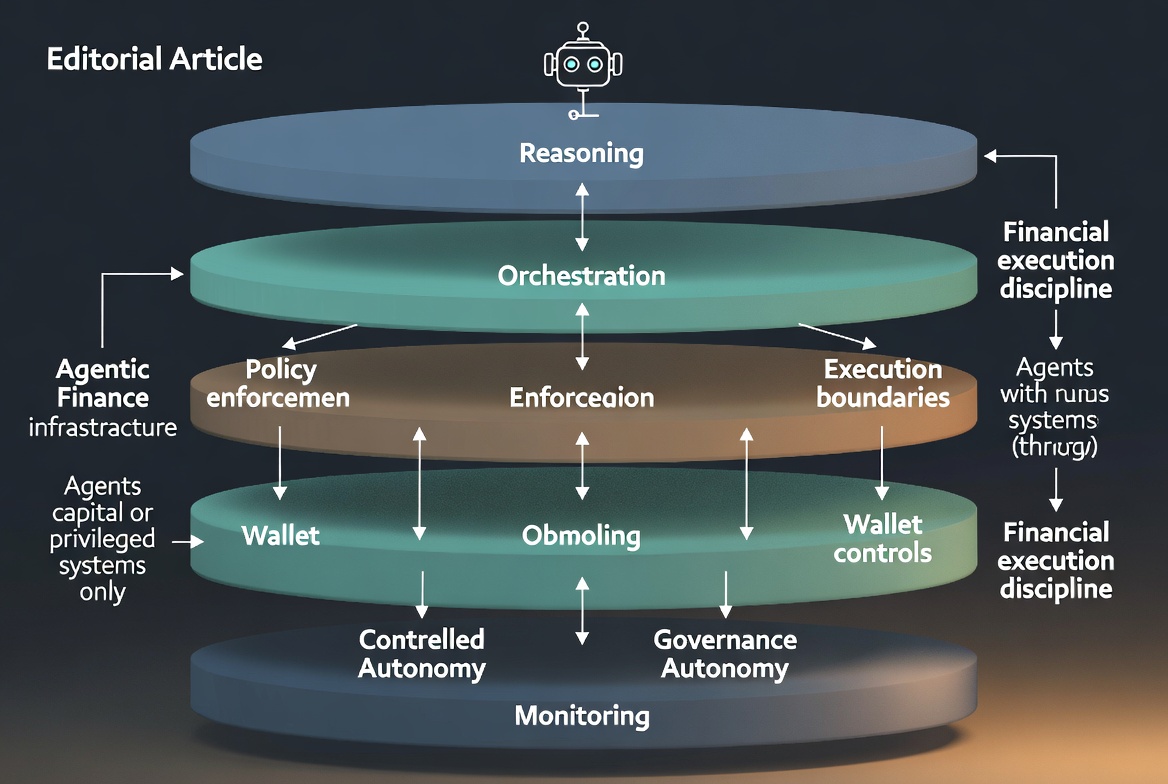
Agentic finance sounds exciting because it promises to move beyond dashboards and simple automation into systems that can perceive data, reason about conditions, and take action on their own. In crypto and trading, that can mean agents screening opportunities, managing treasury positions, rebalancing capital, routing orders, monitoring risk, reacting to market events, or coordinating operational workflows without waiting for a human in the loop.
The promise is real, but so is the danger. The moment an agent gains the ability to move capital, alter platform state, trigger policies, or call production tools, the architecture around that agent matters more than the intelligence inside it. A weak architecture turns autonomy into a faster way to make mistakes. A strong architecture turns autonomy into controlled execution.
Agents should not be treated like smarter bots
A common mistake is to think of agentic systems as ordinary automation with a language model attached. That mindset leads teams to give agents broad access too early. They wire in wallets, exchange APIs, admin tools, treasury actions, or protocol controls before they have designed a stable execution boundary.
That is dangerous because agents are not just scripted workers. They operate through interpretation, tool use, context assembly, and dynamic decision loops. Even when they behave well most of the time, they create different failure modes from deterministic automation. They can make poor choices from incomplete context, misuse tools in unusual combinations, overreact to noisy signals, or pursue an instruction that was locally plausible but globally unsafe. The more authority they hold, the more expensive those errors become.
The real problem is not reasoning, it is permissioned action
People often focus on whether the model is intelligent enough. That is not the first question production teams should ask. The first question is what the system is allowed to do when it believes it is right.
An agent that writes summaries or proposes ideas is relatively safe. An agent that can rebalance stablecoin reserves, route exchange orders, trigger treasury transfers, alter collateral policy, or touch a privileged backend is operating in a completely different risk category. At that point, the challenge is no longer prompt quality by itself. It becomes a matter of execution policy, authority boundaries, approval design, rollback ability, and whether unsafe actions can be meaningfully contained before they become loss.
This is why agentic finance architecture has to begin with permission models instead of feature excitement. Teams need to define which actions are advisory, which are constrained, which require approval, which can be simulated only, and which should never be granted to an agent at all. If that hierarchy is unclear, the system is not autonomous in a disciplined way. It is merely overpowered.
Agents need a control plane, not just a model
One of the clearest differences between hobby demos and serious systems is the presence of orchestration and governance around the agent. Production-grade agentic finance is not just one model making decisions in isolation. It usually needs an orchestration layer, tool routing, memory boundaries, policy enforcement, and monitoring over how the agent behaves.
That matters because the model itself should not be trusted as the full control surface. A better architecture separates reasoning from execution. The agent can analyze, propose, rank, and select, but another layer should decide whether the requested action is allowed, whether prerequisites are satisfied, whether position limits are respected, whether timing is safe, and whether the system should continue, pause, or escalate to a human.
Without this separation, teams accidentally build systems where natural language reasoning and operational authority collapse into one another. That may look fast in a prototype. In production, it becomes a liability because every inference path quietly turns into a power path.
Identity becomes harder when the actor is not human
Traditional financial and operational systems often inherit identity from people. A user logs in, a role is checked, an action is recorded, and accountability follows that human path. Agentic finance complicates that model because the actor is no longer always a person making each decision directly.
As soon as agents begin acting across wallets, exchanges, treasury tools, internal APIs, and protocol interfaces, teams need a stronger answer to a simple question: who is this actor, exactly. Is the agent operating under a narrow task identity. Does it inherit scoped authority from a human owner. Does it hold its own machine identity. Can it prove which action came from which decision loop. Can the organization distinguish one agent's permissions and outputs from another's.
These questions are not academic. They shape logging, approvals, forensics, revoke paths, and liability. If an agent can take action but the system cannot clearly explain under which identity, policy scope, and authority chain that action was performed, the platform is not ready for real autonomy.
Finance-grade autonomy requires stronger guardrails than generic automation
The more capital-sensitive the workflow becomes, the more the architecture has to narrow the blast radius of bad decisions. This is especially true in crypto, where transactions can be fast, final, and difficult to unwind.
That means agentic systems should be built with guardrails that are financial, not just technical. Position limits, slippage controls, venue allowlists, treasury exposure caps, policy-aware rate limits, dry-run modes, simulation gates, escalation thresholds, and strong post-action monitoring all matter. The point is not to make agents powerless. The point is to ensure they can only exercise power within conditions the platform can survive.
A useful mental model is that the agent should not be trusted with raw freedom. It should be trusted to operate inside a constrained execution box. Within that box, it may still provide real value. Outside that box, the cost of autonomy tends to rise faster than the quality of its judgment.
Multi-agent systems multiply coordination risk
Some of the most ambitious designs use multiple agents rather than one: a supervisor, one or more specialists, market or research agents, execution agents, monitoring agents, compliance agents, and reporting agents. This can improve separation of concerns, but it also creates a second layer of risk.
Once agents coordinate with one another, the system no longer fails only through one bad decision. It can fail through misunderstood handoffs, recursive loops, stale context being passed forward, inconsistent tool assumptions, or one agent amplifying another's error. What looked like specialization can become distributed confusion if the orchestration layer is weak.
That is why multi-agent finance systems need explicit task boundaries, message semantics, policy checkpoints, and observability over agent-to-agent coordination. The platform should be able to answer who proposed an action, who approved it, which tools were called, which limits were checked, and how the final execution path was assembled. Without that visibility, multi-agent systems become harder to trust precisely when they become more powerful.
The wallet should be the last thing an agent touches directly
In crypto environments, the most dangerous shortcut is often the fastest one: giving the agent direct wallet or transaction authority too early.
That shortcut is tempting because it makes the system feel truly autonomous. But it collapses too many responsibilities into one layer. The same component that interprets context, chooses tools, and reasons under uncertainty suddenly also controls signing or capital movement. In mature systems, those concerns should be separated as much as possible.
A safer pattern is to treat wallet execution as a downstream privilege layer with strict constraints. The agent can propose an action, construct an intent, or request a transaction path, but a separate execution control layer should evaluate limits, simulate results, enforce policy, and determine whether the action can actually proceed. This keeps capital movement attached to infrastructure discipline rather than model enthusiasm.
Observability and rollback define whether autonomy is survivable
Many teams obsess over whether an agent can act intelligently, but they spend too little time on whether the platform can observe and reverse the consequences of wrong action quickly enough.
That is a major mistake. In real financial systems, survivability matters at least as much as capability. Teams need to know what the agent saw, what it concluded, which context it used, what tool calls it made, what constraints were checked, what the output was, and what happened after the action landed. They also need to know which actions can be rolled back, which cannot, and how the system should degrade if the agent begins acting outside normal bounds.
A production-ready agent is not simply one that can decide. It is one that can be watched, constrained, paused, audited, and narrowed without chaos. If a team cannot reconstruct the full path from context to action, then the system is not yet autonomous in a safe sense. It is only powerful in an uncontrolled sense.
According to the OWASP Top 10 for LLM Applications, excessive agency and insufficient output validation are among the most common ways autonomous AI systems cause real-world damage.
Autonomy is earned through architecture
The strongest agentic finance systems will not be the ones with the boldest demos. They will be the ones whose architecture makes autonomy proportionate to trust.
That means clean execution boundaries, layered permissions, narrow identities, strong policy enforcement, observable reasoning paths, controlled tool access, approval-aware action design, and rollback strategies that assume the agent will eventually be wrong in a consequential way. This does not make agentic systems less useful. It makes them survivable.
In finance and crypto, autonomy should never be understood as raw freedom. It should be understood as controlled authority operating inside a system built to absorb mistakes. The intelligence matters, but the architecture decides whether that intelligence becomes leverage or liability.
Knowledge Base / FAQ
Frequently Asked Questions
Is it safe to give an AI agent direct access to a trading wallet?
No. Direct wallet access should be treated as a last-resort privilege, not a default. A safer pattern separates reasoning from execution, so the agent proposes actions while a constrained policy layer decides whether they can actually be signed and sent.
What is the biggest architectural risk in agentic finance systems?
The biggest risk is collapsing reasoning and execution authority into a single layer. When the same component that interprets context also controls capital movement, every inference mistake becomes a financial event instead of a contained error.
Why do multi-agent systems need stronger observability than single-agent systems?
Because failures can come from coordination, not just individual decisions. Misunderstood handoffs, stale context, or one agent amplifying another's error can produce losses even when each agent behaves reasonably in isolation.
How does identity work when the actor is an AI agent instead of a person?
Production systems need a clear answer for which identity an agent acts under, whether that identity is scoped from a human owner, and how each action can be traced back to a specific decision loop. Without this, accountability and rollback become very difficult.
Can Zanvexis help design guardrails for autonomous trading or treasury agents?
Yes. Zanvexis can help design execution boundaries, wallet controls, orchestration layers, and policy enforcement for agentic finance systems so autonomy stays proportionate to the trust the platform can actually survive.
If you need help designing or hardening agentic finance infrastructure (execution boundaries, wallet controls, orchestration, policy enforcement, or autonomous trading and treasury systems), you can request a high-performance infrastructure engagement through the Services page or reach out directly via the Contact terminal.
Need help building secure technology?
Explore how Zanvexis helps teams build secure software, blockchain systems, intelligent platforms, and high-performance infrastructure.
Explore all services →Continue reading
Related articles
Trading infrastructure stops being resilient the moment incident response depends on heroics instead of architecture
Why serious trading platforms need incident response and operational resilience designed into architecture, tooling, and governance instead of relying on ad hoc fixes and individual effort during outages.
Crypto custody stops being security and becomes counterparty exposure when architecture depends on people behaving well
Why institutional-grade crypto custody has to enforce separation of duties, destination controls, cryptographic dual control, and operating model discipline in architecture instead of trusting operator conduct.
Trading bots become brittle when architecture pretends every market is the same
Why serious trading bot infrastructure needs clear separation between exchange adapters, strategy logic, execution paths, risk controls, and observability instead of one-size-fits-all bots.