Why crypto teams need security policies before they need more features
Why early security policies, access controls, incident procedures, and operational discipline matter more than shipping one more feature.
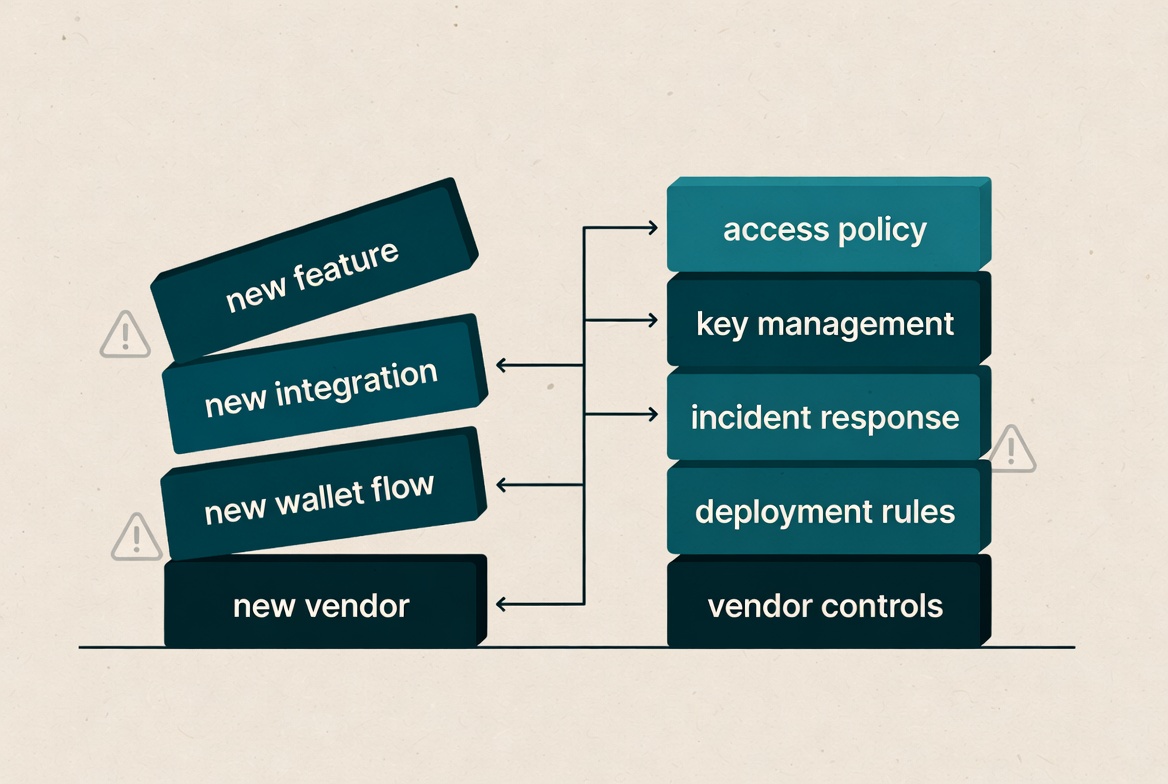
Most crypto teams think they need more features before they need more process. That instinct is understandable, especially in the early stage. Shipping feels like survival. Policies feel like overhead. But once a project touches real users, real funds, or real counterparties, the absence of security policy stops being a speed advantage and starts becoming a structural risk.
Security policy does not mean bureaucracy for its own sake. It means writing down how the company protects credentials, approves sensitive actions, controls production access, responds to incidents, manages vendors, and separates risky operations from critical systems. In crypto, where one bad transaction or one leaked signer can become irreversible loss, undocumented behavior is not agility. It is hidden fragility.
Features scale exposure faster than teams realize
Every new feature adds more than code. It adds new permissions, new flows, new assumptions, new integrations, and often new people who need access to something important. Without policy, those changes accumulate in a chaotic way. A team keeps moving fast, but no one can clearly answer who has access to what, what approvals are required, or what should happen if something breaks.
That is the problem with waiting “until later” to formalize security. Later usually arrives after the system is already more complex, more valuable, and harder to govern. At that point, fixing the problem means untangling access, rewriting processes, rotating secrets, and discovering trust paths that were never intentionally designed.
Policy is how a company turns good intentions into repeatable behavior
A lot of teams believe they are secure because the core people are careful. That works only while the system remains tiny and fully personal. As soon as the team grows, contractors join, wallets multiply, vendors are added, and infrastructure becomes layered, careful people are not enough. The company needs repeatable behavior.
That is what policies are for. A password policy is not about sounding corporate. It is about making weak credential practices unacceptable by default. An access control policy is not about paperwork. It is about making privilege boundaries visible. An incident response policy is not about preparing for drama. It is about making sure the team does not improvise when seconds matter.
The minimum security policies most crypto teams should already have
Even small crypto teams benefit from a lightweight but real policy baseline.
At minimum, that usually means:
- access control and least-privilege policy,
- wallet and key management policy,
- secrets and environment handling policy,
- device and MFA policy,
- vendor and third-party access policy,
- incident response and escalation policy,
- deployment and production change policy.
None of these need to start as a 40-page manual. A small, clear, enforced document is far better than a perfect policy that never gets written. The important thing is that the team knows what the rules are before an exception becomes a breach.
Security policy is now part of compliance reality
By 2026, crypto infrastructure is operating in a much tighter compliance environment across major jurisdictions. That means security and operational discipline are no longer just internal quality signals. They increasingly affect whether a company can work with institutional partners, custody providers, banks, auditors, and serious allocators.
According to established security frameworks like ISO/IEC 27001 and SOC 2 Trust Services Criteria, formal governance, access controls, and documented incident procedures are foundational requirements for operating securely. In practice, that means founders cannot treat security policy as something to add only after product-market fit. Institutional counterparties increasingly want evidence of governance, controls, monitoring, and incident readiness. A protocol may have impressive code and still fail diligence because its operational controls are immature.
Policies reduce founder dependency
One of the hidden benefits of policy is that it reduces dependence on founder memory. Without policy, the company’s security model lives inside a few people’s heads: who can deploy, who can approve treasury movements, how emergency actions work, which vendors are trusted, and what to do when a wallet or domain is compromised.
That model does not scale well. It creates operational bottlenecks and silent single points of failure. Policies externalize those rules. They make the company less dependent on one founder being awake, available, and remembering every edge case correctly under pressure.
Policy is a speed tool when things go wrong
Teams often think policy slows them down. In reality, bad or missing policy only feels faster on normal days. When something goes wrong, policy is what gives the team speed.
A team with clear incident rules knows who responds first, what systems get isolated, which keys must be rotated, how users are notified, and how evidence is preserved. A team without that clarity loses time debating basic questions while the situation gets worse. In crypto, that delay can be the difference between a contained incident and a public loss event.
The right order of operations
The right way to scale a crypto company is not “ship fast now, govern later”. It is “ship with enough structure that growth does not quietly multiply unowned risk”. Features attract users. Policies protect the company that serves them.
That is why serious crypto teams need security policies before they need more features. Not because policy is glamorous, but because without it, every new feature expands an attack surface the company is not truly managing yet.
Knowledge Base / FAQ
Frequently Asked Questions
Why do crypto startups often neglect security policies in favor of feature releases?
Startups prioritize speed to market and shipping features to attract early users, often misinterpreting security policies as corporate bureaucracy rather than necessary operational risk management.
What are the essential baseline security policies every crypto team needs?
At minimum, crypto teams should enforce policies for access control/least privilege, wallet & key management, secrets handling, MFA & device security, vendor risk, deployment controls, and incident response.
How do security policies reduce founder dependency in crypto projects?
Security policies externalize crucial operational rules—such as deployment permissions and emergency key rotations—preventing institutional bottlenecks and removing single points of failure tied to founder memory.
Why are institutional investors requiring formal security policies before allocating capital?
Institutional partners and auditors require proof of operational governance, least privilege access, and rehearsed incident response to ensure assets are protected against insider threats, supply chain attacks, and operational chaos.
Can Zanvexis assist in drafting and implementing security policy frameworks for Web3 startups?
Yes. Zanvexis helps Web3 protocols design lightweight, institutional-grade security policy baselines, access control frameworks, secret management pipelines, and incident response playbooks.
If you need help hardening the off-chain side of your crypto project (wallets, backend, domains, or incident response), you can request a security-focused engagement through the Services page or reach out directly via the Contact terminal.
Need help building secure technology?
Explore how Zanvexis helps teams build secure software, blockchain systems, intelligent platforms, and high-performance infrastructure.
Explore all services →Continue reading
Related articles
Trading infrastructure stops being resilient the moment incident response depends on heroics instead of architecture
Why serious trading platforms need incident response and operational resilience designed into architecture, tooling, and governance instead of relying on ad hoc fixes and individual effort during outages.
Crypto custody stops being security and becomes counterparty exposure when architecture depends on people behaving well
Why institutional-grade crypto custody has to enforce separation of duties, destination controls, cryptographic dual control, and operating model discipline in architecture instead of trusting operator conduct.
Trading bots become brittle when architecture pretends every market is the same
Why serious trading bot infrastructure needs clear separation between exchange adapters, strategy logic, execution paths, risk controls, and observability instead of one-size-fits-all bots.