Three rules for not wrecking your Go platform when you add AI agents
A short, opinionated checklist for plugging AI agents into a Go-based fintech or crypto stack without losing control.
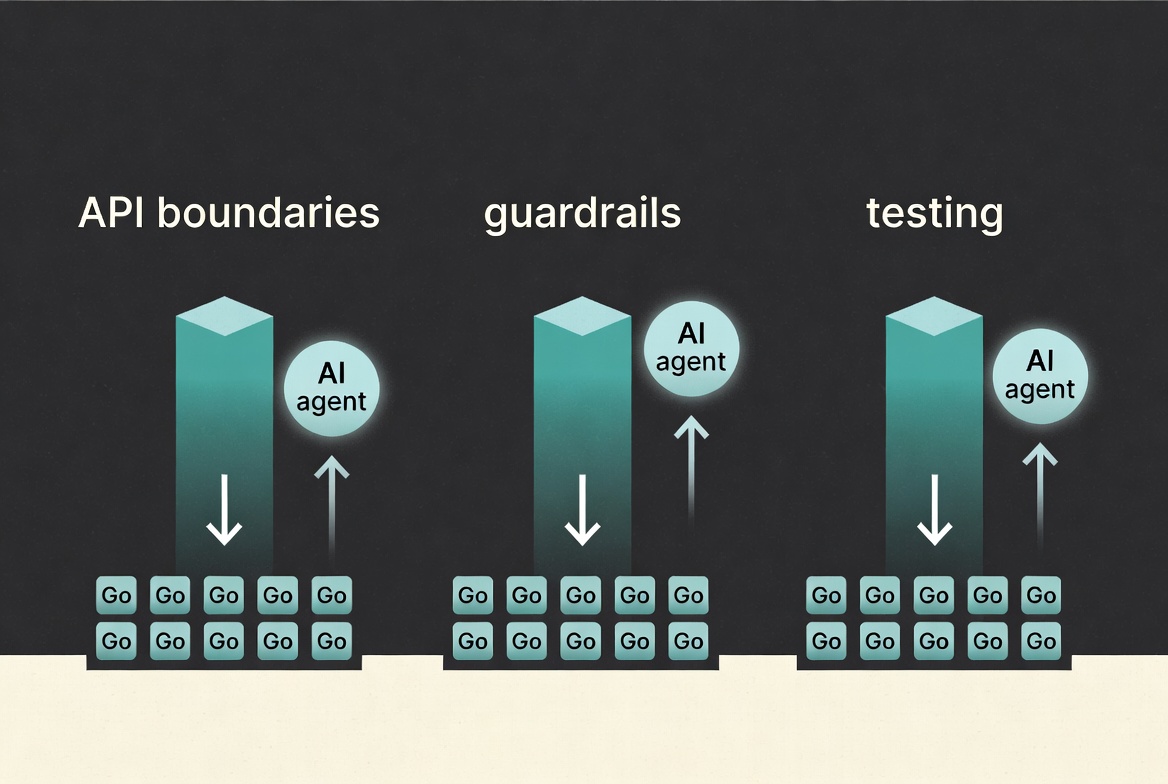
Everyone wants to add AI agents to an existing Go stack and let them take actions. That part is easy. The hard part is doing it without turning a stable platform into an unpredictable one. The safest mindset is simple: the agents are the experimental layer, while the Go infrastructure underneath is still the part users, operators, and auditors have to trust.
Rule 1: Agents should never bypass your APIs
If an AI agent can do something that a normal client cannot do through the platform, the architecture is already drifting in the wrong direction. Agents should use the same Go services through the same REST or gRPC interfaces, with the same authentication, rate limits, validation rules, and operational boundaries that apply to every other caller.
A good pattern is to expose a narrow set of agent-facing capabilities such as simulate, propose, request approval, or submit for execution. The agent chooses which action to request, but the backend still owns validation, execution semantics, and logging. That keeps the agent inside a controlled contract instead of letting it improvise directly against databases, raw wallets, or internal-only systems.
Rule 2: Guardrails belong in infrastructure, not in prompts
A prompt is not a control system. In a financial or crypto environment, real guardrails live in deterministic infrastructure: policy engines, approval workflows, spending limits, identity boundaries, and risk checks. According to the OWASP Top 10 for LLM Applications, relying solely on prompt instructions creates critical vulnerabilities such as prompt injection and excessive agency. Those controls should exist in code and services that can be versioned, tested, monitored, and audited over time.
The clean operating model is this: the agent suggests, the platform decides. The model can propose a transfer, a rebalance, or a support action, but the Go services still enforce the real rules. If the model behaves badly, hallucinates, or misreads context, the infrastructure should be able to reject the action cleanly and consistently without depending on the model to “be careful.”
Rule 3: Test agents in realistic sandboxes before production
An agent that worked in a demo is not ready for production. Before it touches anything irreversible, it should spend time in a sandbox that mirrors the real platform closely: same APIs, same contracts, same error shapes, same timing issues, and similar workflow complexity.
The point is not only to see whether the agent succeeds. It is to see how it fails. You want to observe how it reacts to denials, partial outages, stale information, retries, malformed upstream responses, and edge cases in workflow state. A disciplined rollout starts with shadow mode, then limited execution in narrow scopes, and only later expands into higher-trust actions.
Why this matters
AI agents become dangerous when they are treated like magic instead of software. The more autonomy they get, the more important it becomes to keep the surrounding platform boring, explicit, and constrained.
That is why Go still makes sense underneath all the AI excitement. Models can reason, classify, and propose. Go services can enforce, log, reconcile, and keep the platform understandable when something goes wrong. The winning setup is not “AI everywhere.” It is AI sitting on top of infrastructure that still knows how to say no.
Knowledge Base / FAQ
Frequently Asked Questions
Why should AI agents interact with Go backends through standard REST/gRPC APIs?
Routing agents through standard API endpoints guarantees that all actions undergo the same authentication, rate limiting, validation rules, and audit logging as human users, preventing agents from acquiring unmonitored backdoors to database layers or key stores.
Why are system prompts insufficient as primary security guardrails for AI agents?
System prompts are non-deterministic and susceptible to prompt injection, hallucination, and context drift. Real financial and operational guardrails must be enforced deterministically in Go backend code, policy engines, and database constraints.
How does a Go backend maintain control over agentic execution?
By implementing a "propose and validate" pattern: AI agents issue intent proposals (e.g., rebalance, transfer), while Go services independently verify authorization, spending limits, risk policies, and state consistency before executing transactions.
What constitutes a realistic sandbox environment for testing AI agents?
A realistic sandbox mirrors production APIs, contract specifications, rate limits, error states, and latency characteristics, allowing developers to observe how agents handle edge cases, API denials, and partial infrastructure outages without risk.
Can Zanvexis help integrate autonomous AI agents safely into Go platforms?
Yes. Zanvexis specializes in engineering high-performance Go backends, sandboxed AI agent runtime environments, deterministic policy engines, and secure API gateways for fintech and Web3 platforms.
If you need help hardening your Go infrastructure or integrating AI agents safely (API controls, deterministic guardrails, sandboxing, or audit logging), you can request a high-performance infrastructure engagement through the Services page or reach out directly via the Contact terminal.
Need help building secure technology?
Explore how Zanvexis helps teams build secure software, blockchain systems, intelligent platforms, and high-performance infrastructure.
Explore all services →Continue reading
Related articles
Trading infrastructure stops being resilient the moment incident response depends on heroics instead of architecture
Why serious trading platforms need incident response and operational resilience designed into architecture, tooling, and governance instead of relying on ad hoc fixes and individual effort during outages.
Crypto custody stops being security and becomes counterparty exposure when architecture depends on people behaving well
Why institutional-grade crypto custody has to enforce separation of duties, destination controls, cryptographic dual control, and operating model discipline in architecture instead of trusting operator conduct.
Trading bots become brittle when architecture pretends every market is the same
Why serious trading bot infrastructure needs clear separation between exchange adapters, strategy logic, execution paths, risk controls, and observability instead of one-size-fits-all bots.