Go for risk and limits services in crypto platforms
Why it makes sense to implement real-time risk and limits services in Go for serious crypto and trading platforms.
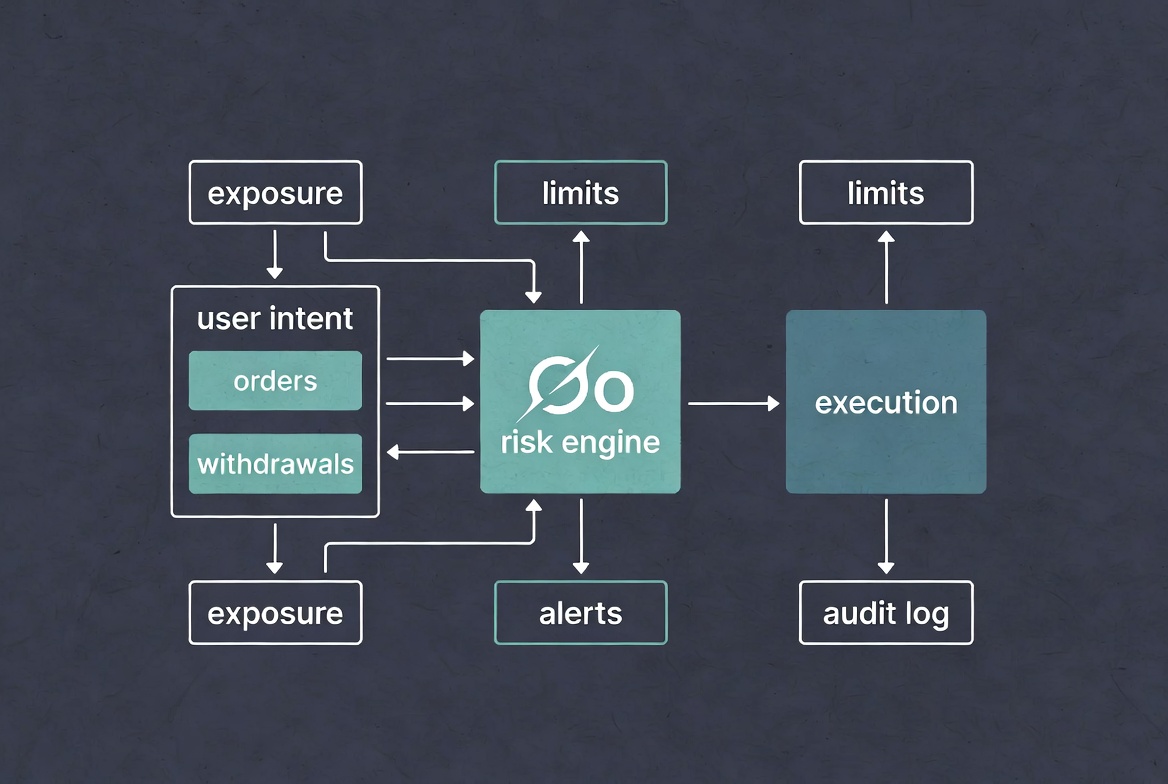
Most crypto platforms eventually discover that “risk” is not just a page in the UI or a few stop-loss rules. It is a set of always-on services that sit between intent and execution: checking positions, enforcing limits, monitoring flows, and making sure the system behaves in a way regulators and users can live with. In a modern stack, those services look a lot more like backend infrastructure than like one-off scripts.
Go is a pragmatic choice for this layer. It is already a default language for high-throughput backend microservices in fintech, particularly where many concurrent requests need to be processed with predictable latency and operational simplicity. For risk and limits in crypto, that combination is exactly what you want: fast enough to keep up with the flow, simple enough to be trusted and operated over time.
Risk and limits need their own services, not just flags
In trading and crypto, “risk management” usually includes several concerns at once: per-account limits, exposure controls, leverage rules, PnL thresholds, velocity limits, withdrawal protections, and often AML and fraud checks on top. Trying to treat all of this as business logic sprinkled through a monolithic API is a recipe for inconsistency and blind spots.
A more robust approach is to treat risk and limits as first-class services: dedicated Go services that accept well-defined inputs (orders, withdrawals, transfers, parameter changes) and respond with clear decisions and reasons. That design makes it easier to keep logic consistent across products, to audit decisions, and to evolve rules without rewriting half the platform.
Go is a good fit for real-time checks
Risk systems typically sit on the hot path between user intent and execution. When a user sends an order or a withdrawal request, the platform does not have the luxury of spending seconds deciding what to do; the decision has to be made quickly and deterministically. At the same time, the risk engine needs to consider multiple dimensions: current exposure, recent activity, configured limits, and sometimes external signals.
Go’s concurrency model and performance profile are well suited to this scenario. A risk service can maintain in-memory views of positions and limits, respond to a high volume of requests, and update its state as events stream in, without sacrificing the operational simplicity of static binaries and straightforward deployments. That means teams can treat it like any other well-behaved backend service instead of a fragile special case.
Microservices make risk boundaries explicit
When risk and limits logic lives inside a monolith, it often becomes intertwined with UI decisions, product experiments, and routing rules. Over time, it becomes harder to answer basic questions: Which service enforces which limit? How many paths bypass this check? What happens when a new product launches?
Go is already heavily used for microservices in cloud-native architectures, making it natural to carve risk and limits into distinct services with explicit responsibilities. For example, one service can handle trading exposure, another can handle withdrawal and funding limits, and a third can monitor behavioral or AML-like signals. Each has its own contract, tests, and observability, which makes both engineering and compliance conversations much clearer.
Observability and auditability are part of risk
Risk systems are not just about making decisions. They are about being able to explain those decisions later. When a limit blocks an order or a withdrawal, support teams, risk analysts, and sometimes regulators will want to know why. That requires structured logging, metrics, traces, and often an event trail that can be reconstructed after the fact.
Go’s ecosystem has solid building blocks for observability and structured logging in microservice environments, which makes it easier to build risk services that emit the right signals by default. When every decision comes with metadata — which rule fired, which thresholds applied, which inputs were considered — the system becomes much more trustworthy, even under scrutiny.
Limits are not only about stopping users
The popular image of “limits” is mostly punitive: blocking trades, rejecting withdrawals, or shutting down accounts. In practice, well-designed limit systems do more subtle work: shaping behavior, nudging users towards safer patterns, and enforcing product constraints in ways that keep both users and the platform within acceptable risk.
Go-based risk and limits services can support that nuance by exposing clear APIs for soft and hard checks, per-user configurations, temporary overrides, and scheduled cool-off behavior. That allows product teams to build experiences where users can see and understand their own constraints instead of being surprised by opaque rejections.
Why Go makes sense specifically for crypto risk
Crypto platforms face a mix of trading risk, operational risk, fraud/AML risk, and regulatory expectations that are converging rapidly towards traditional financial standards. Regulatory frameworks, such as SEC Rule 15c3-5 or CFTC pre-trade risk guidelines, mandate automated pre-trade screening and system safeguards. At the same time, the underlying infrastructure is more fragmented: multiple chains, venues, and products, with a faster pace of change than most legacy systems had to deal with.
Go is well aligned with that environment because it already underpins much of the cloud-native tooling that crypto teams use, from Kubernetes to various orchestrators and monitoring stacks. Building risk and limits services in the same ecosystem makes integration, deployment, and operations more straightforward, while still leaving room for other languages where they make sense.
Knowledge Base / FAQ
Frequently Asked Questions
Why should risk and limits management be isolated into dedicated Go services?
Isolating risk management into standalone Go microservices prevents critical validation logic from getting entangled with frontend UIs or monolithic API flows. This ensures uniform limit enforcement across all products, simplifies auditing, and allows independent scaling.
How does Go achieve sub-millisecond execution for pre-trade risk checks?
Go maintains in-memory position state and limit snapshots using fast concurrency primitives (goroutines and sync packages). This allows pre-trade checks—such as order size bounds, account leverage, and velocity checks—to evaluate in sub-milliseconds before order routing.
What is the difference between soft checks and hard limits in risk backends?
Hard limits deterministically reject transactions that breach critical parameters (e.g., maximum drawdown or daily withdrawal caps). Soft checks provide warnings, nudge user behavior, or trigger temporary cooling-off periods without abruptly blocking account operations.
Why is structured audit logging crucial for Web3 risk engines?
Structured audit logging attaches contextual metadata (rule IDs, threshold values, user state at evaluation) to every decision. This provides an immutable audit trail necessary for regulatory compliance, post-incident investigations, and risk model refinement.
Can Zanvexis help build custom Go risk engines and pre-trade limit controllers?
Yes. Zanvexis engineers real-time Go risk engines, pre-trade limit controllers, automated withdrawal guardrails, and compliance-ready audit pipelines for crypto exchanges and institutional fintech platforms.
If you need help designing or hardening the risk and limits layer of your trading or crypto platform — from Go-based exposure services to withdrawal controls and incident-ready audit trails — you can request a security-focused engagement through the Services page or reach out directly via the Contact terminal.
Need help building secure technology?
Explore how Zanvexis helps teams build secure software, blockchain systems, intelligent platforms, and high-performance infrastructure.
Explore all services →Continue reading
Related articles
Trading infrastructure stops being resilient the moment incident response depends on heroics instead of architecture
Why serious trading platforms need incident response and operational resilience designed into architecture, tooling, and governance instead of relying on ad hoc fixes and individual effort during outages.
Crypto custody stops being security and becomes counterparty exposure when architecture depends on people behaving well
Why institutional-grade crypto custody has to enforce separation of duties, destination controls, cryptographic dual control, and operating model discipline in architecture instead of trusting operator conduct.
Trading bots become brittle when architecture pretends every market is the same
Why serious trading bot infrastructure needs clear separation between exchange adapters, strategy logic, execution paths, risk controls, and observability instead of one-size-fits-all bots.