Rust is not just safer C++ — it changes what teams can trust in production
Why Rust is more than a safer systems language, and how its guarantees change what engineering teams can realistically trust in production.
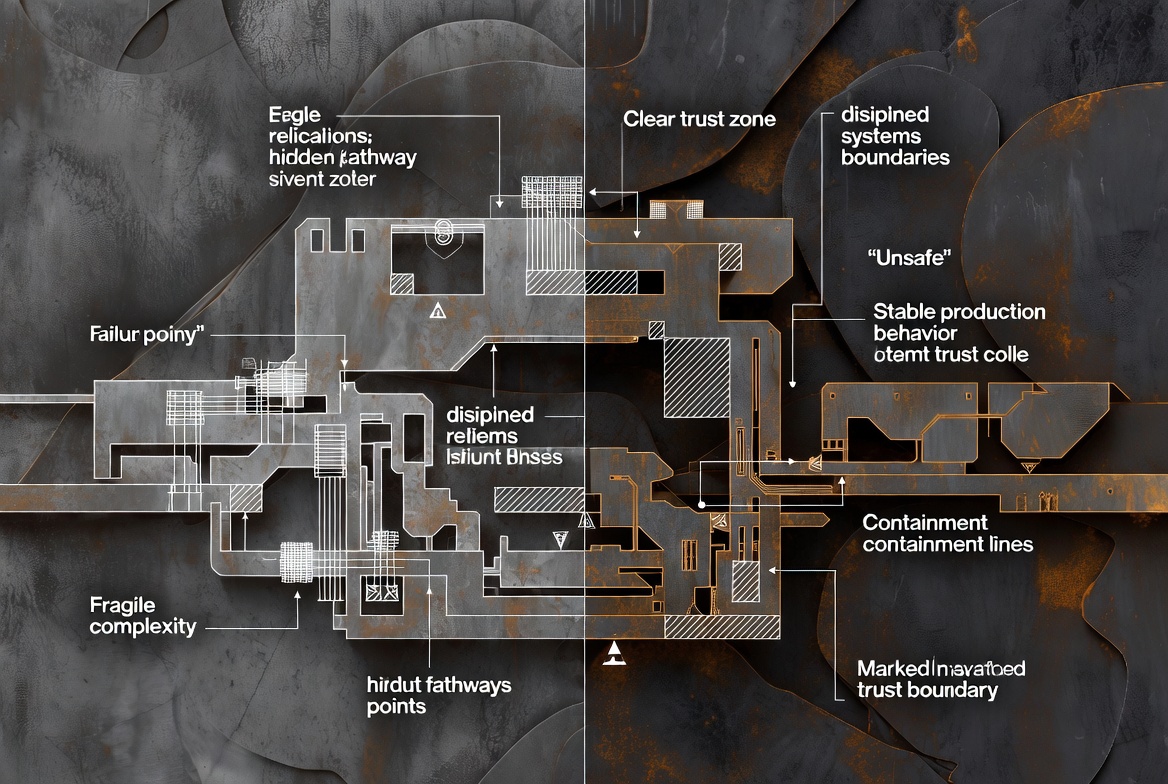
A lot of comparisons between Rust and C++ stop at a simple claim: Rust is safer. That is true, but it is also incomplete. The more interesting difference is not only that Rust reduces certain classes of bugs. It is that Rust changes what teams can realistically trust about their software once it reaches production.
That distinction matters. In production systems, trust is never abstract. Teams need to trust that memory is handled correctly, that concurrent behavior will not collapse under load, that APIs reflect real ownership boundaries, and that dangerous low-level failures are less likely to survive all the way into runtime. Rust changes that trust model by moving more guarantees into compile time and making unsafe boundaries easier to identify.
C++ gives power; Rust gives constrained power
C++ remains one of the most powerful languages ever built for high-performance systems. It gives engineers deep control over memory, layout, abstraction, and hardware-near behavior. In the hands of a disciplined team, it can produce exceptional software.
But C++ often relies on discipline where Rust relies more on enforcement. That difference is not just philosophical. It affects operational confidence. A C++ team may know that its patterns are safe if everyone follows them correctly. A Rust team can often rely on the compiler to reject many unsafe patterns before they ever ship. That changes the baseline level of trust the organization can place in the code.
Production trust is about what fails silently
The real danger in systems software is not only visible failure. It is silent failure: memory corruption, undefined behavior, race conditions, and edge cases that remain latent until the worst possible moment. These are the kinds of problems that can survive code review, hide behind correct-looking behavior, and surface only under stress.
Rust reduces that risk by making many dangerous behaviors much harder to express in safe code. Ownership, borrowing, and type-driven guarantees do not make the software perfect, but they do make certain silent failure paths less available by default. That matters a lot in production, where the cost of a hidden low-level bug is often much higher than the cost of extra friction during development.
Compile-time guarantees change team behavior
One of the deepest production advantages of Rust is cultural. When the compiler enforces stronger guarantees, teams start to build differently. They define clearer ownership, write narrower interfaces, think more carefully about mutation, and become more explicit about where trust boundaries actually are.
This has operational effects. Code reviews become more focused on business logic and architecture instead of repeatedly catching the same classes of memory-risk mistakes. Testing can concentrate more on system behavior because some categories of low-level failure have already been aggressively filtered. Production confidence increases not because the team became magically smarter, but because the language changed the default quality of what gets through.
Unsafe code becomes a visible trust boundary
One of Rust’s strongest ideas is that unsafe code is not hidden. It is marked. That makes a practical difference in production engineering.
In many ecosystems, dangerous low-level operations are mixed into ordinary code without a sharp visible boundary. Rust separates them. Safe Rust carries compiler-enforced guarantees. unsafe Rust is the place where developers assert extra responsibility and must manually uphold invariants the compiler cannot prove. This does not eliminate risk, but it localizes it. Teams can review, test, and reason about those trust boundaries much more directly.
This changes how systems age
A lot of production risk emerges over time rather than at launch. Teams grow, original authors leave, shortcuts accumulate, and pressure builds around delivery speed. Code that once felt manageable becomes harder to reason about because too many assumptions were left informal.
Rust helps here because it encodes more of the system’s discipline into the codebase itself. Ownership rules, explicit lifetimes, tighter interfaces, and visible unsafe boundaries make it harder for a system to silently decay into something nobody fully understands anymore. That does not remove complexity, but it slows the rate at which hidden fragility accumulates.
Rust does not remove the need for engineering judgment
None of this means Rust solves architecture, business logic, observability, product risk, or operational mistakes. A badly designed system can still be badly designed in Rust. Teams can still make poor assumptions, misuse abstractions, or ship logic that is safe at the memory level but wrong at the system level.
But this is exactly why the distinction matters: Rust improves what teams can trust at the systems layer, which leaves more engineering attention available for the harder problems above it. Instead of constantly defending against the same low-level fragility, teams can spend more energy on correctness, resilience, and product behavior.
The real takeaway
Rust is not just safer C++. It changes the production contract between engineers and their software. It lets teams trust more of the low-level behavior by default, localize the places where trust becomes manual, and reduce the number of silent failure modes that historically made systems programming so expensive to maintain.
That is why Rust matters beyond language preference. It does not just offer another way to write fast software. It changes what organizations can reasonably expect from the software they run when the stakes are real.
Knowledge Base / FAQ
Frequently Asked Questions
Why is Rust considered more than just a safer version of C++?
Beyond memory safety, Rust changes the operational trust model by shifting invariant verification from human discipline during code review to compile-time enforcement, drastically reducing silent runtime failure modes.
How does Rust's approach to memory safety differ from C++ in production?
C++ relies heavily on developer discipline and post-hoc runtime sanitizers, whereas Rust uses static ownership and borrowing semantics enforced by the compiler before binaries reach production.
What role does the explicit unsafe keyword play in system reliability?
Unsafe isolates operations that the compiler cannot verify into explicit, reviewable blocks. This localizes potential memory risks rather than scattering implicit pointer risks across the codebase.
How do Rust's compile-time guarantees impact software maintenance over time?
Rust encodes architectural assumptions and ownership rules directly into the type system, mitigating code decay, simplifying refactoring, and lowering onboarding risk as engineering teams grow.
Can Zanvexis help modernize legacy systems or engineer mission-critical Rust infrastructure?
Yes. Zanvexis specializes in designing high-throughput Rust architectures, auditing memory and concurrency safety boundaries, and building mission-critical production systems.
If you need help building, optimizing, or auditing mission-critical Rust systems and high-throughput infrastructure, you can request an engineering engagement through the Services page or reach out directly via the Contact terminal.
Need help building secure technology?
Explore how Zanvexis helps teams build secure software, blockchain systems, intelligent platforms, and high-performance infrastructure.
Explore all services →Continue reading
Related articles
Trading infrastructure stops being resilient the moment incident response depends on heroics instead of architecture
Why serious trading platforms need incident response and operational resilience designed into architecture, tooling, and governance instead of relying on ad hoc fixes and individual effort during outages.
Crypto custody stops being security and becomes counterparty exposure when architecture depends on people behaving well
Why institutional-grade crypto custody has to enforce separation of duties, destination controls, cryptographic dual control, and operating model discipline in architecture instead of trusting operator conduct.
Trading bots become brittle when architecture pretends every market is the same
Why serious trading bot infrastructure needs clear separation between exchange adapters, strategy logic, execution paths, risk controls, and observability instead of one-size-fits-all bots.