The trust problem every RWA protocol ignores
Why self-sovereign identity in DeFi is the missing piece for institutional-ready RWA yield protocols.
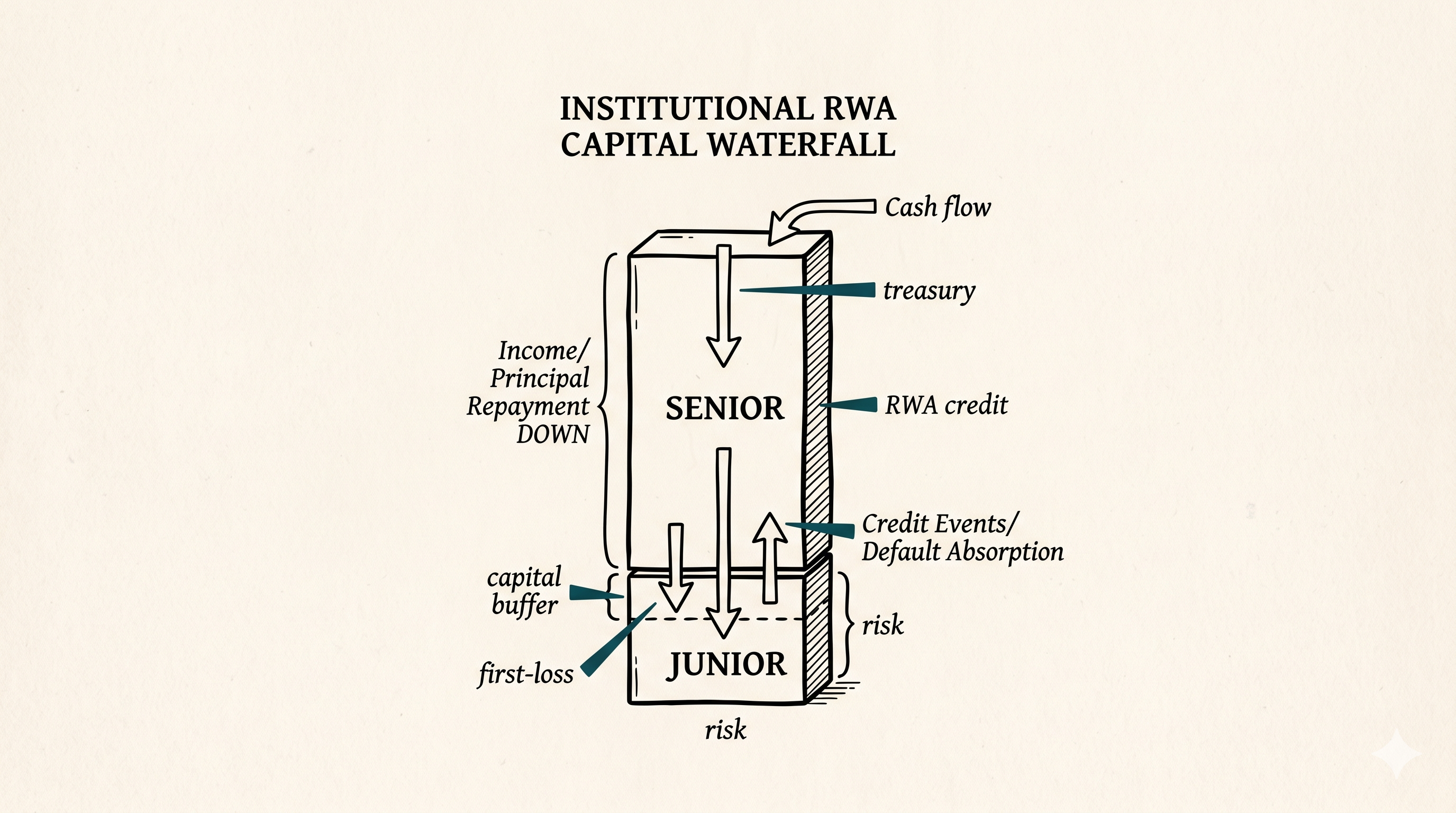
Most conversations about RWA in DeFi focus on yields, TVL, and growth narratives. Almost nobody talks about the problem that actually blocks institutional capital: trust. Not vague, social trust — but the ability to prove who is interacting, what risk each participant has accepted, and where every unit of yield came from.
Smart contracts execute rules. They guarantee that the code runs exactly as written. But they do not answer the questions that matter for serious money: who controls this wallet? Has this participant passed KYC? Is this user legally allowed to access this product in their jurisdiction? Has this person explicitly accepted first-loss exposure before entering a position that can wipe their capital? Who injected this yield, and which real-world event produced that revenue?
Most RWA protocols in DeFi handle this the same way Web3 has handled compliance so far: they don’t. Any wallet can interact. Trust is assumed off-chain. Regulatory control lives in a centralized database that neither users nor the market can actually audit.
STRATA was designed from day one for a different world: vaults isolated in Program Derived Addresses (PDAs), immutable tranche waterfall, checked math throughout. That solves half of the problem: the yield and protection mechanics are transparent and verifiable. The other half is identity — and that is where self-sovereign identity in DeFi comes in.
What self-sovereign identity adds to a yield protocol
Self-Sovereign Identity (SSI) is not a new idea in cryptography. It is new in how it is being applied to RWA DeFi.
The core idea is simple: a user or machine can prove facts about themselves — KYC status, jurisdiction, risk suitability, role credentials — without exposing the underlying personal data. A verifiable credential is issued by a trusted party, held by the user, and presented to the protocol as a cryptographic proof. The protocol learns exactly what it needs to know to decide whether to execute the transaction. Nothing more.
In STRATA’s design, this means the vault can require proof before accepting any operation — without storing identity data on-chain, without depending on a centralized database, and without pushing users through a traditional KYC flow that exposes sensitive information to yet another intermediary. The result is an institutional RWA yield protocol where identity and compliance are programmable, not just a policy page in the footer.
The tranche eligibility problem
STRATA separates capital into two clearly defined layers: a senior tranche focused on capital preservation, and a junior tranche that carries first-loss risk. In a default scenario, the junior tranche can lose some or all of its capital before the senior tranche is touched. This is the foundation of any serious tranched credit market.
On devnet, letting any wallet access any tranche is acceptable: the goal is to test the vault logic and the math of the waterfall. But that model is not acceptable for a protocol that wants to handle real institutional capital, regulated funds, and formal risk structures.
With an SSI layer, the rules stop being “social agreements” and become enforceable on-chain. Access to the senior tranche requires proof of KYC, jurisdiction eligibility, and AML clearance. Access to the junior tranche requires all of that plus explicit proof that the user has acknowledged and accepted the first-loss risk attached to that specific position.
In practice, a wallet cannot simply “click and enter.” It must present valid credentials. If the proof fails, the transaction fails — regardless of what the frontend tries to push. The vault does not store the credential; instead, it checks a short-lived Authorization PDA that the backend creates after verifying the proof off-chain. The Anchor program validates this PDA before executing any movement. If the authorization is missing, invalid, or expired, the transaction reverts.
Machine wallets, DePIN, and automated policies
The same architecture that works for human investors also works for machine wallets in DePIN and IoT networks.
Imagine a network of physical devices — sensors, collection points, energy meters — that generate operational revenue by performing verifiable physical actions. Every time a custody or delivery event is confirmed, the machine’s wallet receives credit. Idle capital from that machine is automatically routed into STRATA’s senior tranche. The yield helps subsidize logistics, maintenance, or operational costs.
Today, there is almost no trustworthy way to authorize machine wallets to interact with DeFi under strict treasury policies. A self-sovereign identity layer changes that: the machine proves it is an authorized device in that network, the operator proves they approved that allocation, and the treasury policy proves the transaction is within defined limits (for example, “no more than 10% of cash allocated to protocols with risk profile X”).
All of this happens without a human manually approving each interaction. Every transaction carries cryptographic proofs of the machine’s identity, the operator’s approval, and the policy that was applied. STRATA stops being “just” a yield product for humans and becomes a programmable treasury layer for machine economies — DePIN networks, IoT systems, autonomous agents with real-world revenue.
Yield provenance: where every unit of return comes from
For yield backed by real-world assets, the core question is never just “how much did it pay?”. The critical question is: where did this yield come from?
STRATA’s planned architecture builds a complete provenance chain: a physical event generates revenue, that revenue is consolidated into a treasury, the treasury allocates capital into the vault, the vault distributes yield, and the use of that yield is recorded. Each step is linked to a verifiable event — wallet signature, DID, credential proof, policy decision, transaction hash, timestamp.
An auditor can reconstruct this entire chain without accessing private user data. That is exactly what an institutional real-world asset tokenization process requires: technical traceability without becoming a data-leak machine for personal information.
What this means for STRATA
STRATA’s vault mechanics are already built. The tranche logic is immutable and running on devnet, with math open for any developer to audit. The next architectural step is the self-sovereign identity in DeFi layer — the component that turns the protocol from an open DeFi product that any wallet can touch into a real RWA infrastructure layer that institutional capital can trust.
STRATA controls the vault mechanics, the risk flow, and the yield calculation. The SSI layer controls who or what is allowed to interact with those mechanics, and under which conditions. When both sides meet, you stop relying on implicit trust and start operating with programmable trust.
To see how this fits into the full protocol architecture — PDAs, authorization, policies, and treasury flows — check the full diagram at:
https://strata.zanvexis.com/evolution
Knowledge Base / FAQ
Frequently Asked Questions
Why is self-sovereign identity (SSI) essential for institutional RWA DeFi protocols?
SSI enables participants to cryptographically prove compliance attributes (such as KYC, accredited status, or jurisdiction eligibility) using zero-knowledge verifiable credentials without exposing raw personal data on-chain or relying on centralized databases.
How does STRATA enforce risk compliance across senior and junior tranches?
STRATA uses short-lived Authorization PDAs generated after off-chain credential verification. The Anchor smart contract checks these PDAs on-chain before executing deposits, requiring senior tranche participants to prove KYC while junior tranche depositors must explicitly acknowledge first-loss risk.
What is yield provenance in Real-World Asset tokenization?
Yield provenance provides cryptographic traceability from physical revenue generation (such as DePIN device activity or corporate credit) down to vault yield distributions, enabling full auditability without violating user privacy.
How can machine wallets and DePIN networks safely interact with tranched yield vaults?
Autonomous IoT devices and machine wallets present verifiable network credentials to authorize automated treasury deposits into senior tranches according to pre-programmed risk and allocation policies.
Can Zanvexis help build or audit Solana-based RWA and DeFi protocols?
Yes. Zanvexis specializes in engineering Anchor smart contracts, high-throughput Solana backends, zero-knowledge compliance integrations, and conducting security-focused protocol audits.
If you need help building, auditing, or hardening Solana smart contracts, RWA architecture, or off-chain compliance infrastructure, you can request an engineering engagement through the Services page or reach out directly via the Contact terminal.
Need help building secure technology?
Explore how Zanvexis helps teams build secure software, blockchain systems, intelligent platforms, and high-performance infrastructure.
Explore all services →Continue reading
Related articles
Trading infrastructure stops being resilient the moment incident response depends on heroics instead of architecture
Why serious trading platforms need incident response and operational resilience designed into architecture, tooling, and governance instead of relying on ad hoc fixes and individual effort during outages.
Crypto custody stops being security and becomes counterparty exposure when architecture depends on people behaving well
Why institutional-grade crypto custody has to enforce separation of duties, destination controls, cryptographic dual control, and operating model discipline in architecture instead of trusting operator conduct.
Trading bots become brittle when architecture pretends every market is the same
Why serious trading bot infrastructure needs clear separation between exchange adapters, strategy logic, execution paths, risk controls, and observability instead of one-size-fits-all bots.