Why Go is a strong choice for off-chain crypto and financial platforms
Why Go fits the off-chain side of crypto and financial platforms: APIs, wallet services, observability, concurrency, and cloud-native operations.
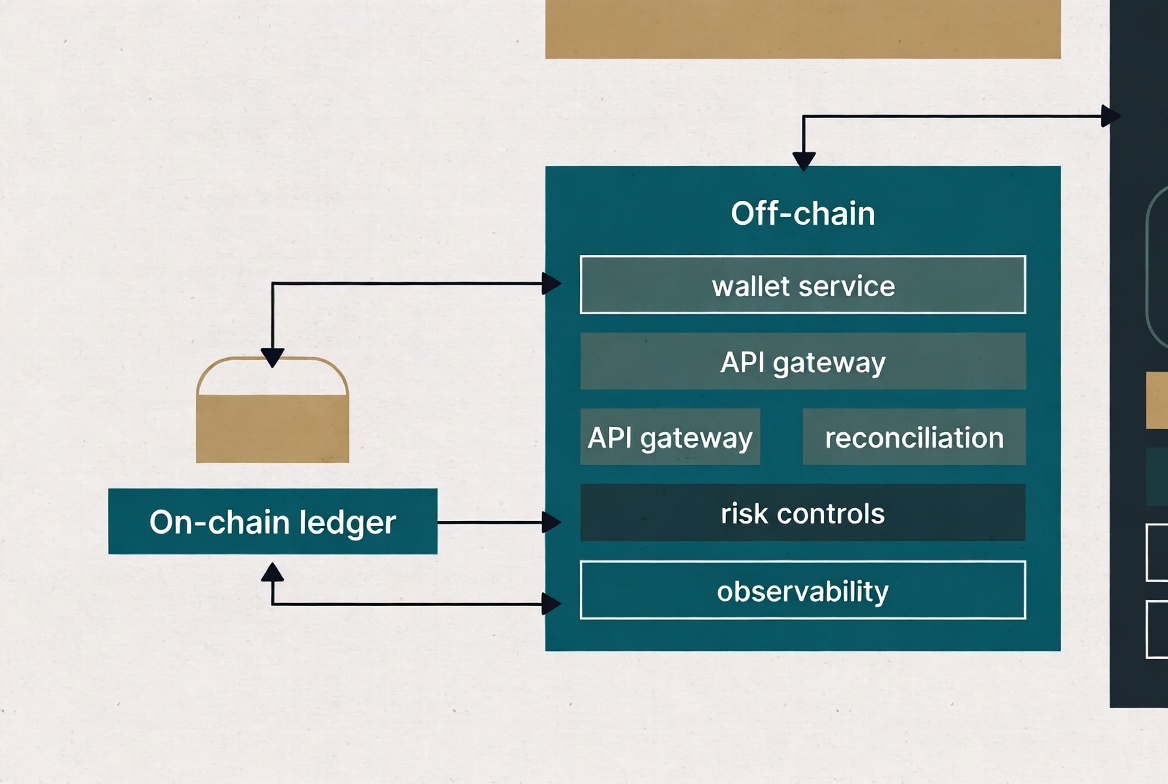
Crypto products are often marketed through their on-chain logic, but most of the operational complexity lives somewhere else. Wallet orchestration, signing services, deposit and withdrawal pipelines, reconciliation jobs, pricing gateways, user-facing APIs, admin tooling, compliance hooks, and incident response workflows all sit on the off-chain side of the system. That layer determines whether a platform is operable under real production pressure.
This is where Go becomes especially compelling. Go is not the language you pick because it feels clever. It is the language you pick when you want backend services that are fast, easy to reason about, simple to deploy, and practical to operate at scale. For financial and crypto platforms, that combination matters more than novelty.
Off-chain architecture is where the real platform lives
A serious crypto or financial product is never just a smart contract or matching engine. The production system usually includes API gateways, authentication services, wallet monitoring, transaction broadcasters, risk controls, reconciliation workers, ledger services, notifications, internal admin panels, and audit-friendly event pipelines.
When teams underestimate this off-chain surface area, the result is familiar: fragile deployments, hidden state transitions, partial failures during deposits and withdrawals, poor observability, and incident handling that depends too much on tribal knowledge. In practice, the “boring” off-chain architecture is often the difference between a system that demos well and a system that survives growth.
Go fits the backend shape of financial platforms
Go is widely used for cloud-native backends, APIs, and distributed systems because it offers a strong balance of throughput, operational simplicity, concurrency, and maintainability. According to the Cloud Native Computing Foundation (CNCF), Go powers over 75% of cloud-native projects—including Kubernetes and Docker—due to its lightweight concurrency model and compiled binary footprint.
Those properties map unusually well to the off-chain side of crypto and fintech products, where a platform needs to process large numbers of network calls, coordinate background work, and expose stable service boundaries without becoming operationally heavy.
For example, many platform components in this space are not ultra-low-latency engines. They are network-heavy services: API layers, webhook consumers, settlement workers, monitoring agents, orchestrators, and control-plane services. Go is especially effective in that environment because it handles concurrent I/O workloads cleanly and compiles into simple binaries that are straightforward to ship and run.
Wallet services are operational systems, not just integrations
One of the biggest mistakes in crypto backend design is to treat wallets as a narrow integration problem. In reality, wallet infrastructure is an operational domain of its own: key isolation, transaction construction, signing boundaries, chain-specific broadcasting logic, retry rules, confirmation tracking, hot/cold segregation, rate limits, policy enforcement, and suspicious-activity controls all need careful handling.
This is exactly the kind of environment where Go is useful. Services around wallet orchestration often need clear process boundaries, strong observability, predictable memory usage, and enough concurrency to monitor chains, handle queues, and process transaction lifecycles in parallel. A good Go service architecture can keep those concerns explicit without turning the system into a tangle of runtime complexity.
Microservices matter when the domain is heterogeneous
Financial and crypto platforms tend to accumulate very different operational domains under one product surface: onboarding, balances, trading, treasury, compliance, notifications, analytics, and support tooling. A microservices approach is not always mandatory, but modular service boundaries become increasingly valuable as the platform grows.
Go is a pragmatic fit here because it has become one of the common choices for microservices and distributed systems, especially in cloud-native environments. A team can isolate wallet services from user APIs, separate reconciliation from real-time request handling, and keep ledger-adjacent workflows independent from support dashboards and auxiliary jobs. That separation helps with scaling, fault isolation, and security review.
Operational simplicity is a security feature
In crypto, many failures are not caused by cryptography breaking. They come from misconfiguration, poor secrets handling, weak service isolation, unclear ownership of incidents, or brittle deployment pipelines. In other words: the system fails operationally before it fails mathematically.
Go helps because it supports a style of backend engineering that is operationally simple. Static binaries, straightforward containerization, strong support for observability libraries, and mature cloud-native usage patterns make it easier to build services that are understandable in production. That does not replace security engineering, but it reduces the accidental complexity that often makes backend security weaker than it needs to be.
Go is not the whole system, and that is the point
A strong crypto platform does not need to be “all in” on one language. In fact, the better architecture is often mixed. Go can own large parts of the off-chain system — APIs, workers, orchestration services, internal tools, and infrastructure-facing components — while other layers use different tools where they are more appropriate.
That architectural honesty matters. If a component is primarily about network coordination, service orchestration, queue processing, or control-plane logic, Go is often an excellent choice. If a component demands different trade-offs, it is fine to choose differently. What matters is building a platform whose off-chain side is robust, auditable, and operationally mature.
Why this matters for real crypto products
The off-chain side of a crypto platform is where users feel reliability. They feel it when deposits appear on time, when withdrawals are processed safely, when dashboards reflect reality, when incidents are contained, and when backend services do not become a black box under load.
That is why Go deserves serious attention in this space. It aligns well with the practical needs of financial and crypto platforms: resilient APIs, concurrent workers, modular services, and infrastructure that teams can actually operate. For organizations building real products instead of demos, that is not a minor advantage. It is part of the foundation.
Knowledge Base / FAQ
Frequently Asked Questions
Why is Go well-suited for the off-chain layer of Web3 platforms?
Go provides lightweight goroutines, static binary compilation, high I/O throughput, and low memory overhead. This makes it ideal for managing network-heavy tasks like API routing, wallet orchestration, event streaming, and background worker loops.
How does operational simplicity in Go enhance crypto security?
Most crypto breaches originate off-chain through operational flaws, misconfigured cloud access, or weak service boundaries. Go's explicit syntax, static compilation, and container-friendly design reduce accidental system complexity, making auditing and deployment security straightforward.
What role do Go microservices play in wallet orchestration?
Wallet orchestration requires transaction construction, confirmation tracking, key isolation, and chain monitoring. Go microservices keep these sensitive flows strictly isolated from public user APIs and background analytics.
Why is a mixed-language architecture common in serious Web3 systems?
Smart contracts and low-level matching engines often require Rust or C++, while Go serves as the off-chain orchestration backbone—managing APIs, risk engines, banking connectors, and operational controls.
Can Zanvexis help architect and harden Go-based off-chain infrastructure?
Yes. Zanvexis specializes in engineering high-throughput Go microservices, wallet orchestration pipelines, cloud-native deployments, and incident response readiness for Web3 platforms.
If you need help hardening the off-chain side of your crypto project — from wallet infrastructure and backend services to domains, observability, and incident response — you can request a security-focused engagement through the Services page or reach out directly via the Contact terminal.
Need help building secure technology?
Explore how Zanvexis helps teams build secure software, blockchain systems, intelligent platforms, and high-performance infrastructure.
Explore all services →Continue reading
Related articles
Trading infrastructure stops being resilient the moment incident response depends on heroics instead of architecture
Why serious trading platforms need incident response and operational resilience designed into architecture, tooling, and governance instead of relying on ad hoc fixes and individual effort during outages.
Crypto custody stops being security and becomes counterparty exposure when architecture depends on people behaving well
Why institutional-grade crypto custody has to enforce separation of duties, destination controls, cryptographic dual control, and operating model discipline in architecture instead of trusting operator conduct.
Trading bots become brittle when architecture pretends every market is the same
Why serious trading bot infrastructure needs clear separation between exchange adapters, strategy logic, execution paths, risk controls, and observability instead of one-size-fits-all bots.