Smart Contract Audits
We deliver rigorous manual line-by-line source code audits, automated symbolic execution, property-based invariant fuzzing, and mathematical formal verification for Solana (Rust/Anchor) and EVM (Solidity/Foundry) protocols to eliminate vulnerabilities prior to mainnet deployment.
Core Capabilities
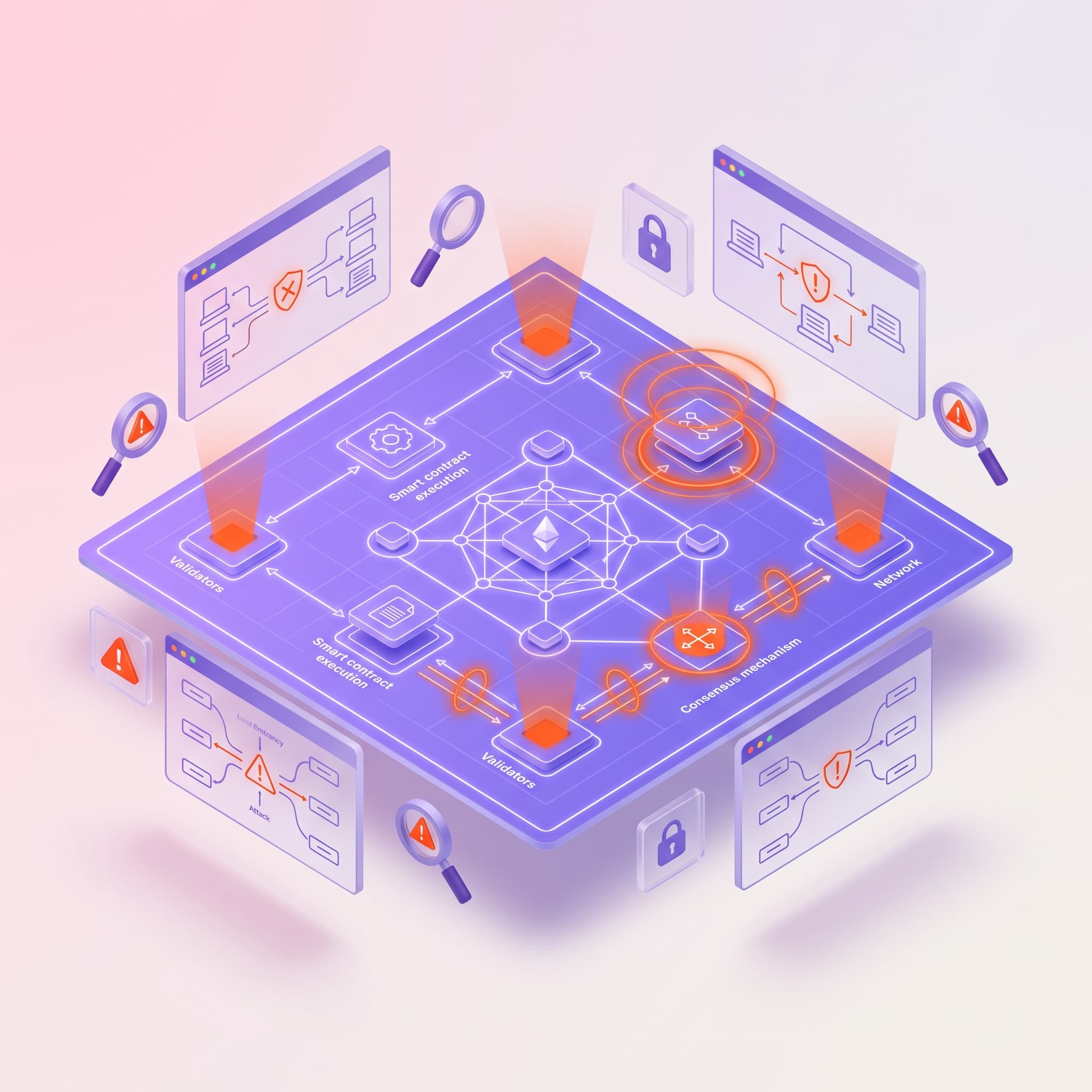
Deep Manual Code Review & Logic Analysis
- ■Exhaustive line-by-line inspection of Rust (Anchor) and Solidity/Yul state machines
- ■Discovery of complex logical flaws, race conditions, and business invariant violations
- ■Auditing cross-program invocations (CPI), arbitrary account loading, and signer checks
- ■Analysis of precision loss, rounding directions, and arithmetic edge cases in token math
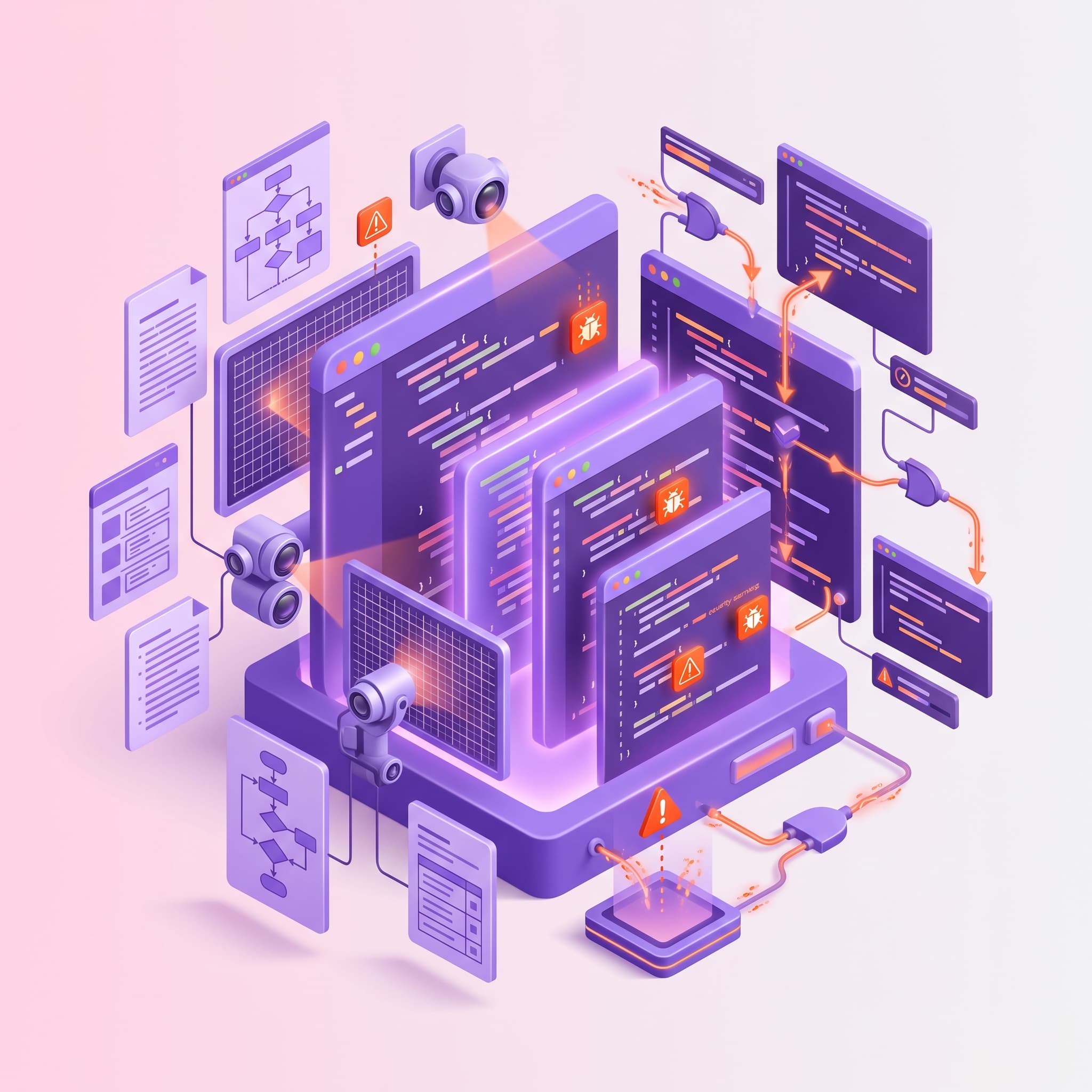
Property-Based Invariant Testing & Fuzzing
- ■Automated invariant fuzzing using Foundry, Echidna, and custom Trident test harnesses
- ■Generation of millions of pseudorandom instruction sequences to break protocol bounds
- ■Stateful fuzz testing verifying constant collateralization ratios and pool balances
- ■Differential fuzzing comparing optimized Rust implementations against reference models

Formal Verification & Symbolic Execution
- ■Mathematical specification and verification of protocol core state transition proofs
- ■Symbolic execution using Manticore and Certora Prover to detect unreachable paths
- ■Formal validation of liquidation curves, fee splits, and mint/burn invariant constraints
- ■Verification of cryptographic signature schemes and zero-knowledge circuit constraints

Adversarial Exploit & Flash-Loan Simulation
- ■Development of executable Proof-of-Concept (PoC) exploit scripts for all discovered issues
- ■Simulation of complex multi-block flash loan borrowing, oracle desync, and pool drain attacks
- ■Testing protocol resilience against MEV sandwiching and transaction reordering vectors
- ■Validation of emergency pause mechanisms and circuit breaker responsiveness under attack

Remediation Guidance & Re-Audit Certification
- ■Actionable code patch recommendations and architectural refactoring support
- ■Collaborative verification of remediated branches to ensure zero regression bugs
- ■Publication of an institutional-grade audit report with clear severity rankings (CVSS)
- ■Cryptographically signed on-chain verification certificate attesting to audit completion
How It Works
Scoping & Threat Modeling
We dissect protocol whitepapers, technical specifications, and smart contract interfaces to map all trust boundaries, user roles, external dependencies, and privileged keys.
Automated Fuzzing & Static Analysis
We run custom static analyzers and invariant fuzzers across the codebase to identify standard vulnerability classes, arithmetic overflow risks, and unchecked external calls.
Manual Line-by-Line Inspection
Our senior security engineers manually examine every line of code, validating business logic assumptions, account validation macros, and complex state transition mechanics.
PoC Exploit Development & Remediation
We write working exploit scripts to prove vulnerability severity and collaborate directly with your engineering team to implement precise, gas-efficient code fixes.
Re-Audit & Cryptographic Certification
We re-verify the patched codebase, mathematically confirm all invariant constraints hold, and deliver the final public report and signed audit attestation.
Target Scenarios
Lending, Borrowing & Collateral Markets
Auditing interest rate curves, liquidation triggers, and multi-collateral vault architectures against price oracle manipulation and bad debt accumulation.
Automated Market Makers (AMMs) & DEXs
Verifying concentrated liquidity math, tick-spacing logic, swap routing, and fee accumulation algorithms across high-throughput decentralized exchanges.
Cross-Chain Bridges & Message Relayers
Auditing threshold signature verifiers, multi-sig consensus contracts, and deposit/withdrawal queues against double-spending and validator hijacking.
Liquid Staking & Yield Aggregators
Inspecting epoch-based rewards compounding, unbonding queue logic, and validator delegation mechanics for non-custodial staking protocols.
Real-World Asset (RWA) & Escrow Vaults
Ensuring compliance-gated tokenization vaults, programmatic escrow settlements, and multi-party governance timelocks execute without state deadlocks.
Tech Stack
Case Studies
Solana Lending Protocol Security Audit ($60M TVL)
Conducted a comprehensive security audit of a Solana Anchor lending protocol. Identified 8 vulnerabilities, including a critical arbitrary CPI signer exploit and a rounding-direction error in interest compounding, protecting $60M in assets.
Foundry Invariant Fuzzing for Concentrated Liquidity AMM
Engineered an automated invariant testing suite running 500,000 fuzz runs. Discovered a subtle precision-loss vector during extreme single-tick liquidity imbalances that could have enabled zero-cost liquidity extraction.
What Our Clients Say
"Zanvexis uncovered an architectural account-validation vulnerability in our Anchor program that two previous automated security tools completely missed. Their deep knowledge of the Solana runtime is exceptional."
"The proof-of-concept exploits they provided made remediation straightforward for our dev team. The final audit report gave our institutional backers complete confidence prior to mainnet launch."
Frequently Asked Questions
What is the difference between automated scanning and a manual smart contract audit?
Automated tools quickly flag known syntactic patterns and common code smells, but they cannot comprehend complex business logic, game-theoretic economic attack vectors, or multi-contract race conditions. Our audits combine automated fuzzing with rigorous line-by-line manual code review by senior engineers.
What specific vulnerability classes do you check for in Solana Anchor programs?
We audit missing signer checks, arbitrary CPI invocations, account type confusion, PDA bump seed canonicalization, duplicate mutable account injection, integer overflows/underflows, and closing account re-initialization vulnerabilities.
How long does a comprehensive smart contract audit take?
A typical audit takes between 1 to 3 weeks depending on the total effective lines of code (nSLOC), instruction complexity, and protocol dependencies. We provide continuous updates and intermediate findings throughout the review period.
What deliverables are included with the audit?
You receive an executive summary, a detailed vulnerability breakdown with CVSS severity scoring, working Proof-of-Concept exploit scripts, exact code refactoring recommendations, and a final verification certificate once fixes are verified.
Related Content
Most smart contract exploits start long before deployment
Why smart contract security is really about assumptions, invariants, permissions, and failure modes — not just audits before launch.
Authorization PDAs: enforcing who can touch your RWA vault
A practical look at how STRATA uses Authorization PDAs and Anchor account constraints to enforce access rules for institutional RWA vaults.
Before you deposit: a practical security checklist for RWA vaults
A pragmatic checklist for evaluating the security of RWA yield vaults, from legal structure and custody to oracle risk and smart contract design.
Related Services
 SERVICE // 01
DeFi Protocol Design
Engineering high-throughput decentralized finance protocols, concentrated liquidity AMMs, and algorithmic lending pools.
 SERVICE // 02
Wallet & Treasury Security
Multi-signature governance, hardware security module enclaves, and programmatic treasury custody for enterprise protocols.
 SERVICE // 03
Monitoring & Incident Response
24/7 telemetry monitoring, automated circuit breakers, and rapid containment protocols for live exploits.