Rust is what memory safety looks like without a garbage collector
Why Rust’s ownership model gives you memory safety and predictable performance without a GC — and what that really means in practice.
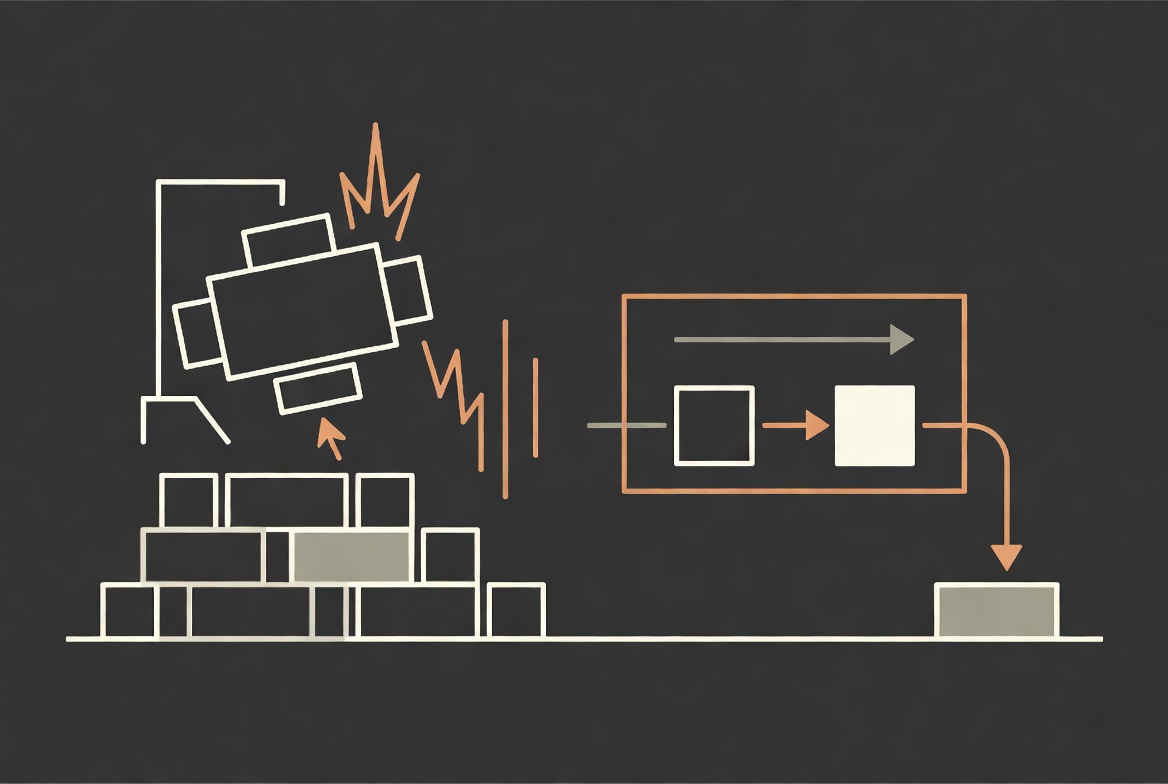
Most developers are used to choosing between two uncomfortable options: fast but dangerous (C, C++), or safe but managed by a garbage collector (Java, C#, Go, many scripting languages). Rust is interesting because it attacks that trade-off directly. It offers memory safety without a GC, while still giving you the low-level control expected from a systems language.
That does not mean “magic performance with no cost.” It means the language moves more of the memory-management work into compile-time reasoning instead of runtime machinery. The compiler tracks ownership, lifetimes, and aliasing in a way that makes entire classes of memory bugs unrepresentable in safe Rust. In practice, that changes not only performance characteristics but also how engineers design systems.
Ownership is compile-time memory management
Rust’s ownership model is the core of how it manages memory without a GC. Every piece of data has a single owner; when the owner goes out of scope, the memory is deallocated automatically. There is no background collector scanning the heap, no reference-counting on ordinary values, and no separate runtime deciding when to free memory.
That model has two big consequences. First, it makes lifetimes explicit enough that the compiler can prove many safety properties statically. Second, it makes deallocation predictable: memory is freed at structurally clear points, not at arbitrary GC pauses. For latency-sensitive systems, that predictability can be as important as raw throughput.
Borrowing replaces many pointer pitfalls
Instead of raw, unchecked pointers, Rust uses references with strict rules: you can have any number of immutable references, or exactly one mutable reference, but not both at the same time. A borrow cannot outlive the value it references. The borrow checker enforces these constraints before the program runs.
This design targets the classic failure modes of systems programming: use-after-free, double free, data races through aliasing, and other forms of undefined behavior. In safe Rust, those patterns do not compile. That is what “memory safety without GC” really means here: the language refuses to generate binaries that rely on undefined memory behavior in the first place.
Zero-cost abstractions change how you write high-level code
Rust also leans heavily on zero-cost abstractions: higher-level constructs like iterators, generics, and type states that compile down to machine code equivalent to hand-written loops and pointer logic in many cases. The idea is that you can express intent at a higher level without paying extra runtime cost for it.
For memory safety, that is important because it means you do not need to drop to unsafe pointer manipulation every time you want performance. You can often stay in safe, idiomatic Rust, relying on the optimizer to erase abstraction boundaries. When you do need unsafe, it is usually narrow, local, and explicitly marked.
There is still overhead — but you choose it
No language can offer truly zero-overhead memory safety. Tracking resources, enforcing invariants, and avoiding undefined behavior always cost something, whether at compile time, runtime, or both. Rust’s advantage is not that it makes that cost disappear. It is that it lets you pick where and how you pay it.
For example, you might choose to use Arc for shared ownership, Vec for contiguous storage, or higher-level crates for ergonomic APIs. Each choice has a cost profile, but you can reason about it explicitly instead of having a single GC policy applied everywhere. In performance-critical sections, you can lean on borrowing and lifetimes to keep runtime overhead minimal.
Safe by default, unsafe by declaration
Rust does not pretend the world can be built entirely from safe operations. Hardware access, FFI, low-level optimizations, and some data-structure tricks require stepping outside what the compiler can prove automatically. That is why unsafe exists — and why it is opt-in instead of the default.
The key is that unsafe is explicit and local. It marks the places where developers must manually uphold invariants the compiler cannot check. That containment makes it possible to build safe APIs on top of small unsafe cores. The rest of the system benefits from memory safety guarantees without needing a garbage collector or pervasive runtime checks.
Why this matters for real systems
For systems where latency, throughput, and resource usage matter — and where memory bugs are unacceptable — Rust’s model is more than a technical curiosity. It changes the reliability envelope. A large class of catastrophic bugs simply cannot appear in safe code, while performance remains competitive with C and C++ in many workloads.
That is what “memory safety without GC” looks like in practice. It is not just a slogan. It is a different way of designing and reasoning about systems: one where the compiler takes on more of the burden, the runtime has fewer surprises, and engineers can get both speed and safety without choosing one at the expense of the other.
Knowledge Base / FAQ
Frequently Asked Questions
How does Rust achieve memory safety without a garbage collector?
Rust enforces a static ownership model with strict borrowing rules checked at compile time. Memory is deallocated automatically as soon as its owning variable goes out of scope, eliminating the need for runtime GC pauses or manual free calls.
What is the borrow checker and how does it prevent runtime bugs?
The borrow checker is a compiler mechanism that enforces reference rules statically: you can have either any number of immutable references or exactly one mutable reference at a time. This statically prevents data races, use-after-free errors, and dangling pointers.
What are zero-cost abstractions in Rust?
Zero-cost abstractions mean higher-level features like generics, iterators, and closure traits compile down to machine code equivalent to raw loops and pointer operations, offering high ergonomics with no runtime performance penalty.
Why does Rust still include an unsafe keyword?
Unsafe Rust allows developers to perform low-level operations that the compiler cannot statically verify, such as interacting directly with hardware, raw pointers, or FFI. It isolates potential memory risk into explicitly marked, reviewable blocks.
Can Zanvexis help build and audit high-performance Rust systems and off-chain infrastructure?
Yes. Zanvexis specializes in engineering high-throughput Rust backends, smart contract protocols, sandboxed environments, and off-chain execution pipelines, as well as conducting security-focused technical code reviews.
If you need help building or auditing high-performance Rust systems, backend infrastructure, or custom protocols, you can request an engineering engagement through the Services page or reach out directly via the Contact terminal.
Need help building secure technology?
Explore how Zanvexis helps teams build secure software, blockchain systems, intelligent platforms, and high-performance infrastructure.
Explore all services →Continue reading
Related articles
Trading infrastructure stops being resilient the moment incident response depends on heroics instead of architecture
Why serious trading platforms need incident response and operational resilience designed into architecture, tooling, and governance instead of relying on ad hoc fixes and individual effort during outages.
Crypto custody stops being security and becomes counterparty exposure when architecture depends on people behaving well
Why institutional-grade crypto custody has to enforce separation of duties, destination controls, cryptographic dual control, and operating model discipline in architecture instead of trusting operator conduct.
Trading bots become brittle when architecture pretends every market is the same
Why serious trading bot infrastructure needs clear separation between exchange adapters, strategy logic, execution paths, risk controls, and observability instead of one-size-fits-all bots.